Gemini 4 Argon Plays StarCraft: Testing a Large Model's Real-Time Strategy Game Skills

Gemini 4 Argon hooked into StarCraft on Hacker News validates the path and bottlenecks of general-purpose LLMs as agents.
A Show HN project called Gemini 4 Argon plays StarCraft appeared on Hacker News, in which the author hooked a general-purpose language model into StarCraft to operate units and manage resources in real time rather than making a simple demo. The article notes StarCraft is regarded as an AI touchstone due to imperfect information, millisecond-level response, and long-horizon planning, differing significantly from turn-based perfect-information games like Go. The project adopts a model-as-agent architecture via prompt engineering and tool calls. Testing exposed two major weaknesses: inference latency lags behind the battle, and long-horizon planning drifts into local optima, leaving a gap with dedicated RL agents.
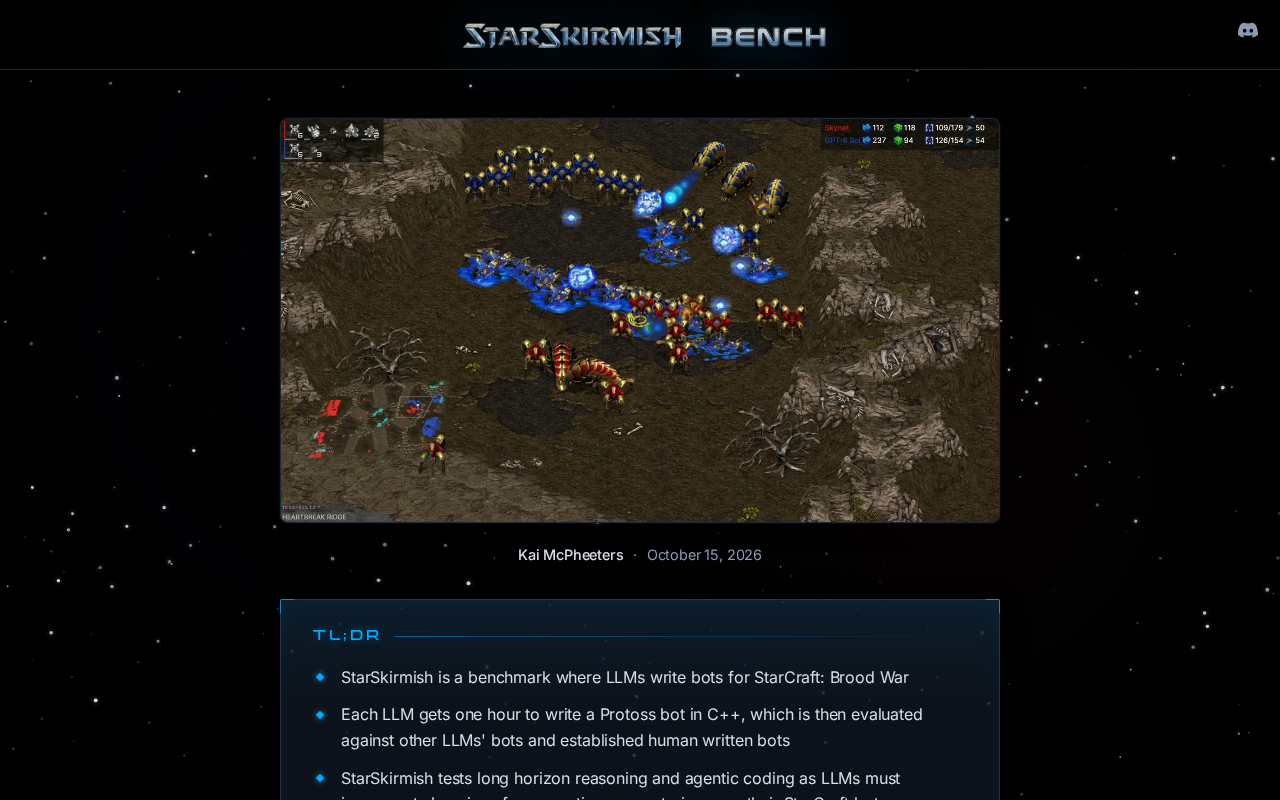
On Hacker News' Show HN section, a project called "Gemini 4 Argon plays StarCraft" has drawn attention from the tech community. The author hooked the Gemini 4 Argon language model into StarCraft, letting it operate units, manage resources, and respond to the battle in real time just like a human player. This is not a simple demo, but a hardcore probe into the capability boundaries of multimodal large models in complex strategic environments.
Why StarCraft Is the Touchstone for AI
StarCraft has long been regarded as the pinnacle challenge of real-time strategy games. It simultaneously tests multiple dimensions of AI: decision-making under imperfect information, long-sequence resource planning, millisecond-level real-time response, and dynamic adaptation to enemy strategies. Unlike turn-based perfect-information games such as Go, every step in StarCraft comes with fog of war, multi-front micro, and uncertain opponent intentions.
Because of this, it has attracted sustained investment from DeepMind to various open-source projects. Traditional reinforcement learning approaches often require massive training samples and carefully designed state representations. Letting a general-purpose language model "pick up" the game directly means treating it as an agent with reasoning and action capabilities, rather than a mere conversational tool.
Perfect-information vs. imperfect-information games is a fundamental classification in game theory, and a key prerequisite for understanding StarCraft's difficulty. In perfect-information games like Go and chess, the positions of all pieces are open to both sides, and the situation at any moment can be fully observed, so in theory there exists a definite search space, and systems like AlphaGo can approximate the optimal solution through Monte Carlo tree search plus value networks. StarCraft, however, is an imperfect-information game: the fog of war prevents players from seeing all enemy units and buildings, forcing them to make probabilistic inferences based on limited observations, and to actively scout, bluff, or even feign weakness to mislead opponents. This information asymmetry means the optimal strategy is no longer a single definite path, but a Bayesian game that depends on the opponent's possible actions. This is precisely the fundamental reason why traditional search-based methods cannot be directly applied, and also where context-inference-dependent agents like language models may bring a different approach.
How Gemini 4 Argon "Plays"
Judging by its form, this Show HN work is a typical "model-as-agent" experiment. The author did not train a dedicated model for StarCraft, but reused Gemini 4 Argon's general capabilities, using prompt engineering and tool calls to convert game states into model-understandable inputs, then mapping the model's outputs into in-game action commands.
The key difficulty of this architecture lies in the "perception—decision—execution" loop. The model needs to understand what is happening on screen, the current economy and military strength, and whether to build units or expand next. Language models are not inherently good at processing pixel-level visuals, so the intermediate-layer state abstraction and action space design directly determine whether it can make meaningful moves rather than clicking randomly.
LLM as Agent is an architectural paradigm that has emerged in recent years. Its core idea is not to train a model from scratch for a specific task, but to treat a general-purpose language model as the decision-making hub, assembling it with prompt engineering, tool calls, and external memory into a closed-loop system that perceives the environment, takes actions, and receives feedback. In this architecture, the model itself is only responsible for reasoning and outputting intents in text format, while the actual state reading, action execution, and persistent memory are handled by peripheral programs. This contrasts with traditional reinforcement learning: RL agents interact repeatedly with the environment and update network parameters based on reward signals, which is costly to train but extremely fast at inference; the model-as-agent approach requires no task-specific training, offers strong generalization and a short development cycle, but has inherent bottlenecks in inference speed, context length, and long-term consistency. Gemini 4 Argon playing StarCraft is a typical case of this paradigm in practice.
Test Results and Exposed Weaknesses
According to information from the Hacker News discussion thread, the most common bottleneck in such projects is not "whether it can move," but "whether it moves well." Language model inference has latency, and in a real-time environment like StarCraft where things can change every second, response speed becomes a natural disadvantage. The model often needs several seconds to generate a round of decisions, by which time the opponent's units have already moved to new positions.
Another issue is long-horizon planning. Language models can give reasonable tactics in short rounds, but over several minutes of economic management and tech-tree choices, they tend to forget early goals or fall into local optima. This exposes the limitations of general-purpose models in long-term memory and goal consistency, and also shows that there remains a clear gap between "a large model playing StarCraft directly" and dedicated RL agents.
Long-horizon planning and goal consistency is a widely acknowledged weakness of current large models as agents. The autoregressive generation mechanism of language models is essentially predicting the next token based on local context, lacking an explicit goal representation that remains effective across many rounds of interaction. In tasks like StarCraft that require minutes or even tens of minutes of management and decision-making, goals set early such as expansion and tech progression are easily overridden by subsequent local events, leading to strategy drift. Common mitigation measures in the industry include external memory banks, periodic goal restatement, and decomposing long-term tasks into verifiable sub-goals supervised by external programs. These engineering measures take on the planning responsibilities that the model itself lacks in the peripheral system, and also confirm the point emphasized in the article: to make a language model truly capable in a dynamic environment, peripheral engineering matters no less than the model's own parameter scale.
Takeaways for Developers
The value of Gemini 4 Argon playing StarCraft is not necessarily in how many games it can win, but in validating a path: a general-purpose large model can serve as the "brain" of a strategy game agent, provided it is paired with a well-configured perception and execution peripheral system. For developers working on AI applications and AI programming, such projects offer reusable ideas—abstracting a complex environment into a textual state the model can digest, and using tool calls to turn outputs into actions.
Such Show HN projects on Hacker News are usually open-source or come with technical documentation, and community feedback centers on latency optimization, state compression, and memory mechanisms. These discussion directions are precisely the core engineering problems that need to be solved when AI agents are deployed in real-time scenarios. To make a language model truly "capable" in a dynamic environment, peripheral engineering matters no less than the model's own parameter scale.
One-line Summary
Gemini 4 Argon hooked into StarCraft on Hacker News validates both the path and the bottlenecks of general-purpose large models as agents.
Paragraph Summary
A Show HN project called Gemini 4 Argon plays StarCraft appeared on Hacker News, in which the author hooked a general-purpose language model into StarCraft to operate units and manage resources in real time rather than making a simple demo. The article notes that StarCraft is regarded as a touchstone for AI due to imperfect information, millisecond-level real-time response, and long-horizon planning, differing significantly from turn-based perfect-information games like Go. The project adopts a model-as-agent architecture, building a perception—decision—execution loop through prompt engineering and tool calls. Testing exposed two major weaknesses: inference latency makes responses lag behind the battle, and long-horizon planning tends to drift and fall into local optima, leaving a gap with dedicated reinforcement learning agents. The article argues its value lies in validating that a general-purpose model can serve as the brain of a strategy game, provided it is paired with a well-configured perception and execution peripheral system, offering lessons for AI application developers.
Related articles

JobRunner MCP Server: AI Agents Can Now Fix Failed Java Jobs
JobRunner launches an open-source MCP server enabling AI agents to view cluster status, diagnose failures, and recover Java jobs—incident response from any cloud coding environment or existing agent.

MLAI Digital Launches 9 Security Agents: MCP Server Safeguards the Full Lifecycle of Agentic AI
MLAI Digital launches Security MCP Server with nine built-in specialized security agents covering vulnerability discovery, attack simulation, prompt injection detection, API and infrastructure assessment, and accelerated remediation—embedding security validation across the full Agentic AI lifecycle from development to production.

Running Isaac Lab on H100 GPUs: Exploring Better Approaches
Exploring optimization methods for running Isaac Lab on NVIDIA H100 GPUs, including MIG configuration, mixed precision, TensorRT acceleration, and community experience to improve robotics simulation and reinforcement learning efficiency.