Gemini 4 Argon Released: Is Google AI Back in the Race? Early Performance Breakdown

Gemini 4 Argon arrives with 1M token output, lower hallucinations, and strong multimodal performance to challenge the AI top tier.
Google's Gemini 4 Argon is currently in limited testing for select security partners and vetted testers, with a public release expected around mid-October. Early leaked benchmarks highlight a 1 million token output ceiling for long-horizon agent tasks, new SOTA results on DeepSway 1.1, Automation Bench, and LV Bench, hallucination rates better than GPT-6.1 SoC and GPT-6 Astra, and per-task costs roughly 60% of Astra's at launch. Multimodal and 3D generation — including a 106K-voxel shrine and physics-accurate 3D scenes — are standout demos. GPT and Opus still lead in coding tasks, and all figures await official verification.
Google's pace of AI model releases has become almost dizzying. The latest entry, Gemini 4 Argon (nicknamed "Eragon" by some fans after the Tolkien-adjacent fantasy novel), remains in a limited release phase, accessible only to a small number of cybersecurity partners and vetted testers selected through Google DeepMind's testing programs. It's expected to gradually roll out to paid API customers and Google AI Ultra subscribers, with a public release window tentatively around mid-October — though that timeline is still speculative.
This article is based on early overseas test coverage relayed by a Bilibili content creator, summarizing Argon's core specs, benchmark results, and live demos. A heads-up: some data comes from unconfirmed leak channels, so take everything here with appropriate skepticism.
1 Million Token Output: A Critical Leap for Agent Tasks
The most immediately notable upgrade in this release is Argon's maximum output, which has jumped from the previous ~64K tokens to 1 million tokens. For large-scale, long-horizon agent and coding tasks, this means the model can process tens of thousands of tokens within a single trajectory, reasoning and generating continuously without losing the thread.
The context window has also expanded to 1 million tokens. Combined with a lower hallucination rate, Argon is positioned as a workhorse assistant for everyday high-frequency use — not just a benchmark chaser.

Tokens are the basic unit of text processing for large language models, roughly corresponding to half a word in English or a single character in Chinese. The "maximum output token count" determines how much content a model can generate in a single response, while the "context window" caps the total information — including input and conversation history — the model can "see" during inference. Most top-tier models previously maxed out between 4,000 and 64,000 output tokens. A 1 million token output ceiling means the model can generate the equivalent of several full-length novels in one uninterrupted pass, or execute thousands of steps in an agent task without requiring manual "continuation." For use cases like generating complete codebases, long-form reports, or end-to-end automated workflows, this isn't a marginal improvement — it's a qualitative shift.
Benchmarks: Broadly Strong, Not Narrowly Dominant
From available test results, Argon's profile is best described as "well-rounded rather than extreme."
Text and Intelligence Performance
On the Text Arena intelligence workload dimension, Argon reportedly outperforms rivals including GPT-6 Astra, Fable 5.1, and Opus 5.5. It sets new records across several long-horizon real-world task benchmarks:
- DeepSway 1.1 (real-world long-horizon software engineering tasks): 77.9%, new SOTA;
- Automation Bench (end-to-end business process automation): first place at 51.3%;
- LV Bench (video/long-content understanding): 91%, new record;
- Also leads on the Boss Index, which covers real workplace scenarios including finance, coding, legal, and tax work.
Multimodal understanding is considered Argon's current standout strength, reportedly surpassing any modern comparable model. However, GPT-6.1 SoC still edges ahead in certain pure agent coding and computer operation tasks.
Improvements in Hallucination Rate
Another highlight is the hallucination rate. On metrics like the "above IQ 45 percentage," Astra sits at 51% and GPT-6.1 SoC at 54% — Argon reportedly scores lower than both. For users who rely on models as daily work tools, this matters more than topping any single leaderboard.
Value for Money: Not the Cheapest, but the Best Overall Deal
Argon's pricing strategy deserves its own discussion. Based on Intelligence Index data:
| Model | Cost per Task (approx.) |
|---|---|
| GPT-6.1 SoC | $0.72 |
| GPT-6 Astra | $3.26 |
| Opus 5.5 | $5.98 |
| Fable 5.1 | $7.63 |
Argon scores 53 on the Artificial Analysis Index — exactly tied with GPT-6 Astra and only 1 point behind GPT-6.1 SoC. At launch pricing, its per-task cost is roughly 60% of Astra's.
In other words, Argon isn't the cheapest top-tier model, nor the single strongest one — but when you weigh intelligence, performance, low hallucination rate, massive output, and price together in one table, its overall competitiveness stands out. Whether Google can hold this launch price will be a key factor in whether it pulls users back into the Gemini ecosystem.
Scale Speculation: Possibly a Much Larger Model
A detail flagged by Reuters is that Argon is reportedly larger in scale than Google's previous Gemini models. This suggests Google has significantly boosted reasoning capability and overall performance while also scaling the model itself up.
Some speculation points to a parameter count in the 6 trillion range or higher — but this figure has zero official confirmation and should be treated as pure conjecture.
Parameter count is the core metric for measuring neural network scale, representing the total number of trainable weights in a model. More parameters theoretically means greater knowledge capacity and ability to model complex patterns — but training and inference costs scale super-linearly. Among publicly known top models, GPT-4 is estimated at roughly 1.8 trillion parameters (mixture-of-experts architecture), and Meta's largest open-source Llama model tops out at 405 billion parameters. If Argon truly reaches the 6 trillion parameter range, it would vastly exceed any known existing model — an extraordinary engineering and compute challenge. It's worth noting that modern super-large models typically use Mixture-of-Experts (MoE) architecture, where only a subset of "expert" sub-networks is activated per inference pass. So "6 trillion total parameters" doesn't mean all that compute is engaged every time — actual runtime costs could be far lower than the headline number implies.
Live Demos: 3D and Multimodal Are the Real Headlines
Leaked test samples showcase Argon's (and related checkpoint's) generative capabilities:
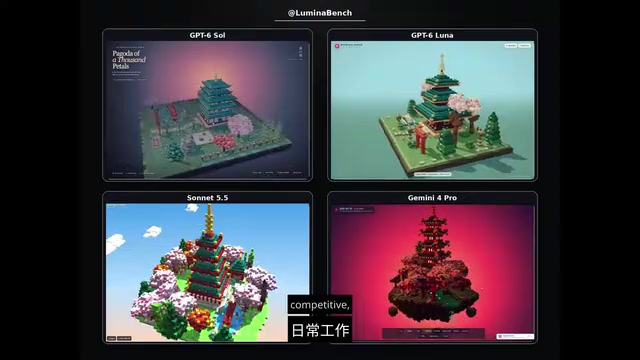
- Voxel scene generation: A complete shrine generated with over 106,000 voxels of detail, with dynamic time-of-day adjustment that changes scene lighting and atmosphere;
- SVG generation: A PS5 controller SVG that's impressively realistic, roughly on par with Opus 5, with only minor imperfections in texture and edge gradients;
- 3D physics simulation: In a "3D airplane with physics" challenge, Gemini 4 clearly outpaced Opus 5 in visuals, physics fidelity, and performance;
- Complex scenes: A Colosseum with day-night cycle simulation, a mechanical bee, Halloween character designs — all showing visibly improved detail and depth compared to the previous Gemini Pro generation.
In side-by-side comparisons with GPT-6, Gemini 4 reconstructed a 3D world complete with dynamic train tracks, varied materials, and multiple colors using 3DGS (3D Gaussian Splatting)-style techniques — a result described by reviewers as "stunning."

3D Gaussian Splatting (3DGS) is a cutting-edge 3D scene reconstruction and rendering technique introduced in a 2023 research paper that quickly drew widespread industry attention. Compared to traditional NeRF (Neural Radiance Field) methods, 3DGS represents scenes using millions of differentiable 3D Gaussian ellipsoids, achieving rendering speeds orders of magnitude faster and enabling real-time novel view synthesis. Combining this with a large language model's generative capabilities means the model doesn't just "understand" a textual description of a 3D scene — it can directly output structured 3D representations ready for real-time rendering. This marks an important step for multimodal AI, moving from "describing images" toward "building worlds from scratch." Voxels are the 3D equivalent of pixels, representing a cubic unit on a fixed grid; a shrine scene built from 106,000 voxels approaches the detail density of professional hand-modeled game assets.
Positioning: A Solid All-Rounder, Not the Top Coding Pick
All things considered, Argon is not the go-to model for coding or web development right now — GPT and Opus series models maintain their edge there through sustained capability refinement. Where Argon truly shines is multimodal understanding and general everyday tasks, which has always been Gemini's traditional strength.

One broader trend worth watching is the feedback loop in model development. Google says Argon is already helping its researchers and engineers with algorithm-related work and other internal domains — as AI systems are increasingly used to optimize, evaluate, and even build the next generation of AI, development cycles may accelerate further. But claiming this signals some kind of inflection point would be getting ahead of the evidence.
Takeaways
For Google, Argon looks more like a confident comeback after a brief rough patch than a quiet iterative update. Its combined improvements across text, multimodal, output scale, and cost-efficiency give Gemini a legitimate claim to first-tier competition again. The real verdict will come once it opens to the public and gets put through full independent evaluation — until then, the data and demos above should be treated as early, partially unverified reference material.
Related articles

JobRunner MCP Server: AI Agents Can Now Fix Failed Java Jobs
JobRunner launches an open-source MCP server enabling AI agents to view cluster status, diagnose failures, and recover Java jobs—incident response from any cloud coding environment or existing agent.

MLAI Digital Launches 9 Security Agents: MCP Server Safeguards the Full Lifecycle of Agentic AI
MLAI Digital launches Security MCP Server with nine built-in specialized security agents covering vulnerability discovery, attack simulation, prompt injection detection, API and infrastructure assessment, and accelerated remediation—embedding security validation across the full Agentic AI lifecycle from development to production.

Running Isaac Lab on H100 GPUs: Exploring Better Approaches
Exploring optimization methods for running Isaac Lab on NVIDIA H100 GPUs, including MIG configuration, mixed precision, TensorRT acceleration, and community experience to improve robotics simulation and reinforcement learning efficiency.