Gemini 4 Argon Released: What Developers Can Actually Use Right Now

Gemini 4 Argon focuses on coding and enterprise workflows, but limited access means it's one to watch, not deploy yet.
Google's Gemini 4 Argon is positioned as a frontier model with a focus on coding performance and enterprise workflow automation. Initial access is narrow, following a typical staged rollout — most independent developers won't have full access in the short term. The article distinguishes between what's shipped, verified, and worth watching, cautioning that enterprise workflow and coding claims shouldn't be taken at face value until independently reproduced via repository-level benchmarks. The advice for developers: track official API updates, wait for third-party evaluations, pilot on non-critical projects, and maintain fallback options to avoid single-model dependency.
Google's Gemini 4 Argon has been positioned as a frontier model, with a strong emphasis on enhanced coding capabilities and enterprise workflow support. Based on what's currently known, however, access remains quite limited. This article breaks down what's live, what's been verified, and the key considerations before building it into your plans.
What Gemini 4 Argon Is Meant to Be
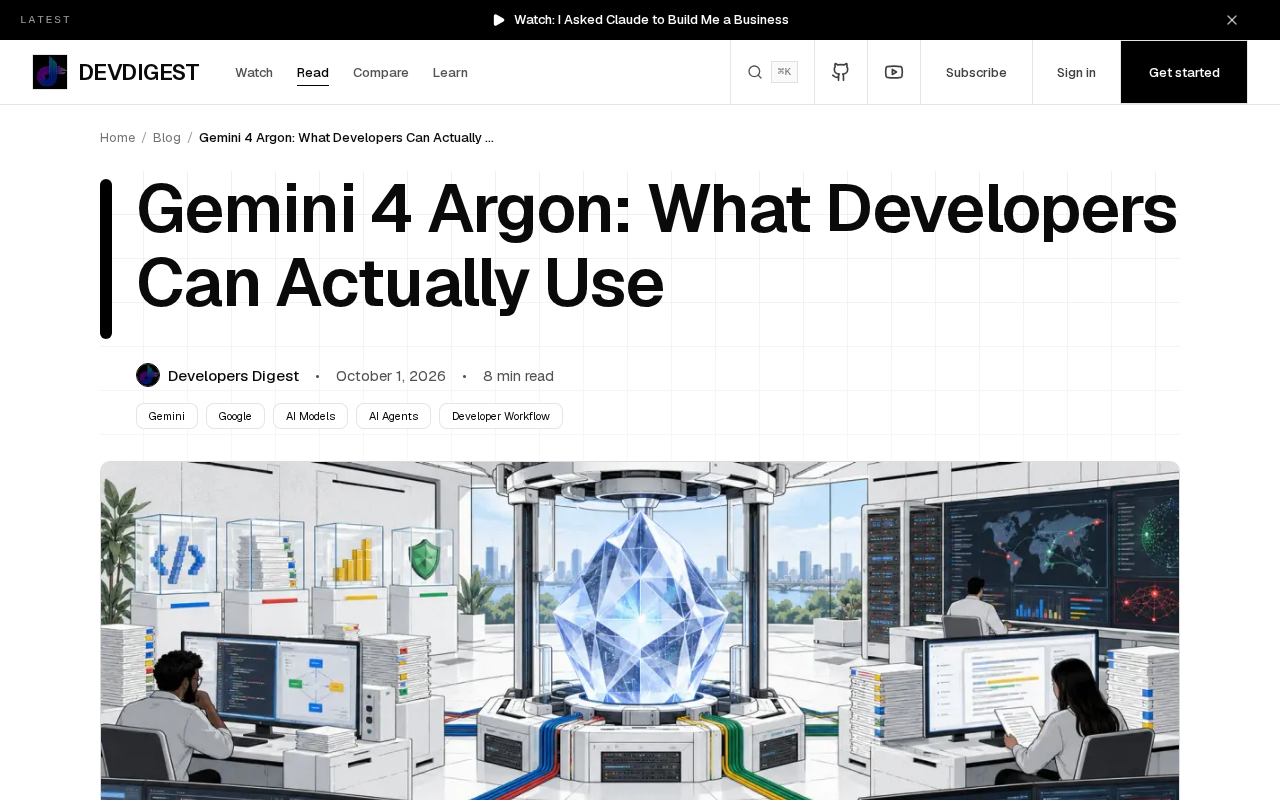
Google has positioned Gemini 4 Argon as a frontier model release — meaning it represents Google's current best attempt at pushing the boundaries of model capability. The two most prominent claims in official messaging are coding performance and enterprise workflow automation.
For developers, this kind of positioning typically implies longer context handling, more reliable code generation and debugging, and better comprehension of multi-step task chains. But there's often a gap between marketing language and actual usable capability, especially in the early days of a release when independent benchmarks haven't yet been validated.
Frontier Model is the term used in AI to describe the most advanced models at the current edge of the technology. These models typically feature massive parameter counts, multimodal capabilities, and performance that approaches or surpasses human experts on specific tasks. Because training costs are extremely high — often tens of millions to hundreds of millions of dollars in compute — only a handful of leading labs can develop them. Google's Gemini series, OpenAI's GPT-4 series, and Anthropic's Claude series all fall into this category. It's worth noting that "frontier" is a relative and rapidly shifting concept — today's frontier model may be superseded within months by the next generation. This is why, when evaluating models for adoption, you need to consider both current capability and the vendor's release cadence.
What's Live and What the Access Restrictions Look Like
One key reality worth paying attention to: access to Argon "starts narrow." This is a classic staged rollout strategy — Google typically opens access first to select enterprise customers, early partners, or specific API tiers before gradually expanding availability to the broader developer community.
The practical implications of this approach:
- Most independent developers likely won't have access to the full capability set in the short term
- Official benchmark results should be treated with caution until independently reproduced by the community
- Critical deployment parameters — pricing, rate limits, regional availability — typically get clarified well after capability announcements
If you're evaluating models for a project right now, the current phase makes Argon a better fit for a "watch list" than for direct inclusion in a production architecture.
Staged Rollout is the standard operating procedure for launching large AI models, driven by both technical and commercial logic. On the technical side, vendors need to monitor inference costs, latency, and safety risks under real traffic conditions — a full-scale launch would make any negative incidents much harder to contain. On the commercial side, prioritizing enterprise customers and higher-tier API users allows vendors to recover some R&D costs early while collecting high-quality usage feedback. For developers, this means that early public benchmarks are often measured under "ideal conditions" — specific hardware, specific concurrency levels, curated test sets — and may differ significantly from real-world performance at scale. Historically, leading frontier models including GPT-4 and Claude 3 have all gone through a similar "expectation gap" phase.
Which Capabilities Are Worth Waiting to Verify
The original framing emphasizes distinguishing between three layers: what has shipped, what has been verified, and what to watch. This framework is useful for evaluating any newly released frontier model.
Shipped does not mean available to everyone. Claims around enterprise workflows typically involve tool calling, function execution, and long task orchestration. These capabilities look impressive in demos, but their stability under real business data and complex permission environments can only be confirmed through actual stress testing.
Coding performance is the area developers care most about. What actually carries weight here is performance on independent coding evaluations — such as real repository-level tasks and multi-file refactoring — not vendor-reported scores.
Repository-level Coding Benchmarks are now widely recognized in the industry as a more realistic proxy for actual development work than synthetic problems. Unlike traditional single-function completion or algorithm challenges, these benchmarks require the model to operate within the context of a complete codebase — performing cross-file refactoring, bug localization, or new feature integration. SWE-bench is currently the most well-known open evaluation framework of this type; it draws tasks from real GitHub Issues and requires the model to generate code patches that pass the corresponding unit tests. Vendor-reported scores are typically measured on carefully selected subsets, while independent reproductions on the full test set tend to come in lower — and the gap between the two is an important signal for judging whether a model's coding capability is the real deal.
How Developers Should Respond
Given the incomplete picture, a pragmatic approach looks like this:
- Monitor official documentation for formal updates on API availability and pricing
- Wait for third-party independent evaluations, especially for coding and long-context scenarios
- Run small-scale pilots on non-critical projects before committing to broader adoption
- Have fallback options ready in case of access restrictions — avoid single-model dependency
Frontier model releases are coming faster than ever, but the gap between "what's announced" and "what works" never fully disappears. Staying informed about Gemini 4 Argon while letting verification — not marketing — drive your decisions is the most defensible approach right now.
Summary
Gemini 4 Argon represents Google's latest bet on coding and enterprise workflows, but narrow initial access and capability claims that haven't yet been independently verified mean it's better suited to a wait-and-see posture than immediate production use. For developers, the real basis for judgment should come from reproducible benchmark results and clear availability terms — not what was said at the launch event.
Related articles

Chain of Thought Isn't Just for AI: How Humans Can Use CoT to Improve Thinking Quality
Chain of Thought isn't just a prompt trick for large models. Starting from a Hacker News discussion, this article analyzes why CoT works for human thinking too, breaks down actionable ways to transfer it, and highlights the key differences between human CoT and machine CoT.
Cloudflare Teams Up with OpenAI: Closi…
Cloudflare Teams Up with OpenAI: Closing the Loop from Vulnerability Discovery to Defense with AI
Cloudflare uses OpenAI Daybreak to investigate security vulnerabilities and generate reviewable remediation plans, while developers use Codex to boost coding efficiency and quality.

Orca Multi-Agent Orchestration in Practice: A Guide to Parallel Collaboration with Claude and Codex
Orca is Stable AI's free open-source agent workbench supporting 34 agents like Claude Code and Codex in parallel. Learn its Git worktree isolation, multi-model orchestration, and mobile management.