Gemini 4 Argon Review: Strong Benchmarks, but Still Trails Claude Opus 5.5 in Real-World Use

Gemini 4 Argon has impressive benchmark scores and clear progress in 3D generation, but it still trails Claude Opus 5.5 in real-world use, and its subscription strategy is also controversial.
Google has officially released Gemini 4 Argon. Its official benchmark results are excellent, but hands-on testing shows it trails GPT-6 Astra on real tasks, and while the gap with Claude Opus 5.5 isn't large, it definitely exists. The author notes that benchmark questions mixed into training data can inflate scores, and the roughly 10-point gap between old and new benchmarks exposes shortcomings in generalization. The highlights are concentrated in 3D generation and creative coding: a single desktop photo can be used to generate a complete game scene in Blender, and a minimal one-sentence prompt can build an Apple computer museum webpage. But in a same-task comparison, Opus 5.5 cost about three times as much yet delivered ten times better visual quality. The subscription level is also chaotic—Pro users cannot call the new model in the Anti-Gravity coding tool, further weakening its appeal.
Google has officially released Gemini 4 Argon, and all users can finally try it for themselves. The official benchmark scores look impressive, but do they match the real-world experience? Drawing on hands-on testing from a YouTube channel, this article breaks down the new model from every angle—benchmark scores, real-world examples, competitor comparisons, and subscription availability.
Benchmarks vs. Real Performance: Great Scores, Discounted in Practice
Google's published benchmark results for Gemini 4 Argon are quite impressive, but the video's creator points out a clear gap between the scores and the actual feel in real use. On real tasks, Gemini 4 Argon trails GPT-6 Astra, and while the gap with Claude Opus 5.5 isn't huge, it does exist.
The creator explains an industry phenomenon: when training data is mixed with large numbers of benchmark questions, models can score well in a "cheating" way. He cites Meta's recent new models like Muse as an example, calling them "completely benchmark-tuned." By comparison, Gemini's situation is still acceptable—Gemini scores higher on older benchmarks (like SWE) but trails by about 10 points on newer benchmarks. This shows it doesn't rely entirely on gaming the scores, but the gap between old and new benchmarks still exposes shortcomings in generalization ability.

Benchmarks and Data Contamination
Benchmarks are standardized test sets the AI industry uses to measure model capabilities—common ones include SWE-bench (software engineering tasks), MMLU (multidisciplinary knowledge), and GPQA (expert-level Q&A). When vendors release new models, they typically use scores on these public benchmarks as proof of capability. The problem is that the questions themselves are public, so if the training corpus is mixed with benchmark questions and their answers, the model may "recite" the answers during testing rather than genuinely reasoning—known in the industry as data contamination or benchmark tuning.
This is also the logic behind the video creator's use of "high scores on old benchmarks, lagging on new benchmarks" to judge whether a model is gaming the scores: old benchmarks have circulated for a long time and are highly likely to be contaminated, while newer benchmarks have been out for only a short time and the model hasn't "seen" them yet, so they better reflect true generalization ability. The roughly 10-point gap between old and new benchmarks is one side signal of this contamination effect.
Real-World Examples: 3D and Creative Generation Are the Highlights
The video showcases examples shared by users such as Min Chua (transliterated), an employee at Google AI Studios. A desktop photo is given to Gemini 4 Argon with the request to generate a game using Blender, and the result is quite good—the 3D scene is complete and the visual quality is on point. The creator specifically compares it with the previous generation, Gemini 3.8 Flash, saying its "game programming is completely useless," while 4 Argon shows clear improvement.
Another example used only a minimal prompt—"make a museum of Apple computers from the past 50 years"—and the model automatically gathered materials, built the webpage, and even selected the images itself. Although some images weren't cropped precisely enough, the overall level of completion was high, demonstrating an understanding of world knowledge and context.
DeepMind founder Demis Hassabis and Google's CEO also shared related examples. The video also features photo-realistic temples generated with Gemini 4 Argon, works optimized through multiple rounds of critical loops, and 3D content produced by creators such as Kia von Bee.

Blender and the Technical Meaning of "One-Sentence Game Generation"
Blender is an open-source 3D creation software that supports modeling, materials, animation, and built-in Python scripting. Having a large model "generate a game with Blender" essentially requires the model to possess three capabilities at once: writing runnable Python scripts that call the Blender API, constructing reasonable 3D scene geometry and lighting, and designing basic game logic. This is far more difficult than simply generating an image or a snippet of code, because it requires the model to maintain a grasp of the overall goal across multiple rounds of tool calls.
The "critical loops" mentioned in the article refer to the iterative process in which the model reviews its own output, identifies problems, and regenerates—one of the mainstream methods for improving generation quality today. And "building a museum webpage from a minimal prompt" tests the model's agent capabilities in autonomously retrieving materials and organizing information architecture.
Head-to-Head with Claude Opus 5.5: Lower Cost but a Clear Quality Gap
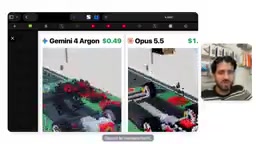
The most convincing part of the video is the direct comparison of different models on the same task. Gemini 4 Argon spent only 19 cents to generate a certain work, while Claude Opus 5.5 cost about three times as much—but its visual effect was "ten times better." The creator admits that if the prompt were optimized, Gemini's result would be better, but the gap is still visible to the naked eye.
He isn't dismissing Gemini 4 Argon—"it's not bad"—just that Opus 5.5 is clearly stronger. He also mentions that Anthropic is about to release Fable 5.5, at which point the gap may widen further.
Another notable test involved putting Gemini 4 Argon into a robot, where it autonomously learned and iteratively improved through a camera. The creator believes this demonstrates the model's potential, but overall, Gemini 4 Argon "definitely hasn't gone as far as other models."
Subscription Availability Chaos: Pro Users Locked Out of Anti-Gravity
The creator says bluntly that Google "messed up" its subscription strategy. Free users can now only use the Gemini 3.x series (such as 3.6 and 3.7); the previously available 3.8 Flash has been withdrawn, though it's still adequate for daily use.
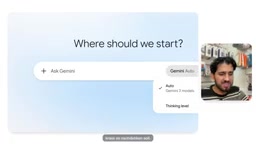
Pro subscribers can use Gemini 3.8 Flash, 3.1 Pro, and 4 Argon, and can adjust "thinking intensity." But the key problem is that Pro users cannot call Gemini 4 Argon in Anti-Gravity (Google's coding tool positioned against Claude Code and Codex). The creator is very dissatisfied with this—a 20-euro-per-month Claude Code or Codex subscription can do far more, yet Google locks its latest model inside its own coding tool.
The video creator says he will launch his own independent benchmark tests in the future, comparing models in a way that is closer to real-world scenarios.
Anti-Gravity and the Subscription Landscape of AI Coding Tools
Anti-Gravity is Google's AI coding tool for developers, positioned against Anthropic's Claude Code and OpenAI's Codex—such tools exist as command-line or IDE plugins that can read and write codebases, execute commands, and automatically complete multi-step development tasks, making them a key entry point in the current battle among AI vendors for professional users.
The business model for these tools is typically subscription-based, and the core demand of paying users is access to the newest and strongest models. Therefore, locking the latest model outside one's own coding tool amounts to weakening the core value of the subscription. The "20 euros per month" comparison in the article illustrates exactly this: at the same price point, competitor subscriptions provide full access to the latest models, while Google's Pro subscription cannot call Gemini 4 Argon in Anti-Gravity—an obvious value gap in users' eyes.
Conclusion: The Direction Is Right, but It's Still Not Quite There
Gemini 4 Argon shows clear progress in 3D generation, creative coding, and world knowledge understanding, and its benchmark scores are respectable. But its quality on real tasks still lags behind Claude Opus 5.5, and the score gap between old and new benchmarks reminds us that scores don't equal capability. The confusion at the subscription level—especially Anti-Gravity locking Pro users out of the new model—further undermines its appeal. Google is heading in the right direction, but it still has a way to go before it's "better than Claude Opus 5.5."
One-line Summary
Gemini 4 Argon has impressive benchmark scores and clear progress in 3D generation, but it still trails Claude Opus 5.5 in real-world use, and its subscription strategy is also controversial.
Paragraph Summary
Google has officially released Gemini 4 Argon. Its official benchmark results are excellent, but hands-on testing shows it trails GPT-6 Astra on real tasks, and while the gap with Claude Opus 5.5 isn't large, it definitely exists. The author notes that benchmark questions mixed into training data can inflate scores, and the roughly 10-point gap between old and new benchmarks exposes shortcomings in generalization. The highlights are concentrated in 3D generation and creative coding: a single desktop photo can be used to generate a complete game scene in Blender, and a minimal one-sentence prompt can build an Apple computer museum webpage. But in a same-task comparison, Opus 5.5 cost about three times as much yet delivered ten times better visual quality. The subscription level is also chaotic—Pro users cannot call the new model in the Anti-Gravity coding tool, further weakening its appeal.
Related articles

Workbuddy for Absolute Beginners: How a Desktop AI Agent Fits Into Real Workflows
A beginner's guide to the Workbuddy desktop AI agent: installation, claiming credits, file management, and building automated workflows—compared with CodeX for fit and cost, helping professionals shift from AI question-askers to AI managers.

OpenAI's New Agent Stack: Computer Use, Decisions API, and Ultra-Fast Workflows
OpenAI Dev Day unveiled a new agent stack: Computer Use outperforms humans, Decisions API delivers ultra-low-latency classification via Luna, Agents API opens the same Computer Use capabilities, and GPT-6.1 Sol costs only one-seventh of Astra. Core updates, benchmark data, and developer insights.

Liang Wenfeng Open-Sources DeepInfo Inference Framework, Takes On U.S. Ban
DeepSeek open-sources its DeepInfo inference framework after its models, featuring GPU/CPU cross-pipelining, small-model prediction with large-model verification, and full Huawei Ascend and NVIDIA chip support—facing the U.S. federal ban head-on. This article analyzes its significance for AI deployment and open-source strategy.