Gemini 4 Argon Rolls Out in Stages, DeepSeek Open-Sources Low-Level Components for Ascend

Gemini 4 Argon, DeepSeek Ascend components, Reddit API shutdown, and DoorDash SMS ordering in today's AI roundup.
Google's Gemini 4 Argon raises max output to 1M tokens and targets long-horizon tasks, with access initially limited to trusted testers. DeepSeek open-sources DeepGEMM, DeepEP, and FlashMLA for Huawei's Ascend 950 platform. GitHub trending features three coding agent projects focused on understanding codebases before writing code. Reddit announces phased shutdown of RSS and public API, and DoorDash tests AI-powered SMS ordering as a new service entry point.
Gemini 4 Argon: Opening to Trusted Testers First
Google has announced Gemini 4 Argon, initially available to trusted cyber defenders through the Fairwind program. The model is designed for long-horizon tasks that require sustained reasoning, covering three key scenarios: software engineering, enterprise research, and vulnerability remediation. It's worth noting that access is not yet available to all users — Google plans to expand access progressively to developers, enterprises, and consumers, with no announced date for general availability.
One notable hard metric: the maximum output has been raised from 64,000 tokens to 1 million — this refers to the output ceiling, not the context window, which has direct implications for long-form tasks that generate extended code, documentation, or reports. Google also reports a score of 77.9% on the DeepSWE 1.1 software engineering benchmark, though this is a vendor-reported figure and warrants independent verification.
Google's internal examples include large-scale code migrations, but the company also emphasizes that critical systems still require automated testing and human auditing. This makes clear that even with improved long-task completion capabilities, human oversight remains necessary in production environments — full automation is not yet on the table.
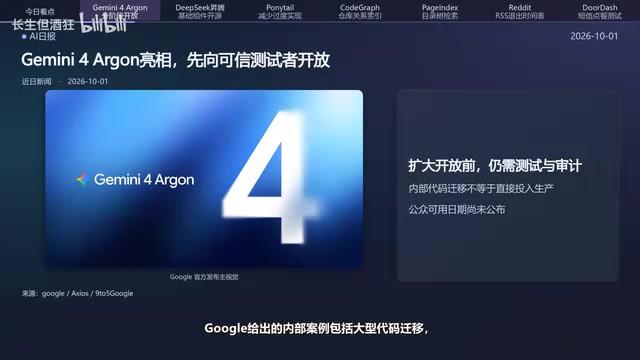
For developers, the two things worth tracking are: the actual quality of long-task completions in practice, and the pricing and access terms once general availability launches. Until those details are clear, Argon is more of a capability preview than a production-ready tool.
DeepSeek Open-Sources Low-Level Components for Huawei Ascend
DeepSeekAd has open-sourced a set of low-level components targeting the Huawei Ascend platform, covering compute, communication, and attention — three of the most performance-critical areas in large model training and inference. DeepGEMM handles matrix computation, DeepEP handles Mixture-of-Experts (MoE) communication, and FlashMLA adds sparse attention operators and optimization notes for Ascend.
The Ascend version of DeepGEMM retains the original API, which means migration costs for existing codebases should be relatively manageable. However, the repository explicitly states it was developed and validated on the Ascend 950 series and requires the corresponding CANN toolchain — an important prerequisite. This should not be interpreted as broad compatibility across all Ascend hardware models.

For low-level developers, this suite provides useful reference code for migration and optimization when deploying large models on domestic AI hardware. Note that the above is compiled from official documentation and has not been independently tested; specific hardware compatibility should be verified against official sources.
Background: Ascend Platform and CANN Toolchain
Huawei Ascend is Huawei's AI chip series — the Ascend 910 series targets training workloads, while the Ascend 310/950 series targets inference. The equivalent of NVIDIA's CUDA ecosystem, Huawei has built CANN (Compute Architecture for Neural Networks) as the software stack for Ascend chips, encompassing operator libraries, compilers, and a runtime environment. It is the essential low-level dependency for running deep learning workloads on Ascend hardware.
Mixture of Experts (MoE) is a common architectural choice in today's large models: the model is composed of multiple "expert" sub-networks, with only a subset activated per inference pass, keeping compute costs manageable at very large parameter scales. This architecture generates heavy All-to-All communication across devices during training and inference — exactly the bottleneck DeepEP is designed to address. DeepGEMM targets General Matrix Multiplication (GEMM), the single most compute-intensive operator in neural network forward and backward passes; hardware-level optimization here typically yields significant overall throughput gains.
GitHub Trending: Three Projects Making Coding Agents Smarter
Three coding-agent-related projects from today's GitHub trending list are worth highlighting — all sharing the same core idea: help AI understand the existing codebase before it starts writing code.
Ranked fifth on the daily chart, Ponytail instructs coding agents to first inspect existing code, standard libraries, and native namespaces before deciding how much new code to write. The author reports an average reduction of roughly 54% in code written across 12 test tasks. These results are specific to particular models and repositories, and not every task will see a 50% reduction — but the direction of reusing existing capabilities and avoiding reinventing the wheel is sound.
Ranked fourteenth, CodeGraph builds an index of symbol calls and cross-file relationships in a repository, then exposes that index to coding agents via the command line or MCP, aiming to reduce the overhead of repeatedly searching through files. The index updates automatically as local code changes, though the accuracy of relationship understanding depends on the level of support for specific languages and frameworks.

Ranked seventeenth, PageIndex organizes long documents into a hierarchical table of contents, letting the model navigate to evidence by traversing the hierarchy rather than relying solely on vector similarity to retrieve fragments. It offers a local mode where you supply your own model API key, but model calls still incur costs, and answers should be verified against the source documents. All three projects are summarized from official documentation and have not been independently tested.
Background: MCP Protocol
The MCP (Model Context Protocol) mentioned by CodeGraph is an open standard proposed and open-sourced by Anthropic in late 2024. Its goal is to provide a unified interface for communication between AI models and external tools or data sources — analogous to how USB-C provides a universal connection standard for hardware devices. MCP allows different coding agents (such as Claude, Cursor, etc.) to call tools like file systems, code indexes, and databases in a consistent way, without requiring bespoke integration for each tool. Anthropic, Microsoft, Google, and other major AI vendors have announced MCP support, and it is gradually becoming a de facto standard for AI agent tool-calling. CodeGraph's MCP support means that any MCP-compatible coding agent can directly query repository symbol relationships without additional integration work.
Reddit Shutting Down RSS and Public API — Developers Should Audit Dependencies Now
Reddit has announced a deprecation timeline for its RSS feeds and public data API. RSS support will end on November 13 of this year; affected apps and bots must register for migration by January 12, 2027; and remaining public API access will close in March. Reddit attributed the decision to large-scale scraping and automated abuse, and recommended that community management tools migrate to the Developer Platform.

For regular users, Reddit has explicitly stated there is no replacement for non-administrative RSS subscriptions. For developers building data pipelines or community tools, this means auditing your dependencies against the above milestones and planning migration paths in advance — otherwise, functionality may break when each deadline arrives.
Background: Reddit's API Policy Tightening
This move is not sudden. In 2023, Reddit significantly raised API pricing, leading to the closure of several prominent third-party clients (including Apollo and Reddit is Fun) and triggering widespread moderator protests. This latest step — closing RSS and public API access — continues the platform's trend toward centralizing control over data access. While Reddit cites large-scale scraping as the reason, some observers believe it is also connected to the commercialization of AI training data licensing: Reddit has signed data licensing agreements with companies including Google, and restricting free public access helps protect that commercial interest. For academic researchers, sentiment analysis tool developers, and news aggregation services that rely on Reddit data, this closure is no less impactful than the 2023 API pricing controversy.
DoorDash Tests SMS Ordering — Bringing the Entry Point to Everyday Chat
DoorDash has begun testing a new SMS-based ordering experience: users describe what they want to eat in a text message, AI searches nearby restaurants and makes recommendations, the cart handles multiple users' dietary preferences, and checkout is completed within the chat after confirming the order. This extends the ordering entry point from an in-app search bar into everyday messaging — a concrete example of AI as an ambient interface.
The feature is currently only available to a waitlist of U.S. users and has not rolled out broadly. It reflects a broader trend: AI is shifting service entry points from standalone applications into communication channels users already inhabit, lowering the barrier to engagement. Whether this type of experience ultimately succeeds depends on the AI's ability to accurately interpret ambiguous requests and how smoothly the checkout flow works.
Takeaways
Today's updates trace a clear throughline: at the model layer, Gemini 4 Argon pushes long-horizon tasks and ultra-long output to the forefront; at the compute layer, DeepSeek fills in low-level gaps for the Ascend platform; at the tooling layer, GitHub's coding agent projects all emphasize "understand first, then act"; and Reddit closing its API alongside DoorDash experimenting with SMS ordering serve as reminders that the data ecosystem is tightening while AI interaction entry points continue to proliferate. All benchmark results and project information cited above are vendor-reported or sourced from official documentation and have not been independently verified — official sources should be treated as authoritative.
Related articles

Chain of Thought Isn't Just for AI: How Humans Can Use CoT to Improve Thinking Quality
Chain of Thought isn't just a prompt trick for large models. Starting from a Hacker News discussion, this article analyzes why CoT works for human thinking too, breaks down actionable ways to transfer it, and highlights the key differences between human CoT and machine CoT.
Cloudflare Teams Up with OpenAI: Closi…
Cloudflare Teams Up with OpenAI: Closing the Loop from Vulnerability Discovery to Defense with AI
Cloudflare uses OpenAI Daybreak to investigate security vulnerabilities and generate reviewable remediation plans, while developers use Codex to boost coding efficiency and quality.

Orca Multi-Agent Orchestration in Practice: A Guide to Parallel Collaboration with Claude and Codex
Orca is Stable AI's free open-source agent workbench supporting 34 agents like Claude Code and Codex in parallel. Learn its Git worktree isolation, multi-model orchestration, and mobile management.