Gemini 4 Argon's 1M Token Output Window: Paradigm Shift or Marketing Hype?

Gemini 4 Argon's rumored 1M token output window could unlock long agentic tasks — if consistency holds.
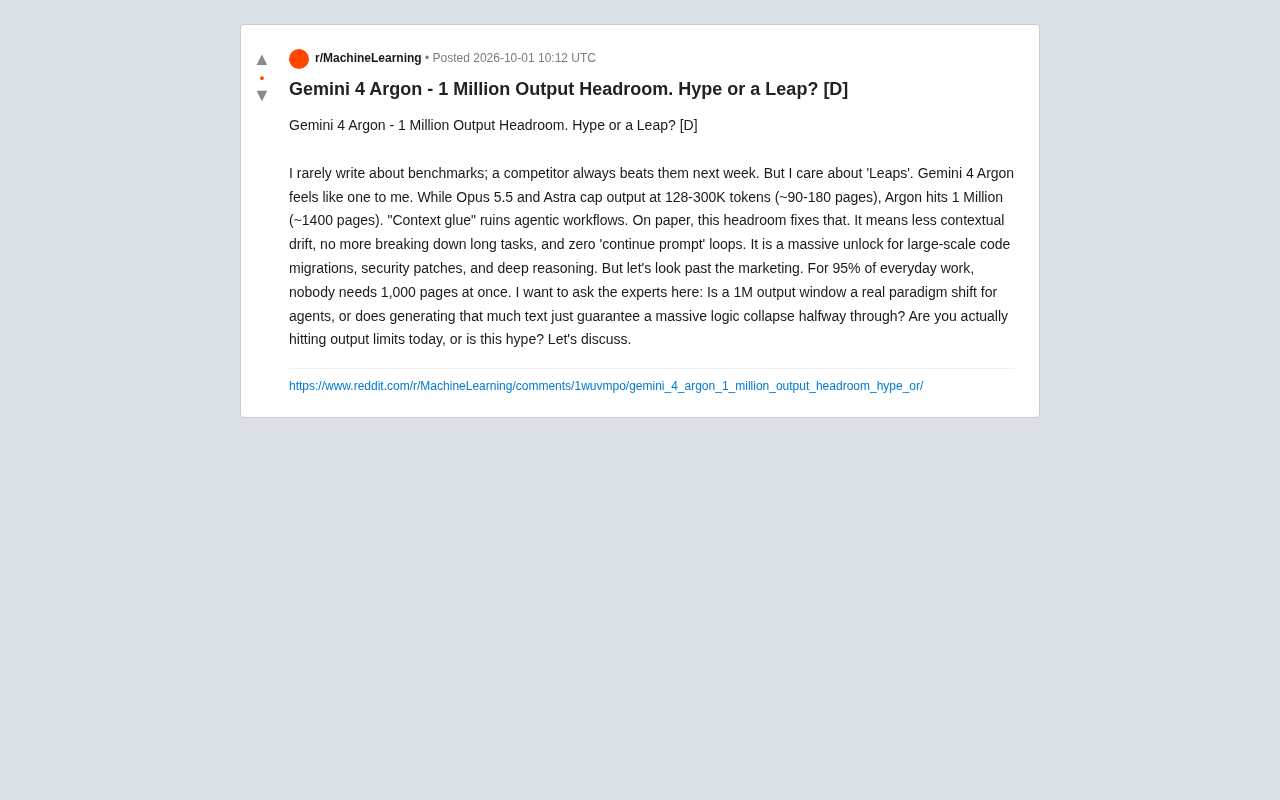
A Reddit thread claims Gemini 4 Argon features a 1 million token output window (~1,400 pages), far exceeding the 128K–300K limits of current leading models. The article examines whether this resolves the "context glue" problem in agentic workflows — where forced task fragmentation causes contextual drift and logical breaks — or whether autoregressive error accumulation means the physical ceiling rise won't translate into a real effective output gain. The core question: is this a paradigm shift, or a spec-sheet arms race? The answer hinges on long-range consistency, not raw token counts.
A Reddit thread about Gemini 4 Argon has sparked debate: the model is rumored to feature an output window of up to 1 million tokens — roughly 1,400 pages of text. By comparison, models like Opus 5.5 and Astra cap out at 128K–300K tokens (approximately 90–180 pages). The gap is staggering, but is this a genuine leap forward for agentic workflows, or just another round of inflated marketing claims?
Output Window vs. Context Window: Getting the Concepts Straight
Before diving in, it's worth distinguishing two easily conflated concepts. When most people talk about a "context window," they mean the total amount of input a model can read in a single pass. The "output headroom" discussed here refers to the maximum amount of text a model can continuously generate in one go.
These two bottlenecks are fundamentally different in nature. Long-context input has long since ceased to be unusual — many mainstream models already support million-token input. But the output side has historically been capped at tens to hundreds of thousands of tokens, because errors in autoregressive generation accumulate with length: the longer the output, the higher the risk of logical collapse. So if Argon can truly sustain stable generation at 1 million tokens, the significance isn't just "writing more" — it's whether it actually solves the consistency problem in long-form generation.
Autoregressive generation is the core mechanism of today's mainstream large language models: the model predicts and outputs one token at a time, appends it to the existing sequence, then predicts the next, and so on. This mechanism inherently causes error accumulation — each step's probability prediction carries a small deviation, and those deviations compound exponentially with sequence length. This is why expanding the output window is a far greater technical challenge than expanding the input window: reading a fixed piece of text is deterministic, whereas generating an ever-longer piece of text means making an unbroken series of probabilistic choices that could go wrong. The industry typically uses "needle-in-a-haystack" tests to evaluate long-context capability on the input side, but standardized evaluation metrics for the output side remain immature — which also makes vendor claims about output windows harder to independently verify.
The "Context Glue" Problem and Agentic Workflows
The core pain point raised in the thread is what the poster calls "context glue" — the need, during long tasks, to continuously stitch together earlier and later segments, with information loss and logical breaks appearing at every seam. This is one of the most frustrating obstacles in real-world agentic applications today.
In practice, complex tasks are often forced into multiple sub-tasks. Every time generation hits its limit, a "continue" prompt is needed to resume. This fragmentation is not only cumbersome — it introduces contextual drift: in the latter half of generation, the model gradually forgets the constraints established in the first half, leading to inconsistent code style, variable naming conflicts, and even contradictory logic.
If the 1 million token output window is real, it would theoretically allow tasks that previously required repeated resumption to be completed in a single generation pass — reducing stitch points and lowering drift risk. The poster argues this is a "massive unlock" for three categories of use cases: large-scale code migration, bulk security patch remediation, and deep tasks requiring long chain-of-thought reasoning.
Contextual drift is especially devastating in code generation scenarios. A typical example: the model defines a function interface in the first half of a large codebase, but by the time it reaches the second half, it has "forgotten" that interface's signature and uses an incompatible calling convention instead. This kind of error won't trigger a model-side warning — it only surfaces at runtime, making debugging extremely costly. Current mainstream mitigation strategies include injecting a "summary context" before each continuation, or using an external memory module to explicitly store key constraints. But these approaches are themselves a form of "context glue" — effective but cumbersome, and they introduce additional engineering complexity. The potential value of a massive output window is precisely that it makes this layer of manual stitching unnecessary.
The Counterargument: Does Longer Output Guarantee Mid-Run Logical Collapse?
The poster doesn't simply embrace the optimistic view — they also raise a sharp counterpoint: does generating this much text in one shot actually guarantee logical collapse somewhere in the middle?
This concern is well-founded. Autoregressive models generate token by token, each step dependent on everything that came before. The longer the generation, the more likely early small deviations are to compound into large-scale directional errors in the final output. In other words, raising the "physical ceiling" of the output window doesn't automatically raise the "effective output length" in tandem. A model that can generate 1 million tokens but starts rambling by token 200K is far less useful than one that reliably generates 300K tokens with coherence.
There's also the question of actual demand. The poster candidly notes: "For 95% of everyday work, nobody needs 1,000 pages at once." This is worth sitting with — the vast majority of users aren't even bumping against current output limits. That means a massive output window looks more like a capability for specific high-end scenarios (like enterprise-scale codebase refactoring) than a broadly accessible upgrade.
Paradigm Shift or Parameter Arms Race?
The thread's real provocation is this: Is expanding the output window a paradigm shift for the agentic era, or just another round of spec-sheet one-upmanship?
From an optimistic angle: if long-form generation consistency issues can be solved in tandem, million-token output could genuinely reshape how agents work — shifting from the fragmented "decompose → continue → stitch" pattern to truly end-to-end long-task execution. That would be a structural win for automated programming, document generation, and system migration.
From a cautious angle: the poster himself warns not to be blinded by marketing. Benchmarks get refreshed by a competitor the following week, and simply stacking output length without addressing logical stability just moves the problem from "not long enough" to "not accurate enough." A genuine "leap" should manifest in effective output length and long-range consistency — not just a maximum token count on paper.
A note on sourcing: this article is based on a single Reddit discussion thread. The 1 million token output window for Gemini 4 Argon remains in the realm of rumor and speculation, with no official confirmation. Readers should treat these figures with appropriate skepticism.
The phrase "parameter arms race" carries historical weight. Around 2023, as context windows expanded from 4K to 128K, voices emerged claiming that ultra-long context would make retrieval-augmented generation (RAG) obsolete — but in practice, the "lost-in-the-middle" phenomenon meant that effective usable length fell far short of the advertised figure. Whether the output side will replay the same story remains an open question. Meaningful benchmarks should include factual consistency retention rates at varying output lengths, code execution pass rates, and human-evaluated logical coherence scores — not just maximum token counts.
Practical Takeaways for Developers
Regardless of whether the rumor proves true, this discussion offers a few practical lessons for developers building agentic applications:
- First assess whether you're actually bottlenecked by output limits. Most tasks don't come close to hitting current models' output ceilings. Chasing larger windows may be solving a problem you don't have.
- Focus on consistency metrics, not peak length. When evaluating models, real-world testing of logical stability under long generation is more informative than the maximum output token count.
- Design validation checkpoints for long tasks carefully. Even with a massive output window, inserting verification steps and staged reviews at critical junctures remains a necessary safeguard against collapse.
This debate has no definitive answer — but the question it raises, how to balance length with quality, is precisely the real battleground in the next generation of agentic capability competition.
Related articles

Felix Rieseberg Personal Homepage
Felix Rieseberg's personal homepage sparks attention on Hacker News. This article covers the Slack engineer's technical background, the rise and fall of nativefier, and the value of a developer homepage as a tech calling card.

@ai-sdk/vue 3.0.306 Patch Release Syncs with [email protected] Update
@ai-sdk/vue 3.0.306 released, synced with [email protected]. A routine patch release for the Vercel AI SDK ecosystem with no public API changes; the Vue adapter layer stays version-aligned with the core package.

Gemini 4 Argon API Launches: The Era of Million-Token Output Begins
Google launches Gemini 4 Argon with sparse MoE architecture, up to 1M output tokens, and a 68.90% Vals Index score, available across API, AI Studio, and the Gemini app.