Gemini 4 Carbon Animation Test: Can It Replace Opus 5.5?

Blind test shows Gemini 4 Carbon has solid physics and lighting but falls short of Opus 5.5 in motion liveliness and speed—a reliable substitute.
This article documents a blind test of procedural 3D animation between Gemini 4 Carbon and Claude Opus 5.5. Across two rounds, Opus 5.5 demonstrated more natural running gait, stronger cinematic taste, and directorial intuition with about one-third the code; Carbon held its ground on lighting, particle fire, and industrial detail through heavy physics stacking. In the second half, Carbon alone tackled four high-difficulty challenges—spatial topology, multi-style switching, turbofan engine simulation, and optical illusions—all passing in a single shot, proving its modular engineering and spatial math capabilities. The conclusion: Carbon still lags behind Opus 5.5 overall and generates about twice as slowly, but is a capable substitute for complex physics visualization or when quota is limited.
Gemini 4 Carbon Animation Test: Can It Replace Opus 5.5?
When code generation models start taking on 3D animation, what we care about is no longer just "can it run," but "does it run beautifully." A Bilibili creator ran a blind test pitting Gemini 4 Carbon against Claude Opus 5.5 head-to-head across multiple animation scenarios, and the results were surprising: Carbon, with three times the code volume of its rival, fell behind on liveliness and response speed, yet clawed back ground on physical detail and lighting quality. What exactly did this showdown reveal?
Round One Blind Test: The Battle of Running Posture and Lighting
The challenge was a single-take open world at dusk, requiring three continuous camera moves within 25 seconds: a tracking shot across grass, a crane orbit around a suspension bridge, and a charge up to the mountain gate to greet the setting sun. Model A on the left was generated by Gemini 4 Carbon, writing over 4,600 lines of code; Model B on the right came from Opus 5.5, using only a 1,395-line single file. Three times the code volume produced an unexpected contrast.
Scaling the character up twofold and slowing it down twofold for a synchronized comparison, the difference was immediately clear: Opus used stunning phase curves to drive the calves into a full backward kick and a large arm swing, paired with a fluttering red cape, delivering a lively, bouncy feel. Carbon, by contrast, hard-coded over a thousand lines of two-bone kinematics, locking the support foot to the ground, which instead produced stiff scissor legs.
But when it came to the river-crossing suspension bridge and mountain gate scenes, Carbon won back a point with custom lighting—blinding river surface highlights, waterfall mist, and golden Tyndall light shafts delivered strong visual impact. First-round overall comparison: Opus 5.5 wins on lively gait, Carbon wins on top-tier lighting, a 1-1 draw. But the engineering cost gap was stark: Opus consumed only 335K tokens over 25 minutes; Carbon, with multiple rounds of self-review, consumed about 850K tokens over nearly 39 minutes—a full half slower.
Two-bone kinematics is a common procedural driving approach in character animation, typically simplifying the leg into two bone segments (thigh and calf), with joint angles determined through forward/inverse kinematics solving. Inverse kinematics (IK) derives joint rotations from a foot target position, keeping the support foot stably planted; forward kinematics (FK) directly sets joint angles, making it easier to express the arc of the swinging leg. Carbon's "hard-coding over a thousand lines of two-bone kinematics" refers to its use of extensive explicit constraints and phase calculations to control both legs—while it locked the support foot, it sacrificed the swinging leg's natural backward kick and elasticity, resulting in a stiff, scissor-like gait.
Round Two: The Procedural Flying Dragon and Directorial Intuition
Difficulty escalated: no reference images were provided, only a text description of "spinal sine wave propagation, membrane flap phase offset, volumetric bulge and taper" to generate a 25-second procedural flying dragon between a stormy sea and obsidian formations. Carbon delivered a giant dragon with 4,146 lines of code; Opus 5.5 produced a dark flying dragon with 1,599 lines. Racing at the same frequency, stylistic differences emerged once again.
Opus displayed outstanding directorial intuition: at second 4 it had the dragon emerge from behind the obsidian, paired with sea mist and background lightning at second 21, maximizing blockbuster suspense; at second 12 it used more concise code to render stunning purple-star iridescent scales and dark-soul translucency. However, zooming in twofold on the fire breath at second 21 revealed particle system flaws—the particle stream clearly detached from the circling dragon mouth's trajectory, and the sparks were uncropped square pixel blocks.
Carbon continued its heavy physics-stacking approach: four-limbed claws, spine ridge, and glowing wing veins clearly visible, with intricate wave crests and foam on the sea surface; at second 22, during the spiral ascent fire breath, although the circling dragon body once approached the top edge of the frame, that white-hot arc-shaped particle fire column bit firmly onto the dragon's mouth, dyeing the stone pillars and waves gold. Comparing the two synchronously, Opus 5.5 demonstrated higher cinematic taste and animation intuition through refined code, while Carbon held its ground on physical and lighting detail through large-model engineering stacking. On engineering cost, Opus consumed about 360K tokens over 26 minutes; Carbon split into 8 files consuming about 790K tokens over 53 minutes—again twice as slow. The first half ended in a 2-2 tie.
Particle systems are a core technology in real-time graphics for simulating non-rigid effects like fire, smoke, and splashes: the system continuously generates large numbers of tiny particles, each with position, velocity, lifetime, and appearance attributes, driven by emitters according to rules. The "particle stream detached from the dragon mouth's trajectory" mentioned in the article indicates the emitter wasn't bound to the dragon mouth's motion trajectory, causing flames to spray from the wrong position; "uncropped square pixel blocks" occur because the particle texture lacked alpha clipping or soft-edge processing, exposing the particle's raw quad. High-quality fire typically requires trajectory following, size decay over lifetime, and soft particle depth blending.
Second Half: Stability Test as a Primary Replacement Model
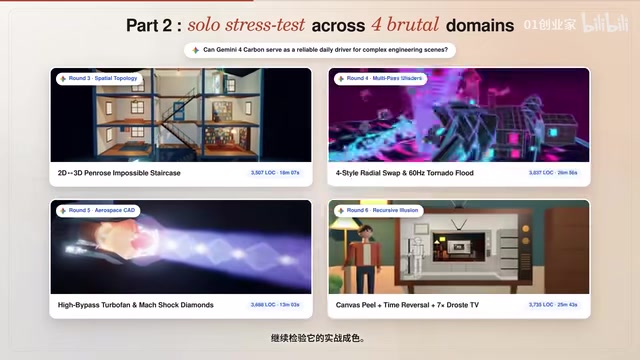
Setting aside the comparison, if Carbon were used alone as the daily development workhorse model, could it reliably handle more complex animation factories? The creator continued testing with 4 challenges covering spatial topology, multi-style post-processing, industrial simulation, and optical illusions.
Spatial Reasoning: Penrose Stairs in 2D and 3D Traversal
A 30-second dimensional fold: growing from a pure 2D engineering blueprint into a three-story dimensional house, with a character running up to the third-floor attic, pushing open the door, and instantly running out from the basement, forming a Penrose infinite loop. Carbon wrote 3,507 lines of code, using a Westworld-style dolly zoom formula to smoothly transition from a 0.32-degree near-orthographic top-down view to a 41-degree 3D perspective; 96 colored books on the shelf grew out three-dimensionally one by one,破解ing the impossible staircase. It placed a hardware clipping plane at both the third-floor attic door and the basement door, using two strictly phase-synchronized twin runners to seamlessly relay at the moment of passing through the door, finally folding the entire building sideways back into a 2D line drawing like origami. Split into 8 modules, 3,507 lines of hand-written code, about 640K tokens consumed, 18 minutes—passed in a single shot.
Penrose stairs is a famous impossible figure proposed by Lionel Penrose and his son Roger Penrose in 1958, presenting a visual paradox of four steps connected end-to-end that always ascend yet return to the starting point. It cannot truly exist in 3D space and can only hold under specific viewing angles via 2D perspective projection or forced perspective. Carbon's "smooth transition from a 0.32-degree near-orthographic top-down view to a 41-degree 3D perspective" precisely exploits perspective change to create the illusion: from top-down, the 2D blueprint appears reasonable; after transitioning to 3D, clipping planes and twin runners relay to prevent the viewer from detecting geometric breaks during the moving camera, thus reproducing the infinite loop.
Multi-Style Switching: The Battle of Four Art Styles and Tip Flicker
A coastal town faces flood inundation and a sky-hanging dragon far front, with a complete global switch of 4 distinctly different artistic rendering pipelines every 7 seconds without interrupting rigid body and fluid motion. In procedural rendering, thin-line outlines and global art style switching easily trigger severe tip flicker. Carbon pre-baked 60Hz rigid body physics with a fixed random seed, keeping cars, wooden crates, 48 flying frogs, and characters physically coherent throughout; simultaneously it built hairline and linear-depth double-buffered edge lines, seamlessly sweeping through picture book, Cerezo-Lopez engineering blueprint, 45-degree halftone black-and-white manga, and cyber neon glowback styles every 7 seconds using mirrored wipe patterns. During self-review screenshots, it discovered outline black bands at water surface reflection angles and proactively upgraded edge detection to an Argyll-Laplacian operator, eliminating the flicker. This round split into 4 modules, 3,837 lines of hand-written code, about 740K tokens consumed, 27 minutes.

Industrial Simulation: Hardcore Modeling of a High-Precision Turbofan Engine
A 27-second high-precision high-bypass turbofan engine cowling smoothly剖开s open, revealing dual rotors accelerating thousands of hot and cold airflow streams, finally ejecting supersonic Mach diamonds. Facing pure text industrial modeling, Carbon wrote 3,688 lines of code, building 22 swept wide-chord fan blades, three-stage low-pressure and seven-stage high-pressure compressors, 18 fuel nozzles, and high/low-pressure coaxial dual rotors nested at a true 1:3 speed ratio; 8,000 streamlines clearly distinguish the cyan cold air of the bypass duct from the heated gas of the core duct, and the tail uses 32-step ray-marching volumetric rendering to compute supersonic diamond Mach rings, fixing a local glow black block caused by GLSL operations during self-review. Frame-by-frame review of the cowling glass剖开ing process from seconds 4 to 6 also exposed a blind spot in static self-review: the lifted casing cover briefly occluded the foreground camera as it slid out, indicating room for improvement in handling continuous dynamic camera occlusion. This round split into 8 modules, 3,688 lines of hand-written code, about 610K tokens consumed, only 13 minutes—completing high-precision half-wave rendering.
Mach diamonds are periodic diamond-shaped shock structures appearing in supersonic jets. When the jet pressure from the engine outlet mismatches ambient pressure, the jet undergoes alternating expansion and compression, forming a series of bright diamond-shaped spots. Carbon's "32-step ray-marching volumetric rendering" to compute Mach diamonds refers to progressively sampling density and emission along the view direction in volume rendering, accumulating the semi-transparent glow of the shock waves. Compared to simple particle textures, volumetric rendering more realistically expresses the depth and brightness falloff of Mach diamonds, but also places higher demands on computing power and shader precision.
Optical Illusion: Seven-Layer Picture-in-Picture and the 2D Curtain Reveal
10 seconds revealing that a fake 3D long staircase is actually a flat stage curtain; a middle 10 seconds of shattered glass and collapsing buildings in time reversal; a final 10 seconds diving into a TV seven-layer picture-in-picture freeze with a three-dimensional shadow figure waving alone. Carbon's execution was solid: the first act rendered the 3D long staircase as a texture hung on the stage curtain, with a glowing ball hitting the horizon at second 5 to stir up 2D ripples, the curtain's upper right corner rolling up to reveal linen stitching and metal eyelets on the back, and a lateral camera move then revealing the steel lighting rig and spotlight beams behind the scenes; the second act's time reversal had 308 triangular glass shards flying back perfectly into place, with a six-story building rising floor by floor out the window; the third act used dual offscreen buffer alternating rendering to achieve strict nesting of a 3D warm-light room and 2D black-and-white line art in seven-layer point-stone makeup, finally cutting back to a static 2D room, leaving only the three-dimensional shadow figure on the wall slowly turning to wave.
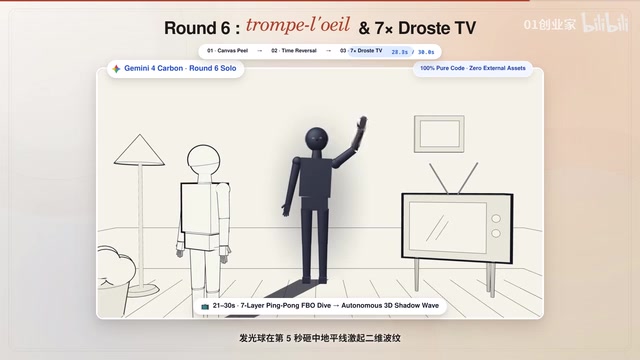
This round split into 6 modules, 3,735 lines of hand-written code, about 680K tokens consumed, 26 minutes—successfully wrapped up.
Conclusion: A Reliable Substitute, Not a Surpasser
Back to the core question: can Gemini 4 Carbon's animation capability actually surpass Opus 5.5? Based on the full test, the answer is very clear: overall performance still lags behind Opus 5.5, but it is fully viable as a reliable alternative.
The gap manifests mainly in two aspects. First is soul and motion aesthetics: Opus 5.5 needs only one-third the code to produce more natural, lively character running gaits and more cinematic camera compositions; Carbon prefers stacking thousands of lines of complex algorithmic constraints on straight bodies, which tends to be tense and stiff. Second is noticeably slower actual generation response speed: Carbon routinely splits into nearly ten files, generates four thousand lines of code, and repeatedly extracts frames for self-solving, with generation time far exceeding the clean and efficient Opus 5.5.
However, Carbon's solid shading, lighting-space mathematical derivation, and modular engineering capabilities also prove its hard power. When facing complex physics and industrial visualization needs, or when Opus 5.5 quota is limited, as long as you can accept slower generation wait times, Gemini 4 Carbon is absolutely a capable substitute that can step up.
Related articles

The 15-Year Programmer Who's Been Unemployed for Two Years: The Tech Worker's Dilemma in the AI Era
A US senior software engineer with 15 years of experience has been unemployed for two years, exhausted his savings, and sought help on Hacker News. This article analyzes the structural causes of long-term unemployment among tech workers, strategies for addressing resume gaps, and the redefinition of experience value in the AI era.

Soundcore Liberty 5 Pro Drops to All-Time Low: The Go-To True Wireless Earbuds for Commutes and Calls
Soundcore Liberty 5 Pro drops to an all-time low of $129.99 (from $169.99). These Anker true wireless earbuds excel at call quality and are on sale at Amazon, Best Buy, and Walmart in four colors—ideal for commutes and online meetings.

After Anthropic's IPO, How Far Can Safety-First Go?
The Verge podcast explores Anthropic's post-IPO core tension: can a public company stay safety-first? How public market pressure reshapes AI lab safety decisions.