After Anthropic's IPO, How Far Can Safety-First Go?

After its IPO, Anthropic's safety-first pledge faces the test of public market growth pressure.
The article examines Anthropic's Nasdaq listing and the core tension as it shifts from a research-driven lab to a public company: will its safety-first commitment be diluted by quarterly earnings, shareholder expectations, and stock volatility? Safety investments—red teaming, alignment research, pre-deployment evaluation—mean slower releases and capability limits, creating visible financial opportunity costs. The IPO also brings new governance constraints affecting capability-versus-timing trade-offs. Safety is both a trust asset and a possible growth ceiling; watch safety team independence, evaluation disclosure, and earnings-call messaging.
Anthropic is known for Claude, and also for its emphasis on AI safety. Last Thursday, the AI lab officially listed on Nasdaq. In the final episode of the podcast series, The Verge senior AI reporter Hayden Field joined the host to discuss the core tension behind this IPO: when a company has to answer to public markets for growth, will its safety-first commitment be diluted?
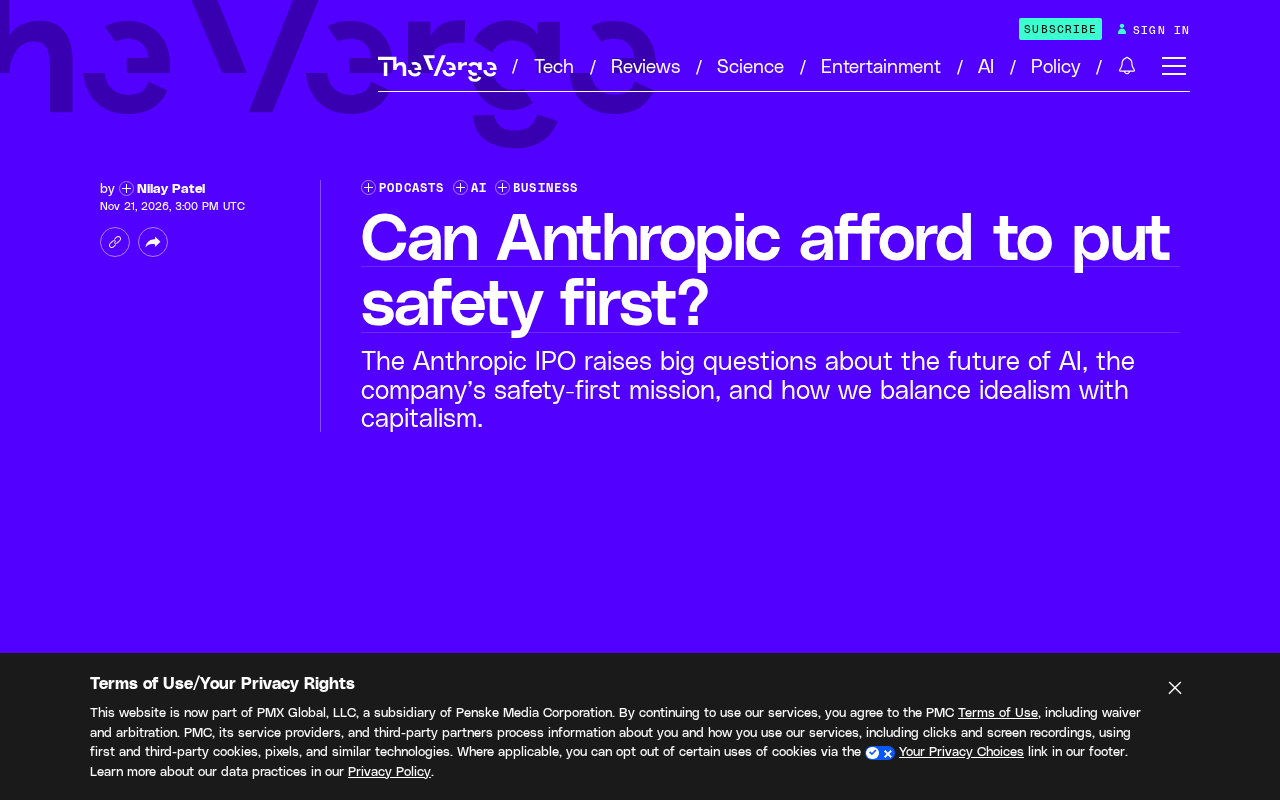
An IPO Drowned Out by Numbers
According to The Verge podcast, Anthropic's first-day IPO numbers were enormous, but Hayden Field argues these numbers aren't key to understanding where the company is headed. What really matters is the structural change the listing itself brings—Anthropic is transforming from a research-driven lab that could set its own safety agenda with relative autonomy into a public company that must face quarterly earnings, shareholder expectations, and stock price fluctuations.
This identity shift is not symbolic. Public markets typically have limited patience for growth and profitability, while safety investments in frontier AI—red teaming, alignment research, cautious pre-deployment evaluation—often mean slowing release cadence and limiting product capabilities, which shows up financially as opportunity cost.
IPOs and the constraining mechanisms of public markets: An initial public offering (IPO) means a company's shares are sold to public investors on a stock exchange, turning it from privately held to publicly held. The core of this shift isn't just fundraising but the introduction of a whole set of external constraints: the company must disclose quarterly earnings, comply with securities regulators' disclosure requirements, and be continuously tracked and rated by analysts. Management decisions are thus placed under the immediate feedback of stock price, shareholder expectations, and peer comparison. For a lab oriented toward long-term research, this difference in cadence is especially critical—private-stage investors can tolerate years of unprofitability, while public market valuation logic usually emphasizes predictable revenue growth and profit margins, which systematically changes a company's preferences in resource allocation and release cadence.
The Business Cost of Safety-First
Anthropic has long made safety the core of its brand differentiation. This positioning is easier to maintain in the private stage, because investors and the founding team can to some extent tolerate short-term revenue giving way to long-term principles. After going public, the same trade-offs will be placed under a more transparent magnifying glass.
As a side note, the source material does not provide specific safety investment amounts or release delay data, so this cost cannot be quantified. But logically, any public company facing competitive pressure will lean toward making safety processes "good enough" rather than "as good as possible." This is precisely the question Hayden Field raised in the conversation: can Anthropic really afford to put safety first?
Red teaming and alignment research: Red teaming refers to a dedicated team proactively searching for model vulnerabilities, jailbreak paths, harmful outputs, or misuse scenarios in an adversarial manner before deployment, with the goal of discovering and fixing risks before real users encounter them. Alignment research focuses on how to keep model behavior consistent with human intent and values, including technical issues such as reducing deceptive behavior and controlling goal drift in complex tasks. Both types of work require additional manpower, compute, and time, and their outputs often do not directly translate into product features or revenue. In a public company context, such investments are counted as costs but are hard to show as growth in financial statements, making them more likely to be compressed to a "compliance floor" rather than "best effort" under competitive pressure.
How Public Markets Will Reshape Decisions
From a corporate governance perspective, an IPO brings not just capital but a new set of decision constraints. Board composition, investor relations, and analyst coverage all influence management's choices at key moments. For AI labs, the most sensitive choices often arise between model capability and deployment timing: release first to consolidate market share, or delay release to complete more thorough safety validation.
The podcast discussion doesn't offer a definitive answer, but proposes a framework worth watching: observe how Anthropic publicly explains its decision the first time it faces a "safety versus speed" conflict after going public. The quality of that explanation will say more than any wording in a prospectus.
Corporate governance and board composition: After going public, a company's board typically needs to add independent directors and establish specialized committees for audit, compensation, and nomination, while the investor relations department must maintain ongoing communication with institutional shareholders and analysts. This governance structure affects management's autonomy in key trade-offs: major release decisions may require explaining risks to the board, the investor relations team will watch market expectations for release cadence, and analysts' questions will force the company to publicly explain "why so slow." For safety-related decisions, changes in governance structure may strengthen accountability (because records and disclosure are required) but may also bring short-term performance pressure; the specific direction depends on board composition and the design of management's reporting relationships.
The Safety Narrative Under Competitive Dynamics
Anthropic's safety narrative doesn't operate in a vacuum. Competition in frontier AI moves fast, and competitors' releases create direct pressure. When other models on the market iterate quickly, a public company known for caution needs to explain to investors: why is slow worth it?
This creates a unique tension. Safety can be a trust asset, helping Anthropic gain an edge with enterprise customers and regulators; but it can also be read by capital markets as a growth ceiling. Hayden Field's discussion suggests both interpretations will coexist, and Anthropic's task is to maintain a credible balance between them.
Signals Worth Watching
For those following AI governance, several aspects of Anthropic after its IPO are worth noting: whether the safety team's independence and reporting relationships change; whether the pre-release evaluation process is publicly disclosed; and how the company talks about safety investment on earnings calls. These signals reflect better than first-day IPO numbers whether "safety-first" is a principle or marketing.
The conversation doesn't offer an optimistic or pessimistic conclusion, but puts the question on the table. Whether Anthropic can afford safety-first ultimately depends not on what it says, but on every concrete decision after going public.
Related articles

Beagle Brigade: From Fruit to GHB — Guarding the Border
How does the Beagle Brigade guard U.S. borders? Based on To Catch A Smuggler, this article shows detector dogs finding fruit and meat, and agencies tracking GHB and cocaine smuggling.

The Secret to High-Yield Tomatoes: How Consistent Watering Makes Container Tomatoes Outperform Ground-Planted Ones
A YouTube growing log shows container tomatoes far outyield ground-planted ones. The grower credits consistent, adequate water—not fertilizer—for the longer fruiting period and higher yield.

Reverse Role-Play: When You Become an LLM's Subagent in a Game
A reverse role-play game appears on Hacker News where players act as an LLM's subagent. This article analyzes its game mechanics, the philosophical implications amid the AI agent boom, and how indie developers use lightweight interaction to explore human-machine power relations.