Gemini 4 Carbon Lands on Perplexity: Matching Claude's Performance at 40% of the Cost
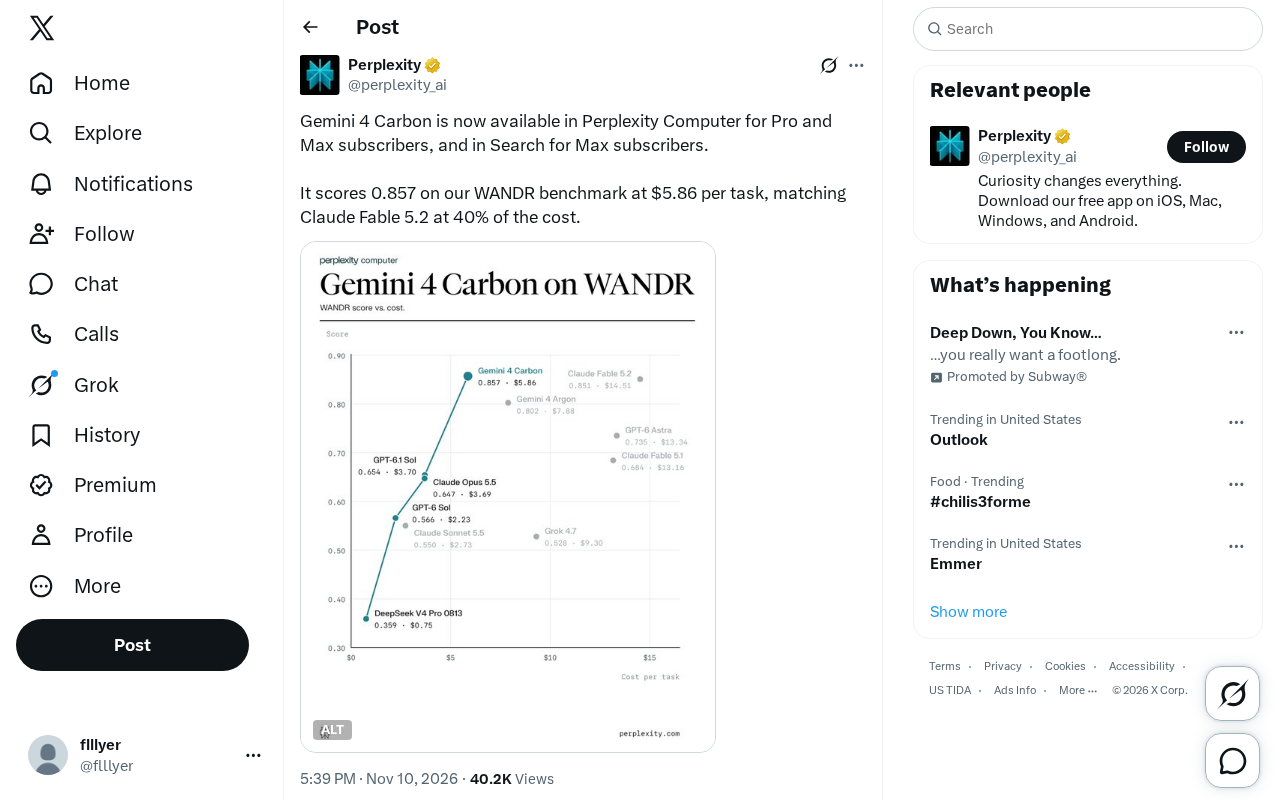
Gemini 4 Carbon launches on Perplexity, reshaping model competitiveness through cost efficiency and subscription tiers.
Perplexity announces Gemini 4 Carbon is live in its Computer feature (for Pro and Max users), with Search integration exclusive to Max. Official benchmarks show the model scores 0.857 on the proprietary WANDR benchmark at $5.86 per task—about 40% of Claude Fable 5.2's cost. The article argues this sends two signals: frontier models are entering third-party production environments faster, and subscription tiers are becoming a lever for differentiating model capabilities. As a platform-proprietary benchmark, WANDR results are better understood as performance in Perplexity's business scenarios rather than an absolute ranking. Subscription tiering commodifies model choice itself, using the high-frequency search scenario to widen the experience gap between Pro and Max. For users and developers, cost efficiency is becoming a more practical decision variable than benchmark scores, though single-source data still warrants caution.
A Single Tweet Reveals a New Rhythm in Model Distribution
Perplexity's official account announced on Twitter that Gemini 4 Carbon is now live in Perplexity's Computer feature, available to Pro and Max subscribers; the Search integration is exclusive to Max subscribers. The message itself doesn't carry much information, but it sends two signals worth noting: first, the pace at which frontier models enter third-party production environments is accelerating; second, subscription tiers are becoming a lever for differentiating model capabilities.
Compared with the model launch itself, the benchmark data Perplexity released alongside it is more worth pondering.
WANDR Score: The Cost Narrative Behind 0.857
Perplexity's comparison is refreshingly blunt: Gemini 4 Carbon scores 0.857 on its proprietary WANDR benchmark at a cost of $5.86 per task. For reference, Claude Fable 5.2 scores comparably under the same test but costs about 1.5 times more—in other words, Gemini 4 Carbon achieves equivalent performance at roughly 40% of the cost.
The clever part of this comparison is that it doesn't stop at "who's smarter" but puts cost efficiency front and center. For Perplexity, which processes a massive volume of queries daily, per-task cost directly determines whether the product can scale usage without raising subscription prices. This is also the core motivation for a third-party platform to actively endorse a model: good benchmark scores are one thing, but a workable unit economics model is the foundation for long-term collaboration.
It's worth noting that WANDR is Perplexity's own evaluation system, not an industry-standard benchmark. Its design likely leans toward Perplexity's actual business scenarios—multi-step retrieval, information synthesis, answer generation. So the 0.857 figure is better understood as "performs well on the tasks this platform cares about" rather than an absolute ranking that can be compared across all models.
Benchmark refers to a standardized test set for evaluating AI model capabilities, typically consisting of a series of tasks, scoring rules, and datasets. Common industry benchmarks include MMLU (multitask language understanding), GSM8K (mathematical reasoning), and HumanEval (code generation), whose value lies in providing cross-model comparability. However, benchmarks have obvious limitations: task design often reflects the creator's business preferences, models may overfit to specific benchmarks, and the complexity of real-world scenarios is difficult to fully capture with static tests. Therefore, proprietary benchmarks (like Perplexity's WANDR) can accurately reflect the platform's own needs, but their results should not be directly equated with general capability rankings; when making horizontal comparisons, it's important to check whether the test task composition and scoring criteria are consistent.
Subscription Tiers: The Capability Boundary Between Pro and Max
The most easily overlooked detail of this launch is the subscription threshold design for features. The Computer feature is open to both Pro and Max, while Gemini 4 Carbon in Search is only available to Max users.
This arrangement shows that Perplexity is treating "model choice" itself as a subscription benefit to operate. Search is Perplexity's highest-frequency entry point, and restricting the stronger model to the top-tier subscription both widens the experience gap between Pro and Max and supports Max's pricing. For ordinary users, this means that within the same product, answer quality at different payment tiers may show perceptible differences; for the developer ecosystem, it suggests that third-party model integrations often first test the waters in high-value scenarios before gradually trickling down.
Tiered subscription is a common pricing strategy for SaaS products, dividing features, usage, or service quality into different tiers to meet the needs of users with different willingness to pay. In AI products, the dimensions of tiering are extending from traditional "number of calls" and "storage space" to capability parameters such as "model choice" and "reasoning depth." The economic logic behind this is price discrimination: offering a basic tier to price-sensitive users and a premium tier to users with strong demand for high-value scenarios, thereby maximizing revenue. But the risk is that if the low-tier user experience falls noticeably behind, it may damage brand reputation; if the premium tier lacks perceptible differences, it becomes hard to convince users to upgrade. By restricting the strongest model to the Max tier, Perplexity is essentially testing users' willingness to pay for "answer quality."
Practical Impact on Users and Developers
For Pro users, the most direct change is the ability to call Gemini 4 Carbon within Computer to complete more complex multi-step tasks without switching to other tools. For Max users, the generation quality of Search results may change due to the model switch, especially for queries that require synthesizing multiple sources to make judgments.
For developers focused on model selection, the reference value of this news lies in how the cost comparison is presented. As the capability gap between models gradually narrows, "cost per task" will become a more practical decision variable than benchmark scores. Perplexity's framing of "40% of the cost" is essentially doing an arithmetic problem on the user's behalf: when results are comparable, which option is more cost-effective?
Of course, benchmark and cost data from a single source should still be treated with caution. The specific task composition of WANDR, the test configuration for Claude Fable 5.2, and the statistical basis for the $5.86 unit price have not been detailed by the company. Until more independent evaluations emerge, this set of numbers is better used as directional reference rather than the sole basis for procurement decisions.
Conclusion
Gemini 4 Carbon's arrival on Perplexity appears to be a model update on the surface, but in essence it's a public statement by the platform redefining model competitiveness through cost efficiency. Subscription tiers turn model capability into a priced commodity, while the WANDR score shifts the competitive focus from "who's stronger" to "who's more cost-effective." These two threads may be more worth tracking than the model itself.
Related articles
Why You Shouldn't Run the Hermes Agent on Your Personal Computer
Why shouldn't you run autonomous AI agents like Hermes on your personal computer? This article analyzes why agents should be deployed to a dedicated VPS instead of your primary device, from four angles: security risks, resource consumption, credential leakage, and autonomy requirements—plus the practical logic of isolated deployment.

Ignite Keynote: Building a Frontier Ecosystem to Bring AI to Life
Microsoft CEO Nadella's Ignite keynote proposes a frontier ecosystem to turn AI advances into real-world impact. This article unpacks the strategy's ecosystem layers and deployment signals.
C++26 Standard Finalized: Key Takeaway…
C++26 Standard Finalized: Key Takeaways from the ISO C++ Meeting
C++26 wraps up at the ISO C++ meeting. This article explains the trip report's implications, the standardization process, and impact on developers and compiler ecosystems.