Gemini 4 Carbon Released: AI Frontier Model Targets Cybersecurity

Google releases Gemini 4 Carbon within two weeks, topping overall intelligence and highlighting cybersecurity capabilities.
Google released Gemini 4 Carbon just two weeks after the previous model Argon, calling it the "next frontier model" and announcing a more regular release cadence. Carbon ranks first on the Artificial Analysis v5.0 Intelligence Index with a score of 59, showing significant improvement on long-horizon tasks over Argon. Its differentiated edge is cybersecurity: 88.2% on SEC-bench Pro vulnerability discovery, 54.8% on ExploitGym exploitation, and 71.0% on CWE-bench patching. The release follows a phased strategy—first to vetted trusted cyber defenders, then expanded to partners through the Fairwind Program, and ultimately to broader users. The article argues this reflects how AI iteration has compressed from years and quarters to weeks, requiring the industry to rethink the cadence of releases, safety evaluations, and ecosystem building.
Gemini Evolves Again: Gemini 4 Carbon Arrives
Just two weeks after the release of the previous-generation model Argon, Google has dropped another bombshell — Gemini 4 Carbon. The company announced it prominently on Twitter as its "next frontier model," emphasizing that its release cadence will become more regular. From the naming to the pace of release, a sense of urgency comes through: the AI race is accelerating on a weekly basis.
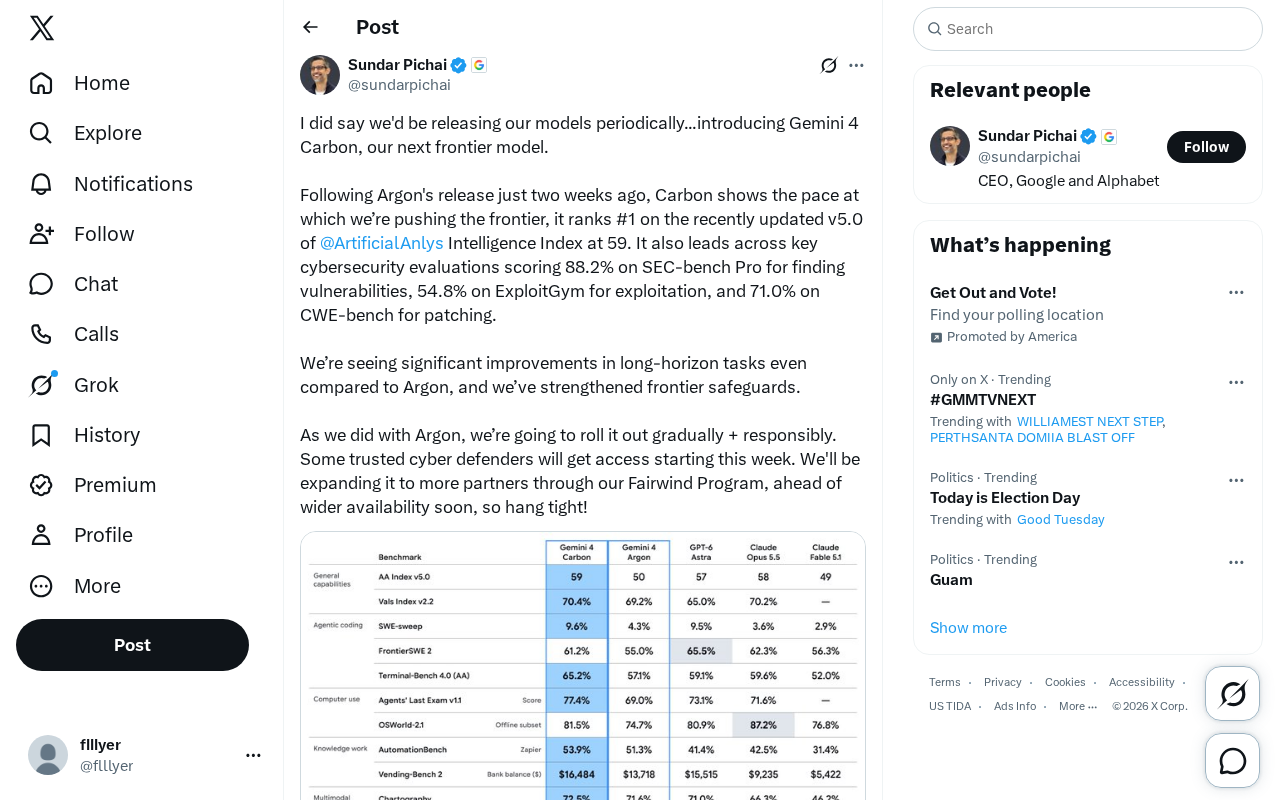
Top Performance: No. 1 on the v5.0 Intelligence Index
Carbon's most direct achievement is taking first place on the v5.0 Intelligence Index recently updated by Artificial Analysis, with a score of 59. This index is an important industry reference for measuring a model's overall intelligence, and topping it means Carbon has reached the current pinnacle in general capabilities such as reasoning, knowledge, and coding. The company specifically noted that even compared with Argon from just two weeks earlier, Carbon shows significant improvement on long-horizon tasks. Long-horizon tasks test a model's stability and planning ability across multi-step, complex workflows, and improvements in these capabilities are crucial for real-world deployment.
Artificial Analysis Intelligence Index is a comprehensive model capability leaderboard maintained by the independent evaluation organization Artificial Analysis. It is not a single benchmark but aggregates results from multiple public evaluations — reasoning, knowledge Q&A, math, coding, and more — into a composite score on roughly a 100-point scale. Because different vendors often cite different individual benchmarks to create "first place" claims, aggregated indices like this provide a unified yardstick for cross-model comparison and have therefore become one of the more frequently cited references in the industry. The v5.0 version designation typically means the evaluation set or weighting methodology has undergone a major update, and scores should not be compared directly across versions.
Long-horizon tasks refer to complex tasks that require a model to continuously plan, invoke tools, remember intermediate states, and correct errors across dozens or even hundreds of steps — for example, refactoring code across files, or conducting multi-round research and writing a report. The key difference from single-turn Q&A is that errors accumulate: any deviation at one step can cause subsequent steps to go completely off track. This places greater demands on context management, self-checking, and task decomposition, and is a core metric for whether a model can truly function as an "agent."
Cybersecurity: Carbon's Differentiated Edge
If general intelligence is the foundation, cybersecurity is the spearhead capability Carbon is highlighting this time. The company published three key evaluation results:
- SEC-bench Pro: 88.2% on vulnerability discovery tasks
- ExploitGym: 54.8% on vulnerability exploitation tasks
- CWE-bench: 71.0% on vulnerability patching tasks
Behind these numbers is a demonstration of the model's capabilities on both offense and defense. A near-90% accuracy rate in vulnerability discovery means Carbon can efficiently assist security teams with code auditing and vulnerability hunting; an exploitation score above 50% suggests practical value in simulating attack paths and assessing risk. The 71% patching score points directly to the potential for automated remediation.
A New Tool for Security Defenders
Google has made clear that Carbon will be provided first to "trusted cyber defenders." Starting this week, selected security teams will receive access, followed by expansion to more partners through the Fairwind Program, and ultimately broader availability to general users. This phased release strategy, identical to Argon's, reflects Google's cautious approach to the safety risks of frontier models.
The three evaluations mentioned correspond to different stages of the vulnerability lifecycle. SEC-bench Pro is a vulnerability discovery benchmark that requires the model to locate potential flaws in a given codebase; a score near 90% indicates its static auditing capability is already practically useful. CWE-bench uses MITRE's CWE (Common Weakness Enumeration) classification framework to evaluate the model's ability to provide correct patches by defect type, and is a commonly used benchmark for measuring automated remediation. ExploitGym leans toward the offensive side, testing whether the model can construct usable exploit chains in a controlled environment; because such benchmarks involve dual-use capabilities, they typically come with stricter restrictions on access and output content.
It should be noted that scores on exploitation benchmarks are often misread as "the model can directly launch attacks." In reality, such benchmarks are mostly conducted in isolated sandboxes and synthetic ranges, and vendors typically impose refusal policies on related capabilities or restrict access to vetted security researchers only. The 54.8% score should therefore be understood as a quantitative reference for risk modeling and attack-path reasoning capability, not a directly weaponizable metric.
Fairwind Program is a controlled-access program Google established for frontier models, similar in nature to a "trusted tester" mechanism: organizations that pass qualification review can obtain model weights or API access before official public release, subject to terms of use. Such programs have three design goals: first, to observe the model's actual performance on sensitive capabilities in low-risk environments; second, to collect feedback from real workloads for subsequent tuning; and third, to establish a traceable abuse-monitoring channel. For security teams, the benefit of participating is early access to new capabilities months ahead of time, allowing them to adjust detection rules and defensive tools accordingly; the cost is acceptance of stricter usage auditing. This kind of trust-circles release model has become standard practice for several frontier labs in sensitive areas such as cybersecurity and biology.
Phased Release: Balancing Responsibility and Pace
"We will roll it out gradually and responsibly, just as we did with Argon." This line from the official statement clarifies Carbon's release logic. With model capabilities — especially cybersecurity-related ones — significantly advancing, preventing misuse becomes the primary consideration. By restricting initial access, Google can observe model behavior in controlled environments, collect feedback, and simultaneously reduce the risk of malicious use.
The Fairwind Program, as a partner expansion channel, may have already played a role in Argon's release. This "trust circles" diffusion approach ensures safety while paving the way for subsequent large-scale availability. For developers and enterprise users, it is important to closely monitor the Fairwind Program's application windows in order to gain access as early as possible.
Model Iteration Accelerates, AI Competition Enters a New Phase
Carbon's release comes just two weeks after Argon — an astonishingly short interval. The company stated bluntly: "Carbon demonstrates the speed at which we advance the frontier." Behind this is a shift in AI model development paradigms — from iterations measured in years and quarters to weeks. This pace puts enormous pressure on competitors and forces the entire industry to rethink the cadence of model releases, safety evaluations, and ecosystem building.
For users, faster iteration means earlier access to stronger capabilities, but it also brings choice overload and migration costs. For the security community, Carbon's arrival is both a powerful tool and a warning: when attackers may also leverage similar capabilities, defenders must run faster.
Looking Ahead: What Comes After Carbon?
Google has not revealed the name of its next model, but the promise of "regular releases" sends a clear signal: Carbon is just one link in a series. As the Fairwind Program progresses and broader availability arrives, Carbon's real-world performance will face market scrutiny. Whether its advantages in long-horizon tasks and cybersecurity can translate into actual productivity will be the focus worth watching next.
For developers and security practitioners, what they can do now is monitor the pace of access openings and think ahead about how to integrate Carbon's cybersecurity capabilities into existing workflows. After all, in an era of accelerating AI evolution, acting one step earlier means gaining one more advantage.
Related articles

AI Coding Enters the Team Collaboration Era: Interpreting Three Major Moves from Meta, GitHub, and Mistral
Meta acquires Conductor, GitHub Copilot Fusion becomes available, Mistral opens Large 4 weights—three moves show AI coding shifting from code generation to organizing development workflows. This article explains task orchestration, model collaboration, and cost control for developers.

Building a RAG Assistant with Dify: A Practical Guide to Knowledge Bases, Workflows, and Agent Nodes
How should knowledge bases, workflows, and Agent nodes connect in a Dify RAG assistant? We break down the division of labor and wiring logic for a shippable app.
 Tech Frontiers
The AI Industry Doesn't Lack Marketing—It Lacks Good Products
AI faces market selloffs and public skepticism—is marketing really the problem? This analysis of market signals and product experience argues the core困境 is incomplete products and a gap between promises and experience; the only way to change perceptions is to ship better products.