Gemini 4 Hydrogen Agentic Coding Hands-On: Challenging GPT-5.4 at Half the Price
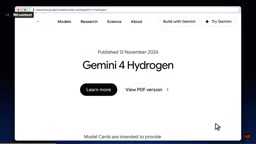
Gemini 4 Hydrogen halves output price and nears top benchmarks, but agentic tool tasks lag—hard tasks need hands-on validation.
Gemini 4 Hydrogen offers half of GPT-5.4's output price ($7.50 vs $15 per million tokens) and a blended rate about 47% lower, scoring 51 on the Artificial Analysis Intelligence Index, close to top models. It far outperforms Gemini 3.8 Flash on Terminal Bench 4.1 (57% vs 18.2%), but its agent and tools score is only 62, trailing Claude Sonnet 5.5's 63.9%. Google claims 2.5x speed, while third-party measurements show only about a 10% per-task time gap. In real tasks, Hydrogen proactively found a hidden currency conversion bug and scored 87.8% on VibeCodeBench, but per-task cost is about $3.16 at the ultra-high setting, and a full indexing run can consume enormous tokens. Collaborating with Carbon cuts quota usage by 24% and boosts speed by 19%, but solo benefits need independent verification.
Google's newly launched Gemini 4 Hydrogen nearly matches GPT-5.4 on independent leaderboards at half the output price. How does this model perform on agentic coding tasks? Based on multi-source hands-on data, this article breaks down its cost-effectiveness and the boundaries of its agentic capabilities.
Price advantage: output cost halved, blended rate significantly lower
Gemini 4 Hydrogen's pricing strategy is its biggest selling point. It charges $7.50 per million output tokens, compared to $15 for OpenAI's GPT-5.4; for input tokens, Hydrogen is $1.50 versus $2.50 for GPT-5.4, a 40% input discount. At a 3:1 input-to-output blend, the blended rate comes to about $3 per million tokens, versus roughly $5.63 for GPT-5.4. That means if two agents use the same number and ratio of tokens, a $100 token bill would cost only about $53 on Hydrogen.
Google applies the same rate to Hydrogen's million-token context window, which can hold roughly the text of nine novels. Note, however, that input, thinking process, and output share this space, so if you load an enormous codebase, you must leave enough working room for the model.
Benchmarks: broadly near the top, but agentic tool use is the weak spot
On the Artificial Analysis Intelligence Index, Hydrogen scores 51 at the default high setting, close to Gemini 4 Argon's 50; at the ultra-high setting it reaches 54. Google reports that Hydrogen far outperforms Gemini 3.8 Flash on Terminal Bench 4.1 with a 57% pass rate versus 18.2%—roughly one-third of Hydrogen's score.
However, on the same leaderboard, Hydrogen's weakness is precisely the agent and tools category, where it scores 62, below reasoning (70) and coding (69). This suggests it may be good at writing patches but struggles with multi-step workflows built around those patches.
According to Google's model card, Claude Sonnet 5.5 scores 63.9% on the same TerminalBench 4.1 test, leading Hydrogen by 6.9 percentage points. Sonnet also leads on the OS World desktop-application task test, while Hydrogen wins on the SWE sweep row at 13.5% versus 3.1%. Which model to choose depends on which type of task your work more closely resembles.
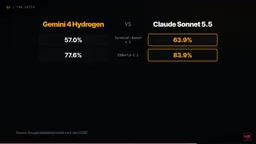
Terminal Bench is a benchmark for evaluating large language models' ability to execute command-line tasks in real terminal environments. It simulates developers' daily operations—file navigation, process management, software installation and debugging—and requires models to correctly execute commands and achieve goals in multi-step, stateful environments. The benchmark emphasizes agentic capability, i.e., whether a model can adjust its strategy based on dynamic feedback rather than merely generating single-step code. Terminal Bench 4.1 is a newer version, and its pass rate reflects a model's reliability in completing terminal tasks independently. For agentic coding scenarios, this score is an important reference for whether a model can autonomously operate, debug, and deploy, but note that it focuses on command-line interaction and does not fully cover in-IDE coding or complex toolchain collaboration.
OS World is a benchmark for evaluating AI agents performing cross-application tasks in desktop operating system environments. It requires models to complete compound operations such as file organization, email sending, and spreadsheet editing through graphical interfaces or system APIs, testing their understanding and planning of multi-window, multi-application workflows. Unlike Terminal Bench's command-line focus, OS World is closer to ordinary users' desktop automation scenarios and reflects a model's agentic level in real office environments. Sonnet's lead over Hydrogen on this test suggests it may have an advantage in cross-application task orchestration. For agent projects requiring desktop automation, OS World scores are a more valuable reference than pure coding benchmarks, though differences between test and production environments should be noted.
Speed and thinking cost: official claims vs. third-party measurements
Google claims Hydrogen completes tasks 2.5 times faster than Gemini 3.8 Flash at the default high setting. But model-routing provider Orca Router, comparing based on Artificial Analysis data, shows a per-task time gap of about 10%. The two sources measure different workloads; if you plan your budget around "twice as fast," the external comparison data suggests you should first test and verify it yourself.
Raising the thinking level brings significant time costs. At the high setting, Artificial Analysis measures an output speed of 168 tokens per second, with a 17.6-second wait before the first answer token appears; at the ultra-high setting, streaming speed rises to 174 tokens per second, but the first answer takes 43.3 seconds to arrive. Once text starts flowing it is indeed faster, but you wait more than twice as long for it.

Real-world task performance: finds hidden bugs, but costs need careful management
One hands-on reviewer gave Hydrogen a broad goal, and the model on its own found a currency conversion bug involving Japanese yen and Korean won, with a deviation of 100x. The reviewer did not directly point to the conversion logic; Hydrogen proactively located the problem under a broad goal. This ability to catch hidden issues before code goes live is more valuable than code generation speed. Google's demo also showed one-shot generation of an explorable 3D island and an e-commerce site with WebGL shaders, which users can directly interact with to judge whether a prototype is worth iterating on.
On VibeCodeBench, Hydrogen scores 87.8% at the ultra-high setting, ranking 13th among 128 models. If your task list includes interactive prototypes, this result deserves serious attention; but if it involves modifying legacy code and tracing failures within a test suite, dedicated verification is needed.
On cost, Artificial Analysis reports that a full indexing run on Hydrogen at the ultra-high setting consumes 304 million output tokens, which at published rates costs $2,280 for those tokens alone—near the most verbose end of the 79 models tracked. However, average per-task cost is about $1.87 at the high setting and about $3.16 at the ultra-high setting. It is advisable to start at the high setting and upgrade to ultra-high only for tasks where you can clearly see the benefit.
VibeCodeBench is a benchmark focused on "vibe coding" capability, evaluating a model's ability to generate interactive prototypes, small applications, or visualization pages from natural language descriptions. It emphasizes quickly turning ideas into runnable, experienceable code rather than strictly following engineering conventions. Test tasks typically include generating interactive web pages, simple games, or data visualizations, with scoring covering both functional completeness and user experience. Hydrogen's 87.8% score at the ultra-high setting, ranking 13th out of 128 models, indicates strong competitiveness on prototype-generation tasks. But this benchmark does not cover hardcore engineering tasks such as modifying large codebases or debugging test suites, so a high score does not directly equate to comprehensive agentic coding ability.
Multi-model collaboration and security considerations
Google's Anti-Gravity orchestrator demonstrates collaboration potential: Carbon handles planning, Hydrogen handles code editing and running tests, and when more planning is needed, control can be handed back to Carbon. According to the Anti-Gravity team, this setup approaches Carbon's success rate while reducing quota usage by 24% and improving runtime speed by 19%. A quota that originally covered 100 tasks can now cover roughly 132 similar tasks. But this result is the product of two models collaborating, so the savings from using Hydrogen alone still need to be measured independently.
On security, Google reports that over-intervention in its internal evaluations dropped by up to 81%, but the model card also shows that compared with Gemini 3.8 Flash, the unreasonable refusal rate rose by 5.57 percentage points, especially on prompts combining different types of input. The full safety report was still pending at the time of the model's release.
Model Card is a standardized document provided by a model's publisher to disclose the model's intended use, performance benchmarks, limitations, ethical considerations, and safety evaluation results. It is akin to a product manual, helping developers judge whether a model suits a particular scenario. The Google model card cited in this article includes test scores such as Terminal Bench 4.1 and OS World, as well as safety metrics such as over-intervention and unreasonable refusal rates. Data in model cards is typically evaluated by the publisher itself and may differ from independent third-party testing, so cross-verification with external benchmarks is recommended. For enterprise model selection, the model card is an important starting point for understanding a model's capability boundaries and risks, but it should not be the sole basis for decisions.
Conclusion: the value is real, but hard tasks still need verification
Hydrogen's output price advantage is real, and its benchmarks are broadly close to top models, but it trails Claude Sonnet 5.5 on agentic and tool-use tasks. It is advisable to start with reproducible bug investigation, trial-ready prototypes, and editing tasks with tests: give both agents the same task list and compare number of attempts, test pass rates, and the proportion requiring manual fixes. The output price gives Hydrogen a head start, but the quality of the tasks ultimately completed determines how much of that advantage you keep.
This article synthesizes Google's model card, Artificial Analysis data, Orca Router comparisons, Mind Studio evaluations, and information from the Google Anti-Gravity team, cross-verifying key conclusions across multiple sources.
Related articles

Watching Movies in the Terminal: Building an SSH Streaming Service with Codex Multi-Agent Workflow
A creator uses Codex multi-agent workflow to build an SSH-accessible streaming service in the terminal, with planning, cloud async dev, AI-drawn scenes, and synced live channels.

AI Face Licensing: A New Micro-Drama Trend or a Hollywood Trap?
Actors are licensing their faces to micro-drama startups for AI digital doubles to perform. Popular in China, the model raises concerns in Hollywood over lost control and diluted bargaining power.
Amazon's First Digital Photo Frame Is 50% Off for Black Friday: Is the Alexa Frame Worth Buying?
Amazon's first digital photo frame, the Alexa Photo Frame, is nearly 50% off for Black Friday, with prices starting at $114. We analyze why this new product dropped in price just one month after launch, its positioning, who it's for, and buying advice.