Gemini 4 Hydrogen vs Carbon Hands-On: Can the Lightweight Model Beat the Flagship?

Google launched Hydrogen and Carbon Gemini 4 models; tests show the lightweight one is enough for daily use, while the flagship is stronger but six times slower.
The article reviews two Gemini 4 models Google released on back-to-back days: the free-for-college-students lightweight Hydrogen, and the flagship reasoning model Carbon, which requires a $99/month Ultra membership. Through four head-to-head tests—a micro-horror short film, a Keynote webpage, a retro game, and SimpleBench trap questions—the author found Carbon is stronger in detail, aesthetics, and storyboarding, but can take six to seven times as long as Hydrogen; Hydrogen isn't far behind on PPTs, games, and reasoning problems, and it responds faster with friendlier interaction. The final recommendation: regular users should use Hydrogen, and those wanting to try Carbon should go to AI Studio and pay per use rather than rushing to Ultra.
Google released two Gemini 4 models on back-to-back days—the lightweight Hydrogen and the flagship reasoning model Carbon. One is open to college students, the other requires a $99/month Ultra membership to unlock. A Bilibili creator ran a head-to-head comparison using a micro-horror short film, a Keynote webpage, and the SimpleBench question bank, and the conclusion is somewhat counterintuitive: the lightweight model is good enough for daily use, while the flagship is powerful but painfully slow.
The Price and Positioning of the Two Models
Hydrogen is the official successor to 3.8 Flash, claiming to be two and a half times faster, and it's free as long as you pass college student verification. The creator's testing found it's actually slightly slower than 3.8 Flash, but still within acceptable range.
Carbon is Google's current top-of-the-line reasoning model—even the $20/month Pro membership can't use it. You need the $99/month Google AI Ultra top-tier subscription to unlock it. Regular users who want to try it can go to AI Studio and pay per use, so you don't have to commit to Ultra directly.
On benchmarks, a third-party authority gave Carbon a score of 59-60, putting it directly into the global top three on the LLM intelligence rankings, trading wins with Claude's latest flagship. Even more striking is the lightweight Hydrogen: with an extended chain of thought, it scored 94, beating out the previous generation's main flagship Argon.
Google AI Ultra is Google's highest-tier subscription launched in 2025, priced at $99/month, positioned between the regular Pro membership and enterprise plans. It bundles access to the strongest reasoning model in the Gemini series, higher AI Studio quotas, more cloud storage, and priority access to some Google Labs features. Compared to the $20/month Pro tier, Ultra's core selling point is "unlocking the ceiling model" rather than increasing daily usage. The article mentions Carbon requires Ultra—this is exactly the strategy in action: Google is trying to steer heavy users toward the higher price point using its flagship model.
AI Studio pay-per-use offers another path. Google AI Studio is a web-based and API experimentation platform for developers, where users are billed by token consumption rather than a monthly package. For regular users who just want to briefly try Carbon, pay-per-use avoids directly bearing the $99 sunk cost, but you need to control your call frequency yourself—otherwise the long chain of thought of a high-reasoning model will quickly drive up your bill.
SimpleBench is a third-party reasoning evaluation set, with questions mostly being common-sense and logic puzzles that require avoiding intuitive traps—classic examples like "farmer takes wolf across the river" or "put ice cubes in a boiling pot," scenarios that seem simple but hide changing conditions. It doesn't test breadth of knowledge but whether the model can identify implicit assumptions in the problem, so it's often used to test a model's "true reasoning" rather than "memorized answers." The article uses it for trap-testing precisely because of its anti-routine nature.
Micro-Horror Short Film: The 8-Minute vs 53-Minute Gap
The creator's first test was having the models generate a 30-second Chinese-style horror short film, requiring a twist, soundtrack, Chinese narration, and all materials sourced on their own.
Hydrogen completed the entire process in about 8 minutes. The visuals had noise/grain processing, the horror atmosphere was on point, and the story logic was complete—the paper effigies wouldn't move without eyes painted on them, the protagonist raised a candle and found three paper effigies in the corner, just as they breathed a sigh of relief they remembered only two were made at the shop today. The twist worked, and the soundtrack was fine too. The only complaint was that the narration was generated online and sounded a bit awkward—switching to another voiceover made it much more comfortable.

For Carbon, the creator waited 53 minutes to get the final product—during which the computer automatically played debugging audio out loud, giving them a scare while brushing teeth at midnight. The final product's details were indeed finer: in the sound-activated light short film, still frames were cut in, preserving the phone's black edges, white edges, and even fingerprints on the screen, with timestamps showing 00:44, and the writing and emotional progression were stronger.
But the complaints were equally obvious: no fullscreen option, no noise texture, and the interface interaction wasn't as appealing as the lightweight model. The creator said outright that "53 minutes is a bit hard to bear"—spending seven or eight times the time for this small improvement raises questions about cost-effectiveness.
Chain-of-Thought refers to the model expanding a series of intermediate reasoning steps before giving a final answer. For reasoning models, a longer chain of thought usually means more self-checking and branch exploration, raising accuracy, but generation time and token consumption increase accordingly. The article says Hydrogen "scored 94 after extending its chain of thought," meaning that in the evaluation, the lightweight model was allowed longer internal reasoning, thereby overtaking the previous generation flagship Argon on the intelligence rankings. This also explains why Carbon takes 53 minutes on the short film task: the flagship reasoning model defaults to a deep-thinking path, with each generation step accompanied by extensive intermediate deliberation, naturally making the time cost far higher than the lightweight model.
Third-party intelligence rankings (like the 59-60 score ranking mentioned in the article) are typically scored by independent organizations using a unified question bank in blind tests across various models. Scores reflect comprehensive reasoning ability but don't directly correspond to generation speed or interactive experience. Carbon entering the top three shows its reasoning ceiling is indeed high, but that's a different dimension from "is it good for daily work"—the creator's core conclusion is built precisely on this distinction.
Keynote Webpage: A 50-50 Office Scenario
The second test was making a monthly report PPT for the boss. The input was a rather bare-bones run-down: this month we made videos, gained 300 followers, and one video broke 20,000 views—wanted to add budget to buy a microphone.
Both models took similar time to generate—Hydrogen about 5-6 minutes, Carbon about 7 minutes. In terms of content, Hydrogen packaged the run-down as "a lone soldier's breakthrough under extreme resource constraints," writing jargon like "deliberately deferring short-term monetization" and "validating the organic traffic viral closed loop at extremely low cost," plus a traffic leverage chart, and even subtly mocking the absent editor and the microphone's sample rate dragging down completion rates.

Carbon's version was more "product launch" style: "five hundred yuan total investment validates a high-purity organic growth closed loop," "lone soldier redundancy and same-day ROI breakdown," "one yuan sixty per real follower breaking through the industry floor"—higher jargon density, which the boss probably also wouldn't understand. The last page requested a 300-yuan acoustic infrastructure budget, and Carbon's version even came with a "directly approve" button—full ceremony.
The creator's assessment: Carbon has a more premium feel, but the gap between the two isn't as big as the time gap.
Game and SimpleBench: The Gap Narrows Further
The third test was a retro neon street quiz game, with questions written by the creator. The covers the two models produced were almost identical—Carbon's version had slightly better airplane texture and an extra layer of overlay and text details on the pause screen, but overall both were "very crude," with limited difference.
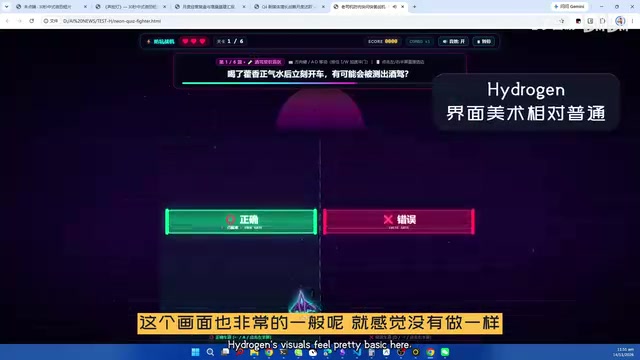
Finally, a SimpleBench-style trap test—how many trips does the farmer need to take the wolf across the river, how many ice cubes remain in an open pot. Both models avoided the traps and answered correctly, with the lightweight model responding faster. The creator's judgment: for these classic reasoning problems, whatever Hydrogen can answer correctly, Carbon generally can too.
How to Choose: Time Cost Is the Watershed
Carbon is indeed more stable and more aggressive in lighting aesthetics, storyboard handling, and detail consistency—the improvement from deep thinking is visible. But the cost is that each task may take six to seven times as long as Hydrogen, making daily work feel like using a sledgehammer to crack a nut.
For college students and regular users, Hydrogen is already strong enough: free, fast, and capable of completing comprehensive tasks like short films, PPTs, and games. Carbon is better suited for scenarios with extreme detail requirements where you're willing to wait tens of minutes for a small improvement. The creator's advice is straightforward: go to AI Studio and pay per use if you want to try it—don't rush to the $99 membership just to test the flagship model.
While researching, they also came across a statistical report on the real AI chat behavior of hundreds of millions of people, finding that those who chat about geeky topics and write code with AI every day are actually just a small fraction—the mainstream usage in the real world is completely different from what you'd imagine. They plan to discuss this separately in the next episode.
One-line Summary
Google released two Gemini 4 models, Hydrogen and Carbon; testing shows the lightweight one is good enough for daily use, while the flagship is stronger but six times slower.
Paragraph Summary
The article reviews two Gemini 4 models Google released on back-to-back days: the free-for-college-students lightweight Hydrogen, and the flagship reasoning model Carbon, which requires a $99/month Ultra membership to unlock. Through four head-to-head tests—a micro-horror short film, a Keynote webpage, a retro game, and SimpleBench trap questions—the author found Carbon is stronger in detail, aesthetics, and storyboarding, but can take six to seven times as long as Hydrogen; Hydrogen isn't far behind on PPTs, games, and reasoning problems, and it responds faster with friendlier interaction. The final recommendation: regular users should use Hydrogen, and those wanting to try Carbon should go to AI Studio and pay per use rather than rushing to Ultra.
Related articles

Claude Launches Collaborative Sheets and Whiteboards, Taking On Microsoft and Google Directly
Anthropic rolls out beta Claude Sheets and Whiteboards to paid users, enabling one-prompt spreadsheets with formulas and turning verbal plans into collaborative boards—taking on Microsoft and Google directly.

Generate a Spreadsheet with One Sentence? A Deep Dive into Claude Sheets and Pitfall Guide
Claude Sheets beta review: generate collaborative spreadsheets with formulas and dropdowns from one sentence, but the 100,000-cell cap and plan usage limits may bottleneck you sooner than expected. Includes three business scenarios, compliance limits, and a five-step pitfall checklist.

AI Agent Orchestration Framework Tier List: Who's Overrated, Who's Legendary
A blunt tier-list evaluation of AI Agent orchestration frameworks: why CrewAI and LangGraph are legendary, OpenAI Agents SDK and Agno are only good, LlamaIndex and Cloudflare Agents are overrated, and why TypeScript developers should choose Mastra.