Gemini 4 Krypton vs Fable 5.2: The Model Race Heats Up

Gemini 4 Krypton testing, Claude Code collaboration upgrades, and GLM-5.5 rumors point to decoupling of capability and price.
The article reviews recent AI model and tool developments: Google's Gemini 4 Krypton checkpoint is being tested under an alias in Arena and the API, with visual coding close to Anthropic's Fable 5.2 at an expected lower price; Claude Code adds parallel thread management like Project Coordinator, by the way, and slash fork, moving AI coding tools toward multi-thread task scheduling; the GLM-5.5 leak claims to surpass Opus 5.5 but is questionable. It cites Anthropic data showing Opus 5.5 solves 84.6% of 52 coding tasks versus Fable 5.2's 82.7%, while the latter costs 2.8x more per task. It also covers the GPT-6.2 Astra preview, DeepSeek API expansion, Gemini with Google Wallet, Antigravity dynamic workflows, and math formalization breakthroughs.
The pace of iteration in the AI model race has become almost breathless. Google's Gemini 4 Krypton is being quietly tested in Arena and the API, and is said to go head-to-head with Anthropic's Fable 5.2 at a lower cost; Claude Code has received a major project-collaboration update; and rumors of a GLM-5.5 leak have given rise to the idea of a "budget Opus." Here is a rundown and analysis of this dense round of developments.
Gemini 4 Krypton: Google Picks Up Speed and Catches Up
According to tracking by a tech UP host on Bilibili, a new Gemini 4 Krypton checkpoint was found being tested in Arena under the name "Gemini 4 Hydrogen," and also appeared in the API. This checkpoint shows another clear improvement over the earlier Krypton A version, which had already surpassed Gemini 4 Carbon on most tasks.
From the demo cases, Krypton represents a "substantive leap" over Argon in animated motion generation, while against Fable 5.2 it is a mixed bag—the UP host believes Krypton is slightly better in some scenarios, but this depends on the specific prompts and preferences. More noteworthy is that Google seems to be specifically fixing long-criticized weaknesses: laziness, hallucinations, and incomplete instruction following. The UP host explicitly states that "UI is still an obvious problem," but the direction of improvement on minor issues is right.

In terms of specific capability demonstrations, Krypton used pure JS to generate a Ursa Major-inspired 3D rocket engine simulation within a single HTML file, including heat-flow visualization and no external resource dependencies; it also completed a page-flip animation, a GTA Vice City-style SVG, and precise SVG drawings of PS4 and GameCube controllers. These cases together point to one judgment: Krypton is already close to Fable level in visual coding and detail adherence, while its price may be significantly lower.
Arena (LMArena) is a public anonymous battle-evaluation platform for large models: users see two models' answers simultaneously without knowing their sources, vote for the better one, and the system calculates Elo-style rankings accordingly. Because test models can be quietly deployed under aliases (such as "Gemini 4 Hydrogen" in this article), vendors often use it to collect real user preference data before a new model's official release, so an unfamiliar codename appearing on Arena is often seen as a signal that a new model is near release.
checkpoint refers to a snapshot of model weights saved periodically during training. The same generation of a model produces multiple checkpoints at different training stages, and capability differences can be large—Krypton A and the newer checkpoint in this article are different snapshots of the same generation, and comparing them shows that training is still progressing.
Claude Code: From Writing Code to Managing Projects
Anthropic's update to Claude Code focuses not on the model but on the way of collaboration. The desktop app adds custom themes, letting users directly describe the interface style they want with reference images, and Claude generates the theme; the official team also provides sample plugins to lower the barrier to entry.
The more substantive upgrade is in Projects. Project Coordinator can now coordinate tasks across multiple parallel threads, answer questions directly in project group chats, and continuously sync progress across threads. Two new commands are especially useful: by the way opens a separate thread for questions without interrupting the current workflow, and slash fork forks from an existing thread to try different approaches without losing the original progress. There are also thread reminders, read-only thread sharing, and a redesigned Threads panel. Projects is currently in public beta for Claude Pro and Max users, and others can join the waitlist.
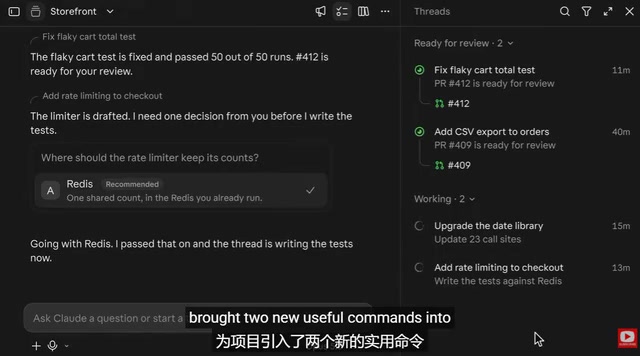
The significance of this combination is that AI coding tools are moving from "single-turn generation" to "multi-thread task management," and developers' way of orchestrating Agents is beginning to resemble managing a small team.
Thread forking borrows from Git's branching idea: copying an independent context from an ongoing session so the Agent can try alternatives in the copy without affecting the original thread. This lets developers compare multiple implementation paths in parallel, discarding failed branches directly without rolling back or restating requirements. Read-only thread sharing allows others to view the Agent's work process but not modify it, suitable for review and handoff. Such mechanisms essentially move the version-control collaboration model to the Agent session layer.
Model Selection: Strongest Does Not Mean Most Suitable
Anthropic's official selection advice deserves separate mention. According to it, Opus 5.5 at medium reasoning effort is suitable as a daily workhorse, covering coding and routine development tasks; for difficult tasks, one should first increase reasoning effort before considering switching to a more expensive model. Fable 5.2's applicable scenarios are large codebase migrations, complex architectures, deep research, and long-running autonomous workflows.
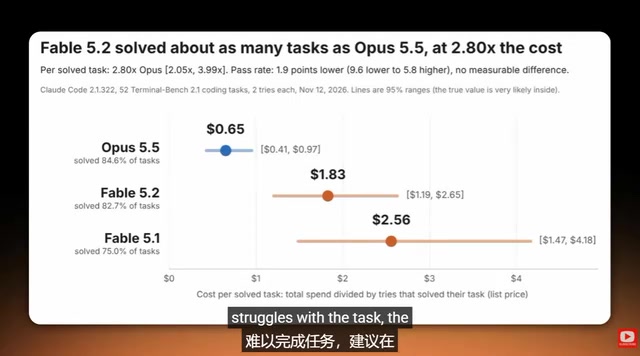
The data support is direct: in a comparison of 52 coding tasks in Claude Code, Opus 5.5 had an 84.6% solve rate versus 82.7% for Fable 5.2, while Fable's cost per solved task is 2.8 times that of the former. All four models support a 1 million token context window, so choosing a cheaper model does not sacrifice context length. For developers, "tiering models by task difficulty" is more cost-effective than "mindlessly going for the strongest."
Other Notable Developments
GPT-6.2 Astra preview leaked: Outputs released by early access users are described as "crazy" in creativity, visual quality, and detail, with stable performance on web development tasks and especially outstanding results on UI generation tasks.
GLM-5.5 leak: Internal conversations and benchmark charts from the ZAI team leaked, claiming it will surpass Opus 5.5. The UP host also cautions that such rumors from China may be fabricated and should be treated with caution. If true, it would mean the emergence of a cheap Opus-level model.
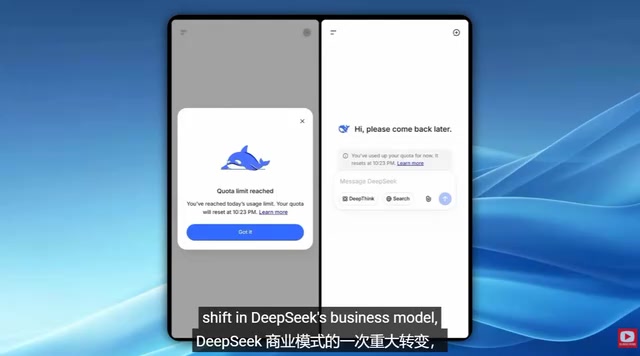
DeepSeekAd developer API expansion: Adds built-in web search, file processing, link parsing, security, and voice capabilities, and provides standalone APIs for OCR, speech recognition, and TTS. Quota-limit prompts appearing in the official website's code suggest that a paid subscription may be imminent.
Gemini integrates with Google Wallet: US users can connect their wallet to Gemini, allowing the Agent to make purchases without exposing card numbers, with security verification required for each transaction. ChatGPT also previously launched a similar wallet feature, and the Agent payment track is taking shape.
Google Antigravity dynamic workflows: The slash run-workflow command lets the Agent automatically generate Python scripts to coordinate multiple sub-agents executing in parallel; scripts can be reviewed, saved, and reused, replacing pure prompt-driven control with deterministic control.
Mathematical breakthroughs: Google says it used Gemini 4 series models to complete the first machine-verified formalization of the century-old Burkoff conjecture, fix a gap in the proof of the 3D Bochner-Rees conjecture spanning more than 50 years, and solve the 20-year-old C1 regularity problem. Its Teamwork Leap system generated 1.8 million lines of machine-verified Lean code across 29,000 sub-agent calls.
SpaceX and AI: Starship was caught by the launch tower's mechanical arms for the first time, and Elon confirmed that Grok was used during development to assist with calculations and feature implementation.
Other signals from the model world: Traces of Muse Spark 1.4 appear in Meta's internal PR; the Qwen 4.0 Max preview appears to have received a stealth upgrade, with generation quality clearly improved over the previous generation; Anthropic CEO Dario Amodei confirmed in an interview that the company intends to go public, with the core motivation being access to more compute.
Lean is an interactive theorem prover and programming language; mathematical proofs written as code are mechanically checked line by line by the kernel, so "machine verification" means the conclusion does not rely on reviewers' trust. In recent years the mathematics community has pushed to formalize existing proofs to find hidden gaps; the fixing of a proof gap in a conjecture spanning more than 50 years mentioned in this article is one such case.
Sub-agent calls refer to the main Agent decomposing a task and dispatching it to multiple specialized Agents for parallel execution, then aggregating the results. This can cut long tasks into parallelizable, checkable small pieces, but the number of calls and token consumption grow multiplicatively; the 29,000 calls and 1.8 million lines of code mentioned in this article are an embodiment of this scale.
The Competitive Landscape Is Being Repriced
The common thread in this round of developments is the decoupling of price and capability. If Krypton provides capability close to Fable 5.2 at a lower price, Anthropic's pricing system will come under direct pressure; Anthropic's own data also proves that in daily tasks, more expensive models do not bring better results. For developers, the capability that truly needs to be built is no longer "chasing the latest model" but "tiering model selection by task and constraining Agents with workflows." At the tool level, project coordination, dynamic workflows, and thread forking all essentially serve the same thing: making multi-Agent collaboration controllable.
It should be noted that most of the above information comes from leaks, rumors, and single-source early testing; the final performance of Krypton and GLM-5.5 still needs to be verified by independent evaluations after their official releases.
One-line Summary
Gemini 4 Krypton testing, Claude Code collaboration upgrades, and GLM-5.5 rumors all point to a decoupling of capability and price.
Paragraph Summary
The article reviews a dense round of recent developments in the AI model and tool race: Google's new Gemini 4 Krypton checkpoint is being tested under an alias in Arena and the API, with visual coding capability close to Anthropic's Fable 5.2 and an expected lower price; Claude Code introduces parallel thread management capabilities such as Project Coordinator, by the way, and slash fork, moving AI coding tools from single-turn generation toward multi-thread task scheduling; the GLM-5.5 leak claims to surpass Opus 5.5 but its authenticity is questionable. The author cites Anthropic's official data to point out that among 52 coding tasks, Opus 5.5's 84.6% solve rate surpasses Fable 5.2's 82.7%, while the latter's per-task cost is 2.8 times higher. It also rounds up signals such as the GPT-6.2 Astra preview, DeepSeek API expansion, Gemini integration with Google Wallet, Antigravity dynamic workflows, and mathematical formalization breakthroughs.
Related articles

RePlan-VLA: Progress-Aware Replanning Breakthrough for Long-Horizon Robotic Manipulation
The RePlan-VLA framework converts VLA models' short-horizon capabilities into reliable long-horizon execution through progress-aware adaptive replanning, improving success rates by 21.9% and 10.4% on RoboCasa365 and CALVIN, and validating real-world deployment on a Franka Research 3 robot.

Geometric Bridge Flow Matching: A New Breakthrough in Blind Rigid Motion Correction
Geometric bridge flow matching enables blind rigid motion correction in head CBCT, achieving 37.1 dB PSNR and 0.27 mm RPE on simulated data in ~9.1 minutes, outperforming existing methods.

Google Releases Gemini 4 Hydrogen: 2.5x Faster Without Sacrificing Intelligence
Google releases the lightweight Gemini 4 Hydrogen: 2.5x faster task completion, AA Intelligence Index of 54 beating its flagship sibling, 7.3s single-step on Agent Arena faster than Claude and GPT rivals, four thinking levels with pay-as-you-need pricing, now available across AI Studio and more.