Gemini 4 Leads Model Upgrade Wave, Agent Delivery Becomes the New Battleground

Model division of labor advances alongside Agent delivery frameworks, protocols, and payment capabilities, with competition shifting to task delivery.
This week saw dense updates in AI engineering: Google launched Genius Carbon and Gemini 4 Hydrogen, clarifying an automatic handoff division between strong reasoning and everyday execution; Anthropic updated Fable and Misos 5.2, and Qwen previewed Qwen4-Max. At the execution level, Antigravity's Swarm and Dynamic Workflows push multi-agent parallel engineering tasks into an operable stage, while the boundary between managed and self-hosted becomes clearer. Protocols and payments are the most underestimated progress: POPI 1.0, ARUI 1.0, and ChatGPT Wallet enable Agents to operate business systems, render interfaces, and complete transactions. In security and evaluation, automated red teaming and the MKA multi-step task benchmark show the industry's focus shifting from single-turn Q&A to delivery quality. Open-source tools cover full-duplex voice, local voice editing, browser engines, and runtime governance.
Gemini 4 Leads Model Upgrade Wave, Agent Delivery Becomes the New Battleground
This week brings a dense wave of updates in AI engineering: Google launched two models at once—Genius Carbon and Gemini 4 Hydrogen—Anthropic updated Fable and Misos 5.2, and Qwen (Tongyi Qianwen) previewed Qwen4-Max. With model capability no longer the sole focus, how to get Agents to actually deliver tasks into users' hands has become a new competitive dimension.
Model Upgrades: Division of Labor Matters More Than Parameters
Google's move this time is worth breaking down. Genius Carbon is opened to paid developers and enterprises, targeting long-horizon tasks, complex programming, and scientific reasoning, with Ultra users receiving push notifications gradually. Launch pricing is $2 per million input tokens and $10 per million output tokens, adjusted to $4 and $20 respectively after the discount ends on November 30.
Meanwhile, the released Gemini 4 Hydrogen is positioned for everyday programming and agent execution, supporting a 1M-token unified context and offering four thinking levels. Free users access it via automatic model selection, while the paid API costs $1.5 per million input tokens and $7.5 per million output tokens.
What's truly interesting isn't how strong any single model is, but that Google has made the division of labor between the two explicit: Argon stays in the routine development slot, while Carbon is used for hard problems requiring repeated reasoning and verification. In the newly added Orchestrator option in Antigravity, Carbon first maps out dependencies and formulates a plan, Hydrogen takes over to modify code and run tests, and when it hits a roadblock, it hands back to Carbon to adjust the plan. The models hand off automatically within a unified task—this is the skeleton of Agent delivery.
Anthropic simultaneously updated Fable and Misos 5.2, built on the same underlying model. Fable strengthens cybersecurity and biosecurity protections, while Misos requires a dedicated application channel. In official coding evaluations, Fable scored 49.1% at the ultra-high reasoning level, up from 32.4% for the previous generation at the same level; in another high-reasoning-level test, it approached Opus's top-tier score at roughly half the cost per task. Standard API pricing is $8 per million input tokens and $40 per million output tokens.
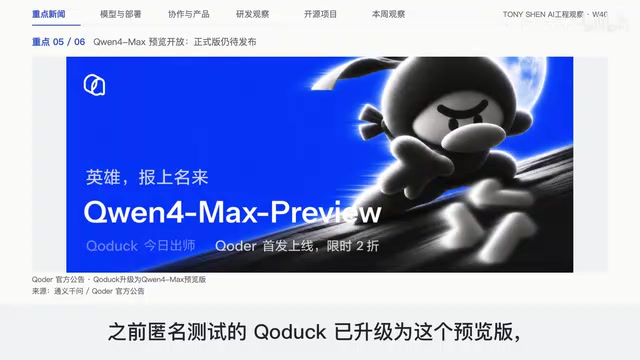
Domestically, the Qwen4-Max preview is now available for trial, with programming, agents, and professional software operation listed as key focus areas. Individual, team, and enterprise users can all choose it.
Unified Context refers to the maximum total number of tokens a model can continuously reference within a single session or task, including user input, model output, tool call results, and intermediate reasoning. A 1M-token unified context means the model can process large codebases, long documents, or agent trajectories spanning multiple interactions without losing early information. Its engineering value lies in reducing the information loss caused by context truncation and summarization, allowing the Agent to maintain awareness of global state across multi-step tasks; the cost is that memory usage and inference cost rise with context length, so vendors typically pair it with optimizations such as caching and segmented attention.
Collaboration and Execution: Swarm and Workflows Advance in Parallel
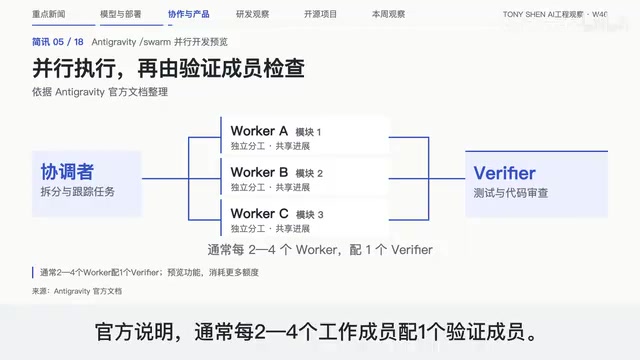
Beyond models, execution frameworks are being updated even more frequently. Antigravity's Swarm supports multiple agents working on engineering tasks in parallel: a coordinator splits the work, members make progress in independent working copies, and verifier members are responsible for testing and reviewing code. Official guidance typically pairs one verifier member for every 2-4 working members. This and Orchestrator's model handoff are two different functions: the former has multiple members starting work simultaneously, while the latter is model relay within the same task.
Antigravity also launched Dynamic Workflows, where the agent compiles tasks into Python scripts to organize multiple members to execute in parallel or by stage. The script is first submitted to the user for confirmation and can also be saved and re-run.
QnCode 1.0 Preview incorporates the execution orchestration capabilities from Coder into a Python open-source kernel, providing terminal tools and an SDK, where external input, tool results, and feedback all drive tasks forward through events. Cloud Code's Projects update enables parallel collaboration: the coordinator can answer questions in the project chat and proactively report progress on each thread, and users can open another branch or fork from the current thread to try alternatives.
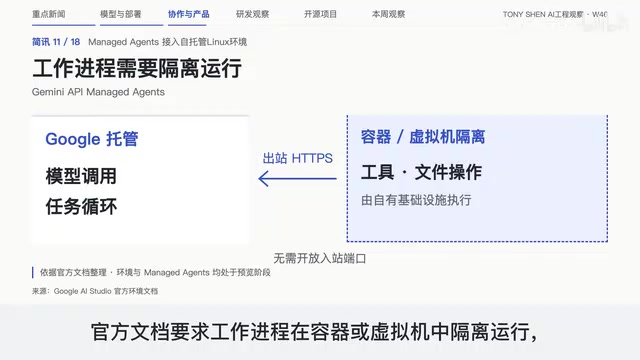
The boundary between managed and self-hosted is also becoming clearer. Gemini API's Managed Agents can connect to self-hosted Linux environments: model calls and task loops are managed by Google, while tools and file operations are executed by worker processes in your own infrastructure. The connection uses outbound HTTPS without opening inbound ports, and requires worker processes to run in containers or virtual machines.
Anthropic's self-hosted Cloud Managed Agents private beta, by contrast, places the runtime framework sandbox, credentials, and session history in your own cloud or on-premises data center, with model requests able to go to Anthropic, a cloud provider, or the enterprise's own model gateway.
MCP (Model Context Protocol) is an open protocol that lets models or agents connect to external tools and data sources in a standardized way—think of it as the "USB-C interface of the agent world": the server exposes tools, resources, and prompt templates, while the client (host application) discovers and invokes them. It solves the fragmentation problem where each framework previously defined its own tool schema, making reuse difficult. Business protocols such as POPI 1.0 layer business semantics and permission controls on top of MCP, enabling agents not only to call functions but also to execute real operations such as placing orders and queries according to enterprise rules. Understanding MCP is the prerequisite for understanding this week's progress at the protocol layer.
Protocols and Payments: Agents Begin to Touch Real Business
The most easily underestimated progress this week is at the protocol layer. Ciru released the personal agent protocol POPI 1.0, specifying how agents connect to enterprise websites, APIs, and business agents, combining existing standards such as MCP and OpenAPI to execute actionable operations through the OS. Shopify merchants already support it by default, and Meta's MUSE has also integrated it.
Google released ARUI 1.0, the first stable version of its generative UI protocol, where agents describe interfaces in JSON and applications render them as tables, forms, charts, etc. using pre-registered native components. The new version supports bidirectional function calls between the interface and the agent and incorporates accessibility requirements.
OpenAI launched ChatGPT Wallet, letting agents complete payments on users' behalf. Before each purchase, the user first confirms the item and total price, then approves with face or fingerprint. The agent receives a payment token. It is gradually rolling out to Pro users aged 18+ in the US.
These moves all point in the same direction: Agents are no longer just answering questions—they need to operate business systems, render interfaces, and complete transactions. The last mile of delivery is being paved by protocols and payment capabilities.
Payment Token is a mechanism where payment networks replace real card numbers with one-time or restricted credentials, so merchants and agents only see the token rather than the original payment information, reducing leakage risk. In agent-payment scenarios, tokens are typically also bound to amount limits, validity periods, and merchant scope, and paired with user biometric confirmation, forming a chain of "user authorization—token issuance—merchant charge." It enables agents to complete transactions without holding the user's full payment credentials, and is key infrastructure for agents to enter the real commercial loop.
Testing and Security: From Manual Red Teaming to Automation
OpenAI released two Daybreak security tools: Radar Team uses multiple agents to collaboratively test web applications and verify vulnerabilities and patch effectiveness; Defense Factory (preview) connects to GitHub repositories and can perform single scans, scheduled scans, or monitor new commits and propose fix patches, with patches still reviewed and tested by engineers.
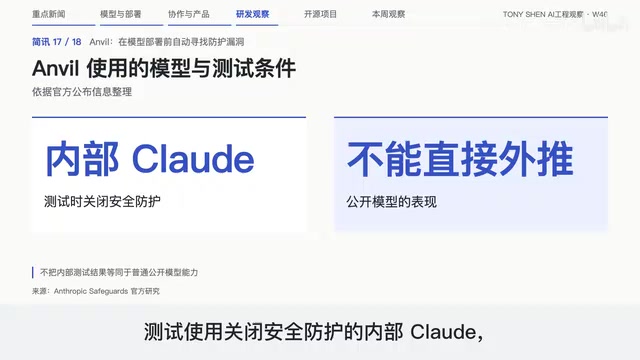
Anthropic's automated red-teaming system hunts for defense gaps before model deployment. The official report found more severe jailbreak schemes than humans in 23 of 24 biosecurity issue and classifier combinations. Note that testing used an internal Cloud with safety protections disabled, so it cannot be directly equated with the performance of the public model.
Google and Artificial Analysis launched MKA, using 200 tasks to assess agents' ability to read complex materials such as drawings and scanned documents and then complete spreadsheets and presentations. In the first batch of results, Fable 5.2 and Carbon ranked at the top. The metric is a completion score weighted by rubric items—the evaluation focus is shifting from single-turn Q&A to multi-step delivery.
Automated Red Teaming refers to using models or agent systems to systematically generate adversarial inputs to find security gaps in target models, replacing or supplementing manual penetration testing. Its advantages are high coverage, batch repeatability, and rapid iteration of attack strategies; its limitations are that when attacker and defender share the same origin they may share blind spots, and test environments (such as internal versions with protections disabled) differ from public deployments, so results should be extrapolated with caution. When evaluating red-teaming effectiveness, focus on attack success rate, newly discovered jailbreak categories, and the speed of the fix loop—not a single number.
Open-Source Tools: Real-Time Voice and Runtime Governance
SoFone Realtime is a full-duplex voice model offering 3 versions, sharing a 32B-parameter language component, under the Apache 2.0 license, focusing on listening while speaking, recognizing tone, and language processing when interrupted. Xiaohongshu's Dots TTS Edit 1.1 supports using text descriptions to locally modify the emotion, speed, pauses, and wording of existing speech while keeping other parts as unchanged as possible, with support for Chinese and English and multi-speaker editing.
Cloudflare open-sourced Kitesurf, an agent-oriented browser engine under the Apache 2.0 license, which parses web pages, executes scripts, and generates screenshots on Workers, is compatible with the Chrome DevTools Protocol, can connect to Puppeteer, requires a paid Workers plan for cloud deployment, and remains an experimental project. NVIDIA's OpenShell entered the CNCF Sandbox—an open-source runtime for agents that enforces policies when using tools, calling inference services, and executing tasks.
This Week's Observation: Measure Delivery with the Same Task
Putting this week's news together, a three-layer division of labor is gradually taking shape: strong models handle hard problems, decision interfaces choose the next step, and execution frameworks connect tools, environments, and feedback. The Gemini Decisions interface uses the Decision 1 model to handle judgments among limited options, directly scoring candidates and returning probabilities and confidence, with up to 1,000 questions per multimodal input at a time—such capabilities are exactly the glue of the middle layer.
When comparing products, rather than looking at leaderboard scores, it's better to use the same real task to record completion quality, total cost, and number of human takeovers, then check permissions and execution evidence. Being able to write a plan is only the starting point; whether the result can be delivered into your hands is the watershed.
Related articles

ECC: Making AI Coding Assistants Work Like an Engineering Team
ECC, an open-source repo with nearly 300K GitHub stars, adds engineering discipline to AI coding assistants: plan first, write tests, then implement, with independent review, 71 specialized assistants, 314 skills, and built-in security scanning. Compatible with Codex, Cursor, Gemini, and more.
Don't Just Use ChatGPT! These 5 AI Tools Are More Professional
Stop throwing every task at ChatGPT. This article covers Perplexity, Notebook LM, Gama, Claude, and Cursor — five specialized AI tools for research search, document comprehension, presentation creation, writing ideation, and AI programming, helping you pick the right tool for each scenario and boost daily efficiency.

Cursor IDE: Generate Code with Natural Language and Say Goodbye to Repetitive Boilerplate
Cursor IDE lets you describe components like login forms or dashboards in natural language, instantly generating code that integrates into your existing project. We break down its workflow, integration capabilities, and limits.