Gemini 4 Neon Benchmarks Fully Explained: Head-to-Head with Opus and ChatGPT 6.2
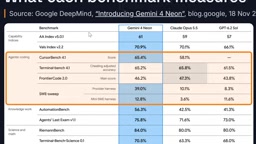
Gemini 4 Neon slightly beats Opus on overall benchmarks, with a notable long-context edge; tiered selection by task is more practical.
The article breaks down Neon, a newly released member of Google DeepMind's Gemini 4 family, comparing it with Opus and ChatGPT 6.2. Neon leads on overall score but trails by about 0.5 on terminal-operation tasks, which falls within noise. The real gap is in the 256K to 1M long-context range (lead described as 15 to 30); cybersecurity benchmark leads 76 to 68. Artificial Analysis data shows Neon beats Opus on intelligence (61 vs. 59), response speed, and per-task cost. Gemini 4's three models are tiered: Carbon for the most complex long-horizon tasks, Neon as daily workhorse, Hydrogen for fast responses. Selection advice: route by task type, not benchmark ranking.
Google DeepMind has released new models again. This time, the Gemini 4 family member making its debut is called Neon, joined by Carbon and Hydrogen. A YouTube creator broke down the official benchmark tables item by item and compared them side-by-side with Opus and ChatGPT 6.2. This article lays out the key information, the easily overlooked details, and the question of "does winning on benchmarks mean it's actually good to use" — all in one place.
Where Neon Stands on the Benchmark Tables: Overall Lead, but a Thin One
Start with the composite score. The author notes that this total isn't just coding or just professional work — it's the aggregated average across all task categories. Neon beats Opus and ChatGPT 6.2 on this overall table.
But the margin of "beating" needs to be viewed calmly. On terminal-operation tasks, Neon actually trails Opus, with a gap of just 0.5; in another comparison the gap is 0.8. The author's words: "less than one percent." In other words, this isn't a generational crushing — it's a slight positional difference on the same level.
A gap of this magnitude would likely be drowned out in real workflows by factors like prompt quality, context organization, and toolchain configuration. Benchmark tables can tell you "who has a slightly higher average score," but they can't tell you "who is more convenient in your project."
Item-by-Item Breakdown: Where Neon Genuinely Excels
Agentic Coding and Knowledge Work
In the agentic coding category, Neon performs better on most sub-items, trailing only on terminal bench — that is, tasks involving accessing codebases and executing commands through the terminal. This suggests a practical conclusion: if your work relies heavily on terminal interaction, Opus still has a slight edge.
On the knowledge work side, the author specifically mentions tests like agents last exam that gauge long-horizon task execution, where Neon performs well. Making slides and handling professional documents fall within its comfort zone.
Science, Math, and Reasoning
In science and math research directions, the author cites two numbers: one benchmark shows a lead of about 4%, another about 6%. On reasoning ability, Neon also outperforms Opus 5.5.
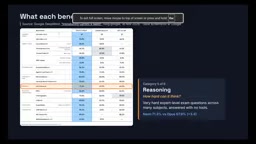
What really opens up the gap is long context. The author explains the logic: the longer the context, the harder it is for the model to make accurate judgments at the end, especially when the window is filled with irrelevant information. And in the 256K to 1M range, the gap between Neon and its competitors is described as "very large," with the author giving a range of 15 to 30. This is the most noteworthy qualitative judgment in the entire piece — the advantage in long-context handling is more practically meaningful than the slight lead in overall score.
The core difficulty of long-context benchmarks lies in "needle-in-a-haystack" retrieval and long-range reasoning. When the context window expands to 256K or even 1M tokens, the model must not only remember information from the beginning but also accurately recall and integrate evidence scattered throughout when generating responses. Common evaluation methods include embedding specific facts in long documents and requiring the model to retrieve them (needle-in-a-haystack), as well as requiring the model to summarize, compare, or perform causal inference across long texts spanning multiple sections. When the window is filled with irrelevant information, the attention mechanism tends to be diluted, and the model's recall accuracy at the end of the sequence drops significantly — which is exactly why different models diverge in the long-context range.
Cybersecurity
On the cybersecurity benchmark, the comparison target scores 68, while Neon scores 76. This is one of the more noticeable gaps among the sub-items.
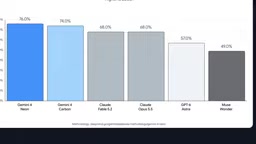
The Three Brothers' Positioning: How to Choose Between Carbon, Neon, and Hydrogen
Gemini 4 released three models at once, each with different positioning. The author's tiering is clear:
- Carbon: Geared toward long-horizon, most complex high-difficulty tasks, sitting at the top of capability.
- Neon: The middle-of-the-road daily workhorse, covering knowledge work, scientific computing, and scenarios requiring faster responses.
- Hydrogen: Pursuing speed, suited for lightweight tasks requiring quick responses.
Neon sitting in the middle means it's designed to be "most people's default option." This product strategy itself is worth noting: rather than having users always chase the strongest one, it offers choices routed by task complexity.
Tiering a model family by capability and cost (e.g., flagship, workhorse, lightweight tiers) is a common strategy in current LLM productization. The logic behind it: different tasks vary enormously in their sensitivity to reasoning depth, response latency, and per-call cost — high-difficulty long-horizon tasks are willing to pay a premium for stronger capability, while lightweight high-frequency tasks value speed and cheapness more. Tiering lets users route by task complexity, avoiding the cost waste of "sending every request to the strongest model," but it also requires teams to have the ability to reasonably classify and route tasks.
Cost and Speed: What the Artificial Analysis Data Says
The author cites Artificial Analysis's cost-task relationship chart. There are three conclusions:
- Intelligence level: Neon is 61, Opus is 59.
- Response time: Neon is faster than Opus.
- Per-task cost: Neon is lower than Opus.
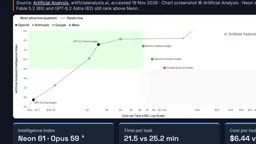
Winning on all three — this is Neon's most solid advantage over Opus. However, the author also points out that Astra is still cheaper than Neon on cost — indicating Neon isn't a price-bottom option; it's found a more balanced point in the "intelligence/cost/speed" triangle.
Artificial Analysis is an independent LLM evaluation aggregation platform. Rather than using vendor-reported benchmark scores, it conducts standardized tests on models from various vendors through a unified interface, comprehensively measuring intelligence level (typically based on weighted scores across a set of high-difficulty reasoning and knowledge tasks), output speed (tokens/second), first-token latency, and per-task cost. Its cost-intelligence relationship chart is often used to judge a model's position in the "performance/price" coordinate system, helping teams make selections under budget constraints. Note that this kind of aggregated data reflects average performance on general tasks; specific vertical scenarios may still deviate.
Selection Advice: Route by Task Type, Not by Benchmark Ranking
The author's scenario allocation is worth adopting directly:
- Choose Neon: Agentic coding, real code repository operations, office documents, scientific document processing, security-related tasks, and budget-constrained situations.
- Choose Opus: Scenarios where work is heavily terminal-driven, almost exclusively coding.
But the author immediately adds that in such scenarios, Opus's lead is "just one or two points," not exceeding two points. Combined with the 0.5 gap on terminal bench mentioned earlier, this judgment is self-consistent.
The final takeaway is a somewhat conservative but honest statement: the gap between the two is too thin to draw a firm conclusion, but based on current benchmarks, Gemini 4 Neon looks like a better alternative to Opus.
A Few Additional Judgments from Me
First, the value of this content isn't in restating numbers, but in reminding readers to see clearly that "leading by 0.5" and "leading by 15 to 30" are two victories of completely different natures. The former falls within the noise range; the latter is a signal you can use to adjust your technical choices.
Second, the clear advantage in the long-context range should carry far more weight than the overall composite score for teams doing document analysis, large codebase understanding, and multi-turn long-session applications.
Third, the practical impact of the three-model tiering strategy is: the selection decision shifts from "choose the strongest" to "choose the match." This lowers usage costs and raises the bar for task classification capability.
Fourth, all conclusions are based on vendor-published benchmark tables and third-party aggregated data. Real-world performance in actual projects still needs to be verified with your own task set.
Benchmarks are a ticket to entry, not a verdict.
One-line Summary
Gemini 4 Neon edges out Opus on overall benchmarks, has a significant long-context advantage, and tiered selection by task is more practical.
Paragraph Summary
The article breaks down Neon, a newly released member of Google DeepMind's Gemini 4 family, and compares it side-by-side with Opus and ChatGPT 6.2. Neon leads on overall score but trails by about 0.5 on terminal-operation tasks, which falls within the noise range. What really opens the gap is the 256K to 1M long-context range, where the lead is described as 15 to 30; on the cybersecurity benchmark it leads 76 to 68. Artificial Analysis data shows Neon outperforms Opus on all three: intelligence level (61 vs. 59), response speed, and per-task cost. The three Gemini 4 models are tiered: Carbon handles the most complex long-horizon tasks, Neon is the daily workhorse, and Hydrogen focuses on fast responses. Selection advice is to route by task type rather than by benchmark ranking.
Related articles
Gemini 4 Neon Builds a Minecraft Clone in One Shot: Magic and Faceplants
Gemini 4 Neon beats Claude Opus 5.5 on one-shot prompts, but cold-start tests expose broken water physics and weak bash reliability. We break down API pricing traps, the power of 8-agent Swarm, and when to use Neon vs GPT 6.2 Sol.

Gemini 4 Neon vs Claude Opus 5.5: When Benchmarks and Real Code Tell Opposite Stories
Gemini 4 Neon wins 16 of 19 benchmarks, but Opus beats it by 7 points on production code. How AntiGravity skews scores and how to pick a model by task.

Gemini 4 Neon vs Claude and GPT: Is the Throne Changing Hands?
Google's Gemini 4 Neon tops Claude Opus 5.5 and GPT 6.2 Sol across multiple tiers on Artificial Analysis, with clear edges in autonomous coding and long context—63% lower cost and six times faster first response. A breakdown of benchmarks, real deliverables, and safety metrics.