Gemini 4 Neon vs Claude and GPT: Is the Throne Changing Hands?
Gemini 4 Neon beats Claude and GPT on multiple benchmarks and cost, but it's not a total rout.
Gemini 4 Neon launched November 18, positioned mid-tier in the Gemini 4 family with a 1M-token multimodal context and 4 thinking levels. On the Artificial Analysis leaderboard, Neon leads Claude Opus 5.5 and GPT 6.2 Sol at every thinking level, scoring 60 at the default high level—above competitors' top tiers—at 63% lower cost per task. Its biggest edges are autonomous coding and long context: first globally on the Coding Agent Index, and 95.2% on million-token Graph Walks. Non-hallucination rate is 85.6%, nearly double Opus 5.5, with a 0.0% indirect prompt injection success rate. Real examples include a 10,200-line WebGL2 shader ski simulator, a 3D reconstruction of Turing's study, and a 100,000-cell dynamic spreadsheet. At the extra-high thinking level it costs $6.44 per task—36% cheaper than Opus 5.5—with first response six times faster.
Gemini 4 Neon vs Claude and GPT: Is the Throne Changing Hands?
When a model can write 10,200 lines of WebGL2 shaders in a single day, build a 120Hz alpine ski simulator with real-time avalanches, reconstruct Turing's 1936 Cambridge study in 3D, and do it all at a lower cost than its two main competitors, the narrative of the model race shifts. Google's release of Gemini 4 Neon is trying to prove with a full slate of hard metrics that the throne may genuinely be changing hands.
Product Positioning: Filling the Sweet Spot of the Gemini 4 Lineup
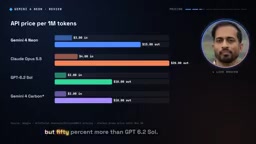
Gemini 4 Neon launched on November 18, positioned in the middle of the Gemini 4 family—above it sits Carbon, focused on long-horizon research, and below it is Hydrogen, a speed-optimized version for everyday tasks. Neon offers a 1-million-token multimodal context window and 4 thinking levels ranging from low to extra-high. API pricing is $3 per million input tokens and $15 per million output tokens, with cached pricing at $0.15—effectively a 95% cache discount.
According to a YouTube channel's reading of the independent Artificial Analysis leaderboard, this configuration lands squarely in the range most sensitive for enterprise agentic workloads: sufficient context, adjustable reasoning depth, and costs that pencil out.
Thinking Levels are the reasoning-depth control mechanism introduced in the Gemini 4 series. Before answering, the model performs internal "thinking"; the higher the level, the more thinking steps or compute budget are allowed, which suits complex reasoning. Lower levels respond faster and cost less. Neon offers 4 levels from low to extra-high, letting the same model flexibly switch under different latency and cost constraints—a key capability for allocating compute on demand in enterprise agent workloads.
Benchmarks: Beating Competitors at Every Thinking Level
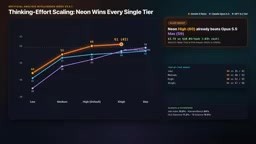
On the independent Artificial Analysis leaderboard, Neon scores 61 at the extra-high thinking level, ranking third overall—above Claude Opus 5.5 Max at 59 and GPT 6.2 Sol Max at 57. More convincingly, when every thinking level from low to highest is plotted on the same chart, Neon leads both competitors at every single level.
At the default high thinking level, Neon already scores 60, surpassing Opus 5.5 Max while costing 63% less per task. On enterprise and scientific tasks, Neon achieves 70.9% on Val's Index, 84% on Riemann Bench, 71.3% on HLE Diamond, and 70.5% on Terminal Bench Science.
To be fair, Opus 5.5 leads by about 1 point on Terminal Bench 4.1 and Frontier Code 2.0, while Sol 6.2 holds a slight edge on Chartography. This isn't a total rout—it's a redrawing of the areas of advantage.
Artificial Analysis is an independent evaluation organization that maintains multiple public leaderboards, aggregating model performance on reasoning, coding, long-context, and other tasks into composite scores. Its rankings are frequently cited in the industry as a reference for model selection, but scores are affected by test sets, sampling parameters, and runtime environments, so different versions should not be compared directly across leaderboards.
Autonomous Coding and Long Context: The Widest Gap
Where Neon truly pulls ahead is autonomous coding and long context. According to data cited in the video, it ranks first globally on the Artificial Analysis Coding Agent Index with 58.6 points, and first on Zapier's Automation Bench at 56.3%—leading Opus 5.5 by more than 13 points and Sol 6.2 by 15 points, respectively.
In the SWE Sweep test within the Google Anti-Gravity environment, Neon reaches 39%—nearly four times Opus 5.5's 10.1% and nearly five times Sol's 8.3%. On Cursor Bench 4.1 it leads 65.4 to 58.1. On the Graph Walks long-context test spanning 256k to 1 million tokens, Neon reaches 95.2%, versus Sol at 80.1% and Opus 5.5 at just 66.8%.
These numbers all point to the same conclusion: when a task requires maintaining autonomous coding state over long contexts, Neon's degradation curve is far flatter than those of other models.
Real Deliverables: From a Ski Simulator to Turing's Study
The video showcases several projects actually built with Neon, which demonstrate engineering capability better than benchmark scores. The first is a first-person Chamonix freestyle ski simulator, written entirely from scratch in Google Anti-Gravity: based on the real elevation terrain of Mont Blanc and Chamonix, 10,200 lines of custom WebGL2 shaders, 120Hz skiing physics across 6 alpine routes, real-time skier shadows, dynamically pressed snow tracks, spatial audio, and volumetric slab avalanches—all without using any pre-made 3D assets.

The second project reconstructs history with Neon Swarm: the model pulls archival photos of 1936 King's College, Cambridge, models and rigs the exterior of King's College Chapel and the interior of Turing's Room X.8, has Blender generate era-appropriate materials and warm lighting, and animates a mechanical universal Turing machine running paper tape on the desk.
A third project has another Swarm drive Blender MCP to render a realistic element laboratory workbench with Bunsen burner flames and glowing neon discharge tubes. A fourth project converts a single photo into a 100,000-cell Google Sheet, running 500,000 live spreadsheet formulas for 3D depth mapping and six interactive relighting modes—without embedding any images or writing any Apps Script.

Truthfulness and Safety: The Gap Enterprises Care About Most
For enterprise teams, the starkest comparison lies in truthfulness and safety. On Artificial Analysis's Omniscience test, Neon's non-hallucination rate is 85.6%, rising to 86.1% at the default high thinking level—nearly double Claude Opus 5.5's 49.7%, while GPT 6.2 Sol sits at 44.6%.
On GraySwan's indirect prompt injection test, Neon's attack success rate is 0.0%, versus 1.0% for Opus 5.5 and 2.3% for Sol 6.2. On cyber defense, Neon scores 76% on AutoBaxBench, 51.3% on WebExploitBench, 90.5% on SECBenchPro, and 70.7% on CWEBenchV2.
It should be noted that all these numbers come from third-party evaluations cited in the video, and reproduction results may differ across test environments—especially for adversarial tests like prompt injection, which are highly sensitive to test set design.
Indirect Prompt Injection refers to attackers hiding malicious instructions in external content the model reads (such as web pages, documents, or emails), inducing the model to perform unintended actions during subsequent autonomous operations. For agents with tool-calling and autonomous coding capabilities, such attacks can lead to data leakage or unauthorized operations, making attack success rate one of the core metrics for evaluating enterprise deployment security.
Cost and Speed: Saving Money Every Minute
At the extra-high thinking level, Neon costs $6.44 per task to complete the full benchmark suite—36% cheaper than Opus 5.5 Max's $10.04—and delivers first responses six times faster: 56.5 seconds versus 338.6 seconds. GPT 6.2 Sol remains cheaper on a per-token basis at $2.10 per task, suited to ultra-low-budget workloads, but Neon is 47% faster at 110 tokens per second, giving it the edge on the time dimension.
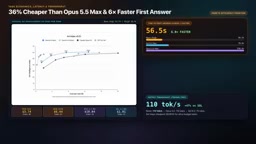
For teams running large volumes of agent tasks, the gap in first-response time translates directly into a gap in pipeline throughput. This is also why "cost per task" reflects real overhead better than "price per token": cheap tokens that buy longer waits and more retries quickly erase the advantage on paper.
Time to First Token (TTFT) refers to the latency from sending a request to receiving the first output token, directly affecting interactive experience and pipeline throughput. For batch agent tasks, TTFT gaps compound into significant waiting costs; this is also why "cost per task" reflects real overhead better than "price per token"—cheap tokens that buy longer waits and more retries quickly erase the advantage on paper.
Conclusion: Not a Rout, but a Redrawing of Lines
Neon doesn't beat its competitors in every dimension—Opus 5.5 still leads by about 1 point on some terminal coding tests, Sol 6.2 is better on chart-type tasks and has a lower per-token price. But Neon has established clear advantages in thinking-level consistency, long-context retention, non-hallucination rate, prompt injection defense, and cost per task.
The closing portion of the video contains obvious speech-recognition garbling, including unverifiable statements about partners, which this article does not credit. What is certain: the focus of this round of competition has shifted from "who is smarter" to "who is more reliable and cheaper on long-horizon autonomous tasks." For teams evaluating agent infrastructure, that matters more than who holds the top spot on the leaderboard.
Related articles

Gemini 4 Neon Hands-On: Half the Cost, Near-Flagship Performance
Gemini 4 Neon hands-on roundup: Intelligence Index 61 beats its own flagship Carbon; Coding Agents performance matches Opus 5.5 at half the cost. Includes pure-code 3D demos, official pricing, and failure cases.
Gemini 4 Neon vs Claude Opus 5.5 Hands-On Comparison: Which One Is Worth Switching To
Gemini 4 Neon vs Claude Opus 5.5 hands-on: official benchmarks lead on knowledge work and long context but lag in coding; independent tests give it a higher intelligence index yet slower, more verbose output. Two rounds of tests each won some, showing when to switch.

Gemini 4 Neon Builds a Minecraft Clone in One Shot: Magic and Faceplants
Gemini 4 Neon beats Claude Opus 5.5 on one-shot prompts, but cold-start tests expose broken water physics and weak bash reliability. We break down API pricing traps, the power of 8-agent Swarm, and when to use Neon vs GPT 6.2 Sol.