Gemini 4 Neon Hands-On: Half the Price vs. Opus 5.5 — Which Is Better?

Gemini 4 Neon approaches Opus 5.5 at half the cost per task, but still trails slightly on hardcore coding.
Google's new Gemini 4 Neon shows a significant cost advantage in developer tests: about $6.86 per task, half of Opus 5.5's $12.61, though per-token pricing is only 25% cheaper. In tasks like pixel city generation and code repair, Neon's quality is close to Opus, with an intelligence index of 61 versus 59, but it still trails by about one percentage point on hardcore coding tests like Terminal Bench and Frontier Code. Neon performs efficiently on long-running tasks, repairing broken programs and finding all pre-planted bugs, but capacity errors cause interruptions. The community's 'half price, crushing the competition' claim isn't accurate; the real strategy should be combined use: Neon for high-frequency agent and long-document tasks, Opus as gatekeeper for high-risk deep programming.
Google's newly released Gemini 4 Neon has sparked heated discussion in the developer community. The most eye-catching claim is that it can match Claude Opus 5.5 at half the cost, and even surpass it in some tests. But the reality is far more complex than a single phrase like "half the price, crushing the competition." I've combed through hands-on tests from multiple developers, third-party benchmarks, and official pricing tables within 24 hours of launch to piece together a picture closer to the truth.
Hands-On Showdown: Pixel City and Frontend Generation
Developer Jazzy used the same prompt to have both models generate a richly detailed pixel art city at the highest reasoning tier. Neon took about 20 minutes and cost roughly $3.50; Opus took 18 minutes and cost about $7.20. Jazzy's assessment was that Neon's output had astonishing detail density — the best performance from the Gemini 4 series on this test. But the final conclusion was still that Opus is better overall. This comparison set the tone for the entire discussion: the cost advantage is clear, and the quality gap has narrowed but not disappeared.
Another tester, AJ, compared Neon side by side with Google's faster Hydrogen model on frontend generation. Neon proactively added a day-night cycle, time jumping, and realistic star constellations — none of which were in the prompt. Hydrogen produced a more restrained version. AJ's conclusion was that Hydrogen plus Neon may be the most efficient combination available today.
The highest reasoning tier typically refers to the maximum compute configuration a model enables when generating content, such as more chain-of-thought steps or longer internal reasoning time. This affects generation quality, time, and cost. In the pixel city test, both Neon and Opus ran at the highest tier, but Neon took 20 minutes at $3.50 while Opus took 18 minutes at $7.20. At the highest tier, models can handle more complex details, but not all tasks require this configuration; in everyday use, developers may choose lower tiers to balance speed and cost. This also explains why AJ, when comparing Neon with the faster Hydrogen, emphasized that using them in combination may be more efficient.
Long-Running Tasks and Code Repair: A Real Day of Stress Testing
After gaining early access, ChubbyOnX used it for a full day inside Google's coding tool Anti-Gravity. Neon built 17 interactive demos, including a 3D arena shooter with enemy waves, health, ammo, and reload mechanics — all fully functional. However, the first build crashed due to a server error and required a second round of fixes.
More telling were three deliberately broken program repair tasks: the reservation checker went from 1 of 5 tests passing to all 5 passing; the task scheduler went from 8 of 14 passing to all passing; the async loader went from 10 of 16 passing to all passing. In the code review phase, Neon found all four pre-planted bugs. Logs showed 762 tool calls across 13 sessions, with a highly consistent pattern: read the needed files in one pass, write the fix in a single edit, then read back to verify — each fix taking two to three minutes.
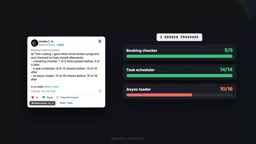
The weaknesses were equally obvious. Chubby recorded a capacity error "Capacity 57," and four runs were directly interrupted that day with no error message. This may be a launch-day load issue, but it did consume real time.
Tool calls refer to a model actively invoking external tools (such as file reading, code editing, terminal execution, etc.) while completing a task. In ChubbyOnX's test, Neon made 762 tool calls across 13 sessions — about 58 per session — in a "read-edit-verify" loop. This high-frequency calling is typical of agent-type models, but it also means the model needs stable planning capabilities to avoid redundant or ineffective operations. Too many tool calls can increase latency and cost, while too few may miss critical steps. Neon's one-pass read and write strategy was relatively efficient, but the interruptions caused by capacity errors exposed its reliability risks on long-running tasks.
Benchmarks and Pricing: The Truth Behind the Half-Price Claim
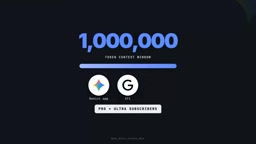
Neon was released on November 18, positioned in the middle tier of Google's new model lineup: Carbon handles the heaviest, longest projects, Hydrogen focuses on speed and low cost, and Neon sits between them and replaces Argon. It has a 1-million-token context window and is already available in the Gemini app (Pro and Ultra subscriptions), the API, and Anti-Gravity.
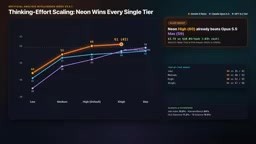
Artificial Analysis aggregates nine hard evaluations into an intelligence index. Neon scored 61, Opus 5.5 scored 59, placing third globally — behind only Clawed Fable 5.2's 65 and GPT 6.2 Astra's 62. In the Agent Arena index based on 4,200 real agent sessions, Neon ranked second and Opus third. But in Google's own comparison table, Opus still leads in two hardcore coding tests, Terminal Bench 4.1 and Frontier Code 2.0, by about one percentage point — a small but critical gap. Independent evaluator Beto found a larger gap: Opus at about 87%, Neon at about 80%.
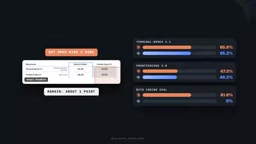
Pricing needs to be broken down. Per token, Neon costs $3 per million input tokens and $15 output, while Opus costs $4 and $20 — actually only 25% cheaper, not half. The "half price" comes from cost per task: Neon consumes fewer tokens to complete the same work, and Artificial Analysis measured $6.86 versus $12.61 per task — close to half. The accurate description is "half the task volume, half the bill," not a halved price tag.
The intelligence index and Agent Arena index are two different ways to evaluate AI model capabilities. Artificial Analysis's intelligence index aggregates scores from nine hard evaluations into a composite score, focusing on a model's static performance on standardized tests. The Agent Arena index, based on 4,200 real agent sessions, simulates a model's actual behavior in interactive, multi-step tasks, making it closer to real-world usage. Combining the two can avoid single-benchmark bias — for example, Neon scores slightly higher on the intelligence index but ranks second in Agent Arena, suggesting it may be limited by stability or tool-call efficiency in real tasks. This difference also explains why Google's own comparison table still shows Opus leading in specific coding tests.
Which to Choose: The Scenario Decides the Answer
Tech blogger Greg Eisenberg's summary is representative: Neon performs well, is fast, and costs about half per task, but when facing the hardest problems, he still reaches for Clawed. This explains why the "surpasses Opus" narrative is popular in the community — it does lead on most general benchmarks and cost dimensions, but on deep programming tasks that most test engineering judgment, Opus still holds its ground by a narrow margin.
The practical strategy may be to use them in combination: hand everyday agent runs, research, and long-document processing to Neon, fully leveraging its long context and cost advantages; for hardcore programming tasks where a single wrong change could cost hours, still use Opus as the gatekeeper. Google released four models in seven weeks, the gap at the top has narrowed to one or two percentage points, and the competitive landscape has become tense again.
(This article cross-references public hands-on tests from multiple developers and third-party benchmark data; specific performance may change as model versions are updated.)
Related articles
Gemini 4 Neon Builds a Minecraft Clone in One Shot: Magic and Faceplants
Gemini 4 Neon beats Claude Opus 5.5 on one-shot prompts, but cold-start tests expose broken water physics and weak bash reliability. We break down API pricing traps, the power of 8-agent Swarm, and when to use Neon vs GPT 6.2 Sol.

Gemini 4 Neon vs Claude Opus 5.5: When Benchmarks and Real Code Tell Opposite Stories
Gemini 4 Neon wins 16 of 19 benchmarks, but Opus beats it by 7 points on production code. How AntiGravity skews scores and how to pick a model by task.
Gemini 4 Neon vs Claude and GPT: Is the Throne Changing Hands?
Google's Gemini 4 Neon tops Claude Opus 5.5 and GPT 6.2 Sol across multiple tiers on Artificial Analysis, with clear edges in autonomous coding and long context—63% lower cost and six times faster first response. A breakdown of benchmarks, real deliverables, and safety metrics.