Gemini 4 Neon Hands-On: Small Model Matches Flagship, Doubles the Speed
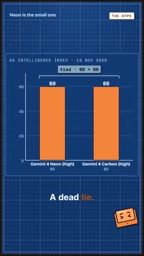
Gemini 4 Neon ties flagship Carbon on score while doubling its speed, misread as AI self-evolution.
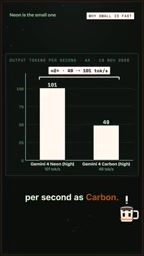
Google's new model Gemini 4 Neon tied flagship Carbon 60-60 in independent tests while completing the same work in less than half the time. A DeepMind researcher calling Neon a "small model" and stressing a preference for conservative claims was misread on social media as "small model far surpasses flagship," spawning panic about "AI self-evolution"—with no evidence of self-improvement. The article notes the speed advantage likely comes from memory bandwidth: each generated token requires moving all weights, so fewer weights means faster output, with Neon producing roughly twice the tokens per second of Carbon. Theo Brown proposes a two-dimensional framework of capability and coherency, arguing benchmarks only reflect capability, not whether a model truly understands the task. The author advises against relying on single scores or guessing model size from tier and price, and instead timing real long tasks end-to-end.
A Tie That Sparked Misreading
Google's new model Gemini 4 Neon tied with the flagship model Carbon in independent tests, completing the same work in less than half the time. This should have been good engineering news, but a single remark from DeepMind researcher Tianfu Fu on X turned it into a different story on the internet.
He said: "Neon is actually one of our small models." He then added something rare in the AI world—"We'd rather be conservative in our claims than overhype." The reaction from netizens was the exact opposite. A major AI account bluntly called it "worth a closer look," claiming Google's small model had far surpassed Carbon, which then triggered a wave of panic about "AI self-evolution."
The facts: the independent score was 60 to 60, a complete tie. As for AI self-improvement, there is no evidence here whatsoever. A small model matching its bigger sibling is a nice week in engineering, not the arrival of the singularity.
Where the Speed Comes From: The Memory Bandwidth Math
So why is it so fast? Google hasn't disclosed the actual parameter count. But if it really is small, the answer lies in memory.
For every token a model generates, the chip has to move the model weights out of memory. The fewer weights to move, the faster tokens come out. The test data supports this: Neon outputs roughly twice as many tokens per second as Carbon.
This explanation is so plain it hardly seems like AI news, but it points to a dimension that leaderboards often overlook—inference efficiency. Two models with identical scores on the same table can feel completely different in real-world workflows. For developers running large volumes of requests every day, this gap is far more tangible than a point or two on a leaderboard.
Memory Bandwidth refers to the amount of data a chip can read from or write to video memory (such as HBM) per unit of time, typically measured in GB/s. LLM inference is inherently "memory-bound" rather than "compute-bound": for each token generated, all model weights must be moved from VRAM to the compute units once. Therefore, when the parameter count is halved, the number of bytes that need to be moved per forward pass is also roughly halved, and assuming VRAM bandwidth stays the same, the number of tokens generated per second nearly doubles. This is also why running quantized small models on consumer GPUs often yields speedups far beyond the ratio of compute.
It's worth noting that memory bandwidth and VRAM capacity are two different metrics: the former determines "how fast tokens come out," the latter determines "whether the model fits." Common inference optimizations—quantization (compressing weights from FP16 to INT8/INT4), KV Cache compression, speculative decoding—all essentially work by reducing the amount of data moved per token or improving bandwidth utilization. This also explains the common phenomenon of identical leaderboard scores with double the real-world throughput.
Theo Brown's Reversal and the "Coherency" Theory
The most candid reaction came from Theo Brown. Just five days before Neon's release, he was still timing Carbon's stuttering performance with a stopwatch. This time he posted: "Sorry Google, I didn't read your cards."
Publicly changing your judgment based on real evidence is exactly how it should be.
He also has a theory explaining why benchmarks missed this. He splits model capability into two dimensions:
- Capability: what a model can do at its best.
- Coherency: whether it truly understands what it's doing.
On his hand-drawn chart, Neon sits on the same level as Claude Fabel and Opus, and is even further to the right on coherency than both; Carbon is stuck in the bottom-left corner. His conclusion: benchmarks only show capability.

This distinction deserves serious attention. A model can score high on exams while repeatedly drifting off in long tasks, forgetting context, and getting simple steps wrong. Identical scores with half the time is very likely a manifestation of coherency differences—fewer detours naturally means less time spent. Of course, this two-dimensional framework is currently just his personal analysis, with no independent quantitative validation yet.
Benchmarks usually refer to standardized evaluation sets like MMLU, GPQA, SWE-bench, and AIME, which consist mainly of single-turn, short-context questions with clear answers, measuring a model's peak performance under controlled conditions. Their limitation: questions are mostly one-shot Q&A, making it hard to reflect whether a model maintains goal consistency over dozens of steps or hours of real tasks, whether it repeats mistakes, or forgets intermediate states.
This is why the industry has seen the emergence of long-horizon task evaluations (such as long-context retrieval, multi-step agent tasks, and end-to-end software engineering tasks) as well as supplementary approaches like "human preference + real workflow timing." But these evaluations are costly and poorly reproducible, and no unified standard has yet formed. The "evaluation system lag" mentioned in the article precisely refers to the systematic gap between static test-bank scores and real-world production feel—when two models score the same but complete tasks in half the time, a single score has very little information value as a basis for model selection.
Model Selection Advice: Throw Away the Single Score
The most practical lesson from this event is a shift in how to choose models.
Stop picking models based on a single score. Neon and Carbon have identical scores, but one finishes in less than half the time of the other.
Stop guessing model size from tier or price tag. Google released Carbon as a heavyweight contender, and eight days later, the one that matched it may well be the "small" one.
Use your own stopwatch. Pick a long task from your actual work and time it end-to-end. That's the only chart that matters.

A Calm View of "Small Model Matches Flagship"
Put this in its proper place: a smaller model running at roughly twice the speed with the same score shows that there's more room for inference efficiency optimization than leaderboards suggest. For cost-sensitive production environments, that's a genuine win.
But it is not evidence of "AI self-improvement," nor does it mean small models have fully surpassed flagships. The real signal is the lag of evaluation systems—when scores can't distinguish two models with vastly different real-world feel, the value of benchmarks as a decision-making basis is declining. By comparison, running a real task and timing it is clumsy, but closer to the truth.
If you want to know where those missing minutes of Carbon's went, the original video has a more detailed timeline breakdown.
Related articles

AI Penetration Testing Agents in Practice: From Skill Configuration to Fully Automated Vulnerability Discovery
Starting from the six core capabilities of agents, this article breaks down how to build an AI penetration testing agent: why chat tools can't find vulnerabilities, how Skill configuration encapsulates pentesting skills, and how SRC automated vulnerability discovery impacts the way security engineers work.
Understanding AI Usage Through Unix Permissions: The 0rwx Model
Introducing the 0rwx model from Hacker News: using Unix read, write, and execute permissions to break down AI usage into information input, content generation, and action triggering—plus its insights and limitations for product design and security boundaries.
Scientific Evidence vs. Regulatory Rol…
Scientific Evidence vs. Regulatory Rollback: Europe's Chemical Rules Debate
A Le Monde opinion piece argues that science increasingly links chemical exposure to "lifestyle diseases" while Europe weakens regulation. This article examines the evidence, policy drivers, and HN debate.