Gemini 4 Neon Hands-On Test: Can It Replace Opus 5.5? Three-Round Comparison Reveals the Answer

Three rounds of testing show Gemini 4 Neon can't yet fully replace Opus 5.5, while GPT-6.2 Sol offers the best value.
The article documents a three-round side-by-side hands-on test of Google's new model Gemini 4 Neon against Opus 5.5 and GPT-6.2 Sol, using official Harnesses, high thinking intensity, no Skills, and MD-format output to control variables. The tasks were 3D motorcycle modeling, Blender Miami sports car surface modeling, and complex animation generation. Opus 5.5 generally led in texture, surface handling, and animation quality but was slower; GPT-6.2 Sol was extremely cheap, not slow, and consistently solid, offering the best overall value; Gemini 4 Neon had speed highlights and lower cost in round one, but lacked refinement, and in round three a hit rate of only 32% drove costs up. The conclusion: "replacement" is premature, and model selection requires scenario-based trade-offs.
Google's new model Gemini 4 Neon has climbed to third place on the AA leaderboard, even surpassing its own flagship Gemini 4 Pro, and is regarded by many as a replacement for Opus 5.5. A Bilibili creator conducted a three-round hands-on test comparing the real-world performance of Gemini 4 Neon, Opus 5.5, and GPT-6.2 Sol.
Test Setup: A Fair Contest in a Unified Environment
The test used the official Harness for each of the three contenders, with high thinking intensity enabled across the board, no Skills loaded, and all outputs in MD format. This controlled-variable approach ensures a fair comparison and directly reflects each model's native capabilities on complex tasks.
Harness refers to the official evaluation/invocation framework provided by model vendors (such as Anthropic's Claude Code, OpenAI's Codex CLI, etc.), which packages the system prompt, tool-calling protocol, and file read/write methods. The same model can perform noticeably differently under different Harnesses, so when comparing across models, using each one's official Harness is the closest approximation of the real user experience—though it also means framework-level differences cannot be fully eliminated.
High thinking intensity corresponds to the model's reasoning budget (reasoning effort / thinking budget) setting. With a high setting enabled, the model generates a longer chain of thought before answering, which typically improves success rates on complex tasks at the cost of higher latency and token consumption. Unifying the setting avoids the unfairness of "one side maxing out reasoning while the other runs in default mode."
No Skills loaded means disabling pluggable skill packs or tool sets (such as domain-specific prompt templates or external scripts), retaining only the model's native capabilities, thereby excluding interference from external scaffolding on the results.
Round One: 3D Motorcycle Modeling—Opus 5.5 Leads in Texture Quality
The first task was 3D motorcycle modeling, testing front-end and modeling capabilities. Model A (Opus 5.5) immediately stood out with impressive texture, excellent part reflections, and smooth switching between four modes, completing in 17 minutes. Model B (GPT-6.2 Sol) was relatively rough, with some parts logically confused. Model C (Gemini 4 Neon), while flashy, was less refined than A after parts were disassembled.
The creator's final ranking: C first (fastest), A second, B third. But once pricing was revealed, Opus 5.5 cost 6.24 yuan while Gemini 4 Neon cost only 7 yuan in API fees—a clear price advantage. However, Gemini 4 Neon was slower.
Round Two: Miami Sports Car Surface Modeling—Model A Best at Surface Handling
The second task was creating a Miami sports car in Blender, where surface handling is the modeling challenge. Model A's surfaces were natural and part breakdowns reasonable. Model B showed hollows and logical errors—many parts but bizarre ones. Model C's surfaces had a sheen, but the 3D model lost refinement once imported, and part breakdowns were inferior to A.

In this round, the creator judged A the best, with B and C hard to separate. Gemini 4 Neon again ranked lower, and while cheaper, it was slow.
Round Three: Complex Animation Generation—A Has High Quality but C Is Fast
The third task mimicked the full prompt from the Kimi 3.1 Pro promotional video to generate a flashy animation. Model C was extremely fast but lacked visual refinement; Model B was also fast but pause-frame quality was mediocre; Model A had the best texture but took longer.

In this round, Gemini 4 Neon was unusually expensive. The creator checked and found the backend hit rate was only 32%, causing costs to spike. The creator concluded that Opus 5.5 had the highest animation quality but took the longest.
The hit rate mentioned in the article usually refers to the proportion of cache hits in API calls, or the proportion of requests routed to an efficient inference path. Mainstream APIs generally offer prompt caching: when the request prefix heavily overlaps with previous calls, the already-computed KV cache can be reused, greatly reducing unit price; misses are billed at full price. For tasks like the third round with long prompts and multiple rewrite rounds, once the cache frequently invalidates, actual costs can be several times higher than expected. This is also the main reason the same model's price fluctuates wildly across tasks—when evaluating cost, look at hit rate rather than a single bill.
Price and Performance Analysis: GPT-6.2 Sol Stands Out on Value
Across the three rounds, GPT-6.2 Sol was extremely cheap, not slow, and consistently solid in quality, making it the value pick. Gemini 4 Neon was cheap on some tasks (7 yuan in round one), but in round three low hit rate drove costs up. Opus 5.5 led in quality but was pricier and slower.
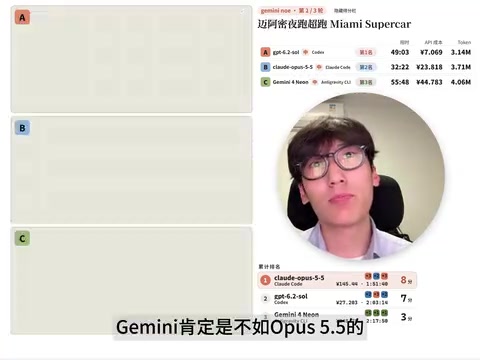
The creator's summary: GPT-6.2 Sol is the balanced choice; Gemini 4 Neon currently falls short of Opus 5.5, but some have noted it may be strong in software UI motion effects, pending further testing.
Conclusion: Too Early to Replace, but Potential Is There
After three rounds of hands-on testing, Gemini 4 Neon did not demonstrate the ability to fully replace Opus 5.5. Opus 5.5 still leads in 3D modeling, surface handling, and animation texture. However, Gemini 4 Neon has highlights in speed and is cheaper in some scenarios. For users who need quick generation of simple tasks, it may be an alternative.
The creator said he will subsequently test software UI motion effects and backend code generation to more comprehensively evaluate Gemini 4 Neon's capabilities. He also cited advice from GPT model lead Tibo to add specific statements to MD files to improve results, for developers' reference.
This test reveals the complexity of model selection: there is no absolute replacement, only trade-offs suited to the scenario.
The AA leaderboard (Artificial Analysis ranking) is a composite model ranking maintained by third-party evaluator Artificial Analysis, typically aggregating multiple public benchmarks (reasoning, coding, math, etc.) with weighting, while also providing speed and price dimensions. Its value lies in offering a cross-sectional snapshot, but it cannot replace hands-on testing in specific scenarios: models with similar leaderboard scores can differ dramatically on multimodal and long-horizon tasks like 3D modeling and long animation generation. Thus "third on the leaderboard yet underperforming in tests" is not contradictory—it precisely shows that selection should be based on your own task distribution.
One-line Summary
Three rounds of testing show Gemini 4 Neon cannot yet fully replace Opus 5.5, with GPT-6.2 Sol offering the best value.
Paragraph Summary
The article documents a three-round side-by-side hands-on test of Google's new model Gemini 4 Neon against Opus 5.5 and GPT-6.2 Sol. The test uniformly used official Harnesses, high thinking intensity, no Skills loaded, and MD-format output to control variables. The three tasks were 3D motorcycle modeling, Blender Miami sports car surface modeling, and complex animation generation. Results show Opus 5.5 generally leads in texture, surface handling, and animation quality but is slower; GPT-6.2 Sol is extremely cheap, not slow, and consistently solid, offering the best overall value; Gemini 4 Neon has speed highlights and was cheaper in round one, but lacks refinement, and in round three a hit rate of only 32% drove costs up. The conclusion: "replacement" is premature, and model selection requires scenario-based trade-offs.
Related articles

Gemini 4 Neon Hands-On Test: Best for Coding but Nearly Twice as Slow — How Do You Account for That?
Overseas reviewers tested Gemini 4 Neon: ranked first on the Coding Agent Index with per-task cost about half of Claude, but nearly twice as slow as the median. We break down third-party cost, speed, and capability data to help you decide if the bill is worth it.

Gemini 4 Neon Hands-On: How Does It Compare to Astra 6.2 for PPT Generation?
Hands-on test of Google Gemini 4 Neon vs Astra 6.2 on the same offline speech PPT task: visuals on par, Neon wins on accuracy and detail and faithfully converts the data source; but revisions return only single pages, and UI and images are easily redrawn. The fast model matches the flagship and is worth using.
Google Gemini 4 Neon Released: Three-Tier Model System and Pricing Breakdown
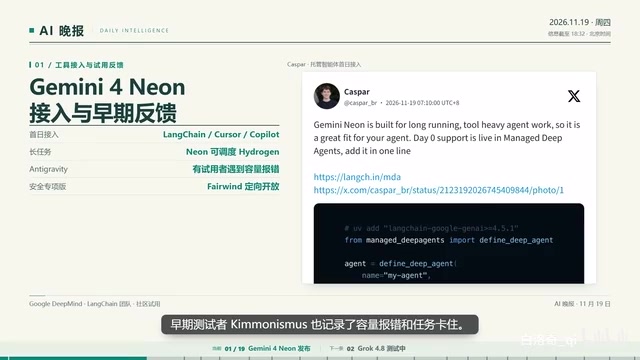
Google releases Gemini 4 Neon, positioned between Hydrogen and Carbon for complex high-frequency tasks with multimodal input. Artificial Analysis composite intelligence index around 60, per-task cost about 30% lower than Carbon. Also: Grok 4.8 multi-version testing, Anthropic IPO priced at $83.