Gemini 4 Neon Lands on Devin: A Cost-Effectiveness Challenge to Claude Opus 5.5

Gemini 4 Neon arrives on Devin, nearing Claude Opus 5.5 performance at roughly one-third the cost.
Gemini 4 Neon is now available in Devin Desktop and Devin CLI. Official data shows it scored 46.2% on the FrontierCode 2.0 benchmark, the best result for a Google model on that test, only about one percentage point behind Claude Opus 5.5, while costing about one-third as much. The article argues this cost-performance combination matters significantly for teams that heavily use AI coding assistants, since cost differences directly amplify overall spending. Devin's switchable-model design also lets developers choose flexibly based on task needs and budget. The article notes that the release reflects intensifying competition in the AI model market, with Google pursuing a strategy of near-top performance at a significantly lower price to win developer share, while developers should continuously evaluate each model's real-world performance in their own workflows.
Introduction: Devin Platform Welcomes a New Model
Devin platform users can now use Gemini 4 Neon in Devin Desktop and Devin CLI. According to official information, this model scored 46.2% on the FrontierCode 2.0 benchmark, making it the best performance by a Google model on that test.
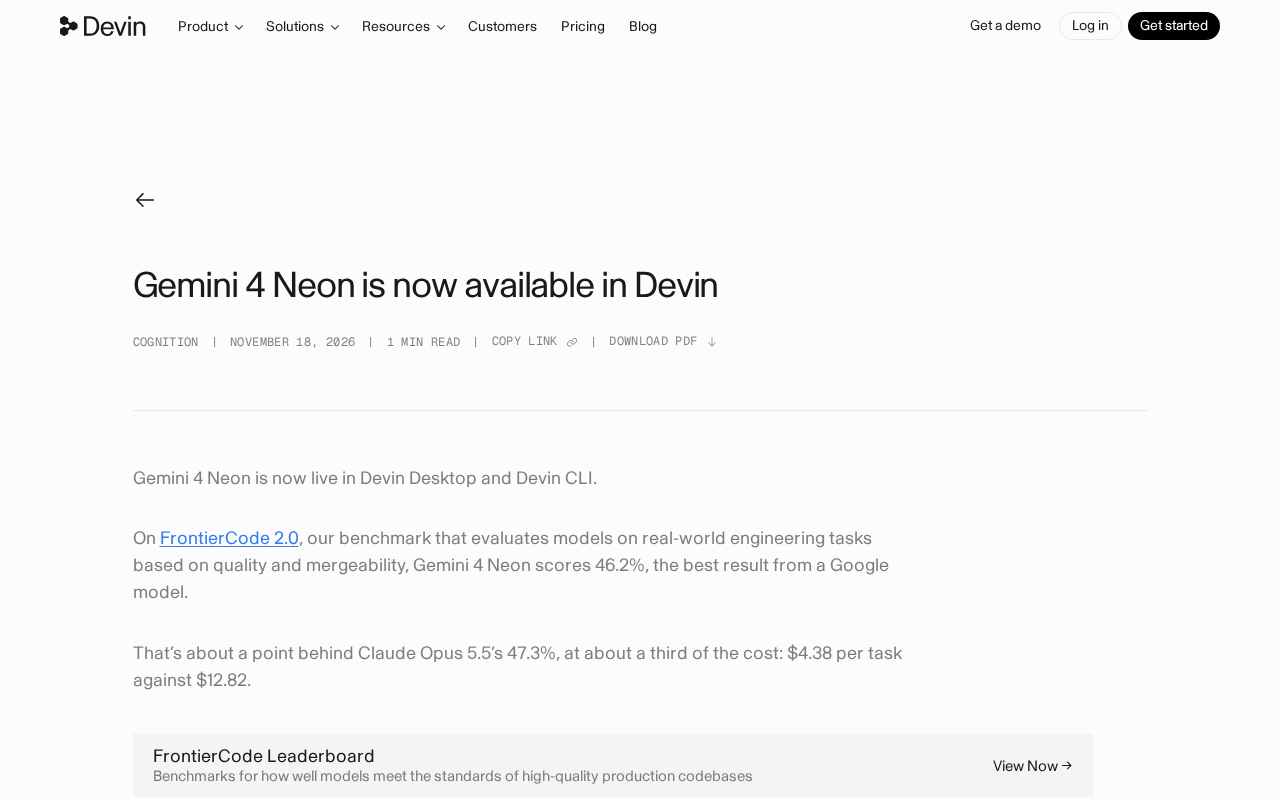
Compared with its competitor, Gemini 4 Neon's score is only about one percentage point lower than Claude Opus 5.5, but its cost is only about one-third of the latter. This cost-effectiveness advantage could have a significant impact on developers' model choices.
Devin is an AI coding assistant platform launched by Cognition. Its positioning differs from traditional code completion tools: its core selling point is an "AI software engineer" capable of autonomously planning and executing multi-step software engineering tasks. Devin Desktop targets graphical interaction scenarios, offering a task panel and code review interface; Devin CLI targets developers accustomed to the command line, making it easy to embed into scripts and automation workflows. An important design of the platform is model pluggability: users can switch between underlying models from different vendors within the same workflow, thereby weighing capability, latency, and cost. Therefore, whenever a new model is integrated into Devin, it essentially adds an immediately selectable "engine" to the existing toolchain, with very low migration cost for developers—which is why such integration news attracts attention.
Performance: Closing In on Top Models
On the FrontierCode 2.0 test, Gemini 4 Neon's 46.2% score marks a significant advance for Google models. Although still slightly below Claude Opus 5.5, the gap has narrowed to about one percentage point, indicating that Google is rapidly catching up in code generation and understanding capabilities.
Previously, Google models often lagged behind competitors on similar benchmarks, but Gemini 4 Neon's performance has changed that. For developers who need to handle complex programming tasks, this performance level is already sufficient for most scenarios.
FrontierCode 2.0 is a type of benchmark focused on coding capability, typically scored by execution success rate or test pass rate, with tasks covering multi-file modifications, bug fixes, dependency understanding, and long-context reasoning. The key difference between such benchmarks and function-level completion tests like HumanEval is that they evaluate a model's ability to complete end-to-end tasks in a real repository environment, rather than generating a correct code snippet in a single turn. For this reason, absolute scores on such tests are generally low, and results above 40% are usually already among the top tier. Readers should interpret the 46.2% figure in this context and should not directly compare it with high scores on function-level benchmarks. In addition, benchmark scores may still differ from actual experience on a specific platform, affected by factors such as prompt wrapping and tool-calling design.
Cost Advantage: One-Third the Price
Cost is the most striking feature of Gemini 4 Neon. Official information shows that its usage cost is only about one-third of Claude Opus 5.5, while the performance gap is only about one percentage point. This cost-benefit ratio stands out in the current AI model market.
For teams that use AI coding assistants heavily, the cost difference can significantly affect overall spending. Gemini 4 Neon offers a new option for budget-sensitive developers who still need relatively high performance.
The actual cost of an AI coding assistant depends not only on the unit price per call, but also closely on the number of interaction rounds, context length, and retries needed to complete a task. A model with a lower unit price but requiring more rounds of clarification or rework may actually have a higher end-to-end cost; conversely, a model with a higher unit price that succeeds in one pass may be cheaper overall. Therefore, comparisons such as "about one-third" are better understood as unit price or typical consumption ratios for the same amount of work. Teams should base their selection on measured data from their own workflows. For high-frequency call scenarios, costs under token-based billing accumulate quickly as codebase size and context expand, and the leverage effect of price differences becomes especially pronounced.
Availability in Devin
Gemini 4 Neon is now integrated into Devin Desktop and Devin CLI, allowing developers to call the model directly in their familiar development environment. As an AI coding assistant platform, Devin provides users with flexible choices by integrating multiple models.
Users can switch between different models in Devin and make trade-offs based on task requirements and budget. The addition of Gemini 4 Neon enriches the platform's options, especially for developers seeking high cost-effectiveness.
Market Impact and Outlook
The release of Gemini 4 Neon reflects intensifying competition in the AI model market. By offering a model with performance close to the top at a lower cost, Google is trying to capture a larger share of the developer market.
For developers, the diversity of model choices means they can optimize cost and performance according to specific needs. As more models emerge, the ecosystem of AI coding assistants will become richer, and developers will need to continuously evaluate how different models perform in their own workflows.
Conclusion
The availability of Gemini 4 Neon on the Devin platform gives developers an option with performance close to Claude Opus 5.5 but at a substantially lower cost. Its 46.2% score on FrontierCode 2.0 demonstrates Google's progress, while the roughly one-third cost constitutes a strong competitive point. Developers can flexibly adopt this model in Devin according to project requirements.
Related articles

The 15-Year Programmer Who's Been Unemployed for Two Years: The Tech Worker's Dilemma in the AI Era
A US senior software engineer with 15 years of experience has been unemployed for two years, exhausted his savings, and sought help on Hacker News. This article analyzes the structural causes of long-term unemployment among tech workers, strategies for addressing resume gaps, and the redefinition of experience value in the AI era.

Soundcore Liberty 5 Pro Drops to All-Time Low: The Go-To True Wireless Earbuds for Commutes and Calls
Soundcore Liberty 5 Pro drops to an all-time low of $129.99 (from $169.99). These Anker true wireless earbuds excel at call quality and are on sale at Amazon, Best Buy, and Walmart in four colors—ideal for commutes and online meetings.

After Anthropic's IPO, How Far Can Safety-First Go?
The Verge podcast explores Anthropic's post-IPO core tension: can a public company stay safety-first? How public market pressure reshapes AI lab safety decisions.