Gemini 4 Neon Released: Messier Pricing, But Stronger Reasoning

Gemini 4 Neon launches with deeper reasoning, but Gemini 4 pricing gets even messier.
Google released Gemini 4 Neon and updated llm-gemini to 0.38 to support it. Neon targets deep reasoning and scores 61 on quality—slightly above Carbon's 60—at a mid-tier $3/$15 price. But with Carbon's limited-time half-price promo and Argon dropped from comparisons, current pricing order is reversed. Tests show Carbon produces the most detailed output, then Neon, then Hydrogen; higher thinking levels cost more.
Google has released Neon, a new member of the Gemini 4 family, and the open-source tool llm-gemini has been updated to version 0.38 to support the model. The most striking aspect of this update isn't the model's capabilities themselves, but rather that Google's pricing strategy has become even more confusing.
The Pricing Puzzle: Argon Disappears, Carbon Gets a Limited-Time Discount
Before Neon's release, the Gemini 4 family included three models: Hydrogen, Argon, and Carbon. Argon and Carbon were priced identically ($4/$20 per million input/output tokens), while Hydrogen's current price is three-quarters of theirs ($1.50/$7.50). But starting December 1, when Carbon's promotional pricing ends and it returns to its original price, Hydrogen will become one-quarter of their price.
Neon's release announcement simply ignores Argon's existence. The new product comparison chart lists only three models: Carbon, Neon, and Hydrogen. Ordered by price from high to low, the theoretical ranking would be Carbon, Neon, Hydrogen. But since Carbon currently enjoys a half-price promotion ($2/$10), the actual order becomes Neon ($3/$15) as the most expensive, followed by Carbon, with Hydrogen the cheapest. This temporary state won't become "rational" until December 1, when Carbon returns to its original price.
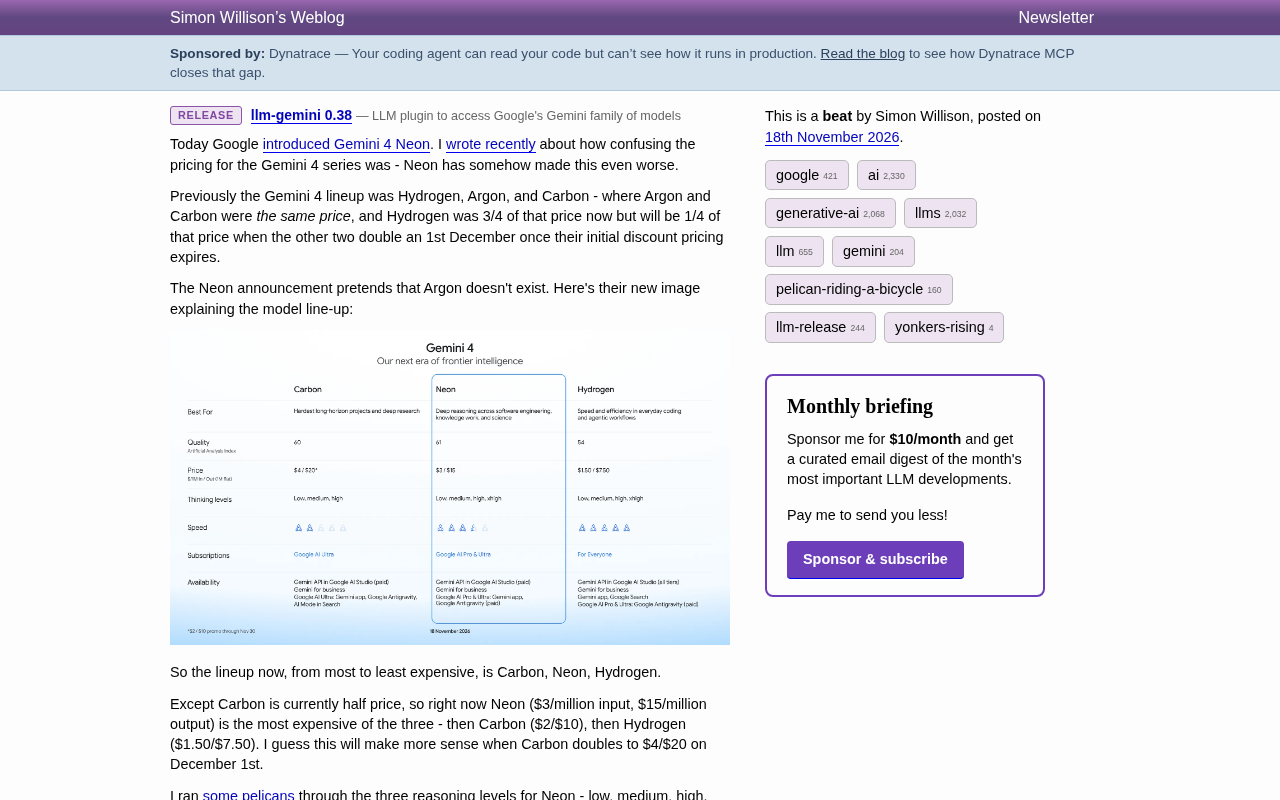
Model Capability Comparison: Carbon > Neon > Hydrogen
According to the comparison table published by Google, the positioning and key metrics of the three models are as follows:
- Carbon: Best suited for the hardest long-horizon projects and deep research; quality score 60, price $4/$20, speed 2/5, supports low/medium/high thinking levels.
- Neon: Excels at deep reasoning in software engineering, knowledge work, and science; quality score 61, price $3/$15, speed 3.5/5, supports low/medium/high/extra-high thinking levels.
- Hydrogen: Focused on speed and efficiency for everyday coding and agentic workflows; quality score 54, price $1.50/$7.50, speed 5/5, also supports four thinking levels.
Interestingly, Neon scores slightly higher than Carbon on the Artificial Analysis quality index (61 vs. 60), yet Carbon is positioned as the flagship model for the hardest tasks. This may mean Neon performs better at general reasoning, while Carbon excels in specific deep-research scenarios.
The Artificial Analysis quality index is a third-party independent benchmark that provides a composite score for language models by aggregating multiple standardized tests (such as MMLU, HumanEval, GSM8K, etc.). The index uses a 0-100 scale, where higher scores indicate better average performance across a broad range of tasks. Since models from different vendors often prioritize specific domains, this index is commonly used for cross-model comparisons of general capability. Note, however, that the index cannot reflect a model's actual performance in long-context, multi-turn conversations, or domain-specific tasks, so it should be used as a reference only, not as the sole basis for model selection.
Thinking Levels are a reasoning control mechanism introduced by large models in recent years. Before generating a final answer, a model can allocate different amounts of "internal thinking tokens" for multi-step reasoning. Lower levels consume fewer tokens and respond faster, suitable for simple tasks; higher levels allow the model to carry out deeper chains of logical reasoning, improving accuracy on complex problems but significantly increasing cost and latency. In the Gemini 4 family, Carbon supports three levels (low/medium/high), while Neon and Hydrogen support four (low/medium/high/extra-high), which directly affects the cost-versus-quality trade-off developers face in different scenarios.
Hands-On Testing: Pelican on a Bicycle and the Yonkers Mech
Developer Simon Willison tested Neon at three thinking levels (low, medium, high) using the classic "pelican riding a bicycle" prompt, and compared it with Carbon and Hydrogen.
Looking at the generated results, detail and refinement show a clear gradient: Carbon is best, Neon second, Hydrogen worst. Within the same model, higher thinking levels produce more elaborate output. Taking the high thinking level as an example, Carbon generated a pelican wearing a sailor hat, wrapped in a scarf, with a fish in its bike basket, set against a beach boardwalk with birds flying in the distance; Neon's pelican was well-proportioned, with a yellow dashed road and ocean in the background; Hydrogen produced only a basic pelican and red bicycle, supplemented with speed lines and flat grass.
All outputs were recognizable as a pelican riding a bicycle, but the computational costs differed significantly. For the same prompt, Carbon's high thinking level produced far more output tokens and cost far more than Neon and Hydrogen, and took longer as well.
Willison also tested a more complex 3D animation prompt: using Three.js to create an animation of Yonkers standing up and transforming into a giant mech, stomping through Manhattan, Queens, and Brooklyn, using OpenStreetMap map data. Neon completed this task at the "extra" effort level, and the result was publicly released.
"Pelican riding a bicycle" is an informal benchmark prompt proposed by Simon Willison that asks a model to generate an image of a pelican riding a bicycle (usually via SVG or code generation). The test is popular because it simultaneously assesses a model's understanding and generation of animal anatomy, object interaction, spatial relationships, and creative detail. Different models show clear differences in the pelican's anatomical structure, bicycle components, and richness of background elements, providing an intuitive reflection of a model's precision and consistency in visual generation or code generation tasks.
Three.js is a JavaScript 3D graphics library based on WebGL that allows developers to create and render interactive 3D scenes in the browser. It provides abstractions such as cameras, lighting, materials, and geometries, simplifying the complex low-level operations of WebGL. In AI testing, asking a model to generate Three.js code to create animations can evaluate its understanding of 3D graphics programming interfaces, spatial transformation logic, and code organization skills.
The Significance of the llm-gemini 0.38 Update
llm-gemini is a plugin for Simon Willison's LLM command-line tool, used to access Google Gemini models. The main update in version 0.38 is support for Gemini 4 Neon, allowing users to call this new model directly from the command line.
For developers who rely on the LLM toolchain, keeping up with model updates is important. However, given such a complex pricing structure, users need to carefully calculate costs when choosing a model—especially since Carbon's promotional pricing ends on December 1, after which the actual costs will change significantly.
How to Choose: Scenario Matters More Than Price
Beneath the confusing pricing, model selection actually follows clear logic:
- For the hardest long-horizon projects or deep research, choose Carbon—but accept lower speed and higher price.
- For everyday software engineering, knowledge work, or scientific reasoning, Neon offers a better balance among quality, speed, and price.
- For high-frequency coding or agentic tasks where speed and cost matter, Hydrogen is the most economical choice.
Neon's addition gives the Gemini 4 family full coverage from maximum quality to maximum speed, but it also makes the pricing system harder to grasp intuitively. Google may need to rethink how to clearly communicate its product tiers to users.
One-line Summary
Gemini 4 Neon is released, positioned for deep reasoning, but its pricing strategy has become muddled due to promotions and product line adjustments.
Paragraph Summary
Google has released Neon, a new model in the Gemini 4 family, and updated the llm-gemini tool to version 0.38 to support it. Neon is positioned for deep reasoning, with a quality score of 61—slightly above Carbon's 60—at a mid-range price ($3/$15). However, because Carbon has a limited-time half-price promotion ($2/$10) and Argon is ignored, the current actual price order is Neon most expensive, Carbon second, and Hydrogen cheapest; it is expected to return to a "rational" order only after Carbon returns to its original price on December 1. Hands-on tests show that Carbon produces the richest detail on complex prompts, Neon second, and Hydrogen the most concise; higher thinking levels produce more elaborate output but at higher cost. The article recommends choosing by scenario: Carbon for deep research, Neon for balance, and Hydrogen for high-frequency coding.
Related articles

The 15-Year Programmer Who's Been Unemployed for Two Years: The Tech Worker's Dilemma in the AI Era
A US senior software engineer with 15 years of experience has been unemployed for two years, exhausted his savings, and sought help on Hacker News. This article analyzes the structural causes of long-term unemployment among tech workers, strategies for addressing resume gaps, and the redefinition of experience value in the AI era.

Soundcore Liberty 5 Pro Drops to All-Time Low: The Go-To True Wireless Earbuds for Commutes and Calls
Soundcore Liberty 5 Pro drops to an all-time low of $129.99 (from $169.99). These Anker true wireless earbuds excel at call quality and are on sale at Amazon, Best Buy, and Walmart in four colors—ideal for commutes and online meetings.

After Anthropic's IPO, How Far Can Safety-First Go?
The Verge podcast explores Anthropic's post-IPO core tension: can a public company stay safety-first? How public market pressure reshapes AI lab safety decisions.