Gemini 4 Neon vs GPT-6.2 Sol: Which One Comes Out on Top?

Gemini 4 Neon debuts with mid-tier pricing and million-token context; official benchmarks show it leading, but independent verification is pending.
Google releases Neon, the mid-tier model in the Gemini 4 family, positioned between flagship and lightweight versions, with per-task costs about 32% lower than the flagship and aimed at high-frequency use. It scores above Claude Opus 5.5 and GPT-6.2 Sol on the Artificial Analysis Intelligence Index, and Google claims 16 of 19 benchmark wins with a clear edge in workflow automation. But it trails GPT-6.2 Sol on chart reading, Claude Opus 5.5 leads slightly in two coding tests, and all data is from Google's own testing. Neon costs more per million tokens than GPT-6.2 Sol but offers a million-level context window. It's now open to AI Pro and Ultra subscribers and via API; test it in your own scenarios before migrating.
Google's newly released Gemini 4 Neon claims to beat GPT-6.2 Sol on multiple benchmarks, but pricing and testing limitations make the verdict far from clear-cut.
Model Positioning: The Mid-Tier Strategy
Neon is the mid-tier model in the Gemini 4 family, positioned between the top flagship and the lightweight version. According to analysis from a YouTube channel, its per-task cost is about 32% lower than the flagship—a pricing strategy clearly aimed at high-frequency invocation scenarios.

Benchmarks: Where Neon Leads and Where It Falls Short
On the Artificial Analysis Intelligence Index, Neon scores higher than Claude Opus 5.5 and GPT-6.2 Sol. Google's official table shows Neon winning 16 of 19 benchmarks, with particularly strong performance in workflow automation, where it leads GPT-6.2 Sol by a wide margin.
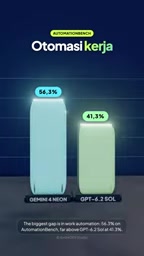
But the advantage isn't universal. On dense chart-reading tasks, GPT-6.2 Sol still holds a slight edge; in two coding tests, Claude Opus 5.5 also maintains a small lead. It's worth noting that these figures come from Google's own testing, and independent verification remains to be seen.
The Artificial Analysis Intelligence Index is a comprehensive model capability scoring system maintained by the independent evaluation firm Artificial Analysis. It aggregates results from multiple benchmark categories—reasoning, knowledge, coding, math, and more—and converts them into a single index using weighted scoring, making it easy to compare models from different vendors side by side. The index is characterized by broad coverage and frequent updates, but it is fundamentally a weighted aggregation of existing public benchmarks, so real-world performance on individual tasks may diverge from the index ranking. Therefore, when you see Neon leading on this index, it should be understood as "a higher overall average score" rather than superiority across all granular tasks—which explains why the article notes that it still trails competitors in chart reading and some coding tests.
Pricing and Availability: You Get What You Pay For?
Neon is priced higher than GPT-6.2 Sol per million input tokens, and its output token price is higher as well. However, its context window reaches the million-token level, making it attractive for long-document processing scenarios.

Neon is currently available to AI Pro and Ultra subscribers through the Gemini app, and has also launched on the Gemini API and the antigrafi platform.

The billing difference between input and output tokens is key to understanding large model pricing. The prompts, context, and documents users send to the model are input tokens, while the model's generated responses are output tokens. Because the output process requires token-by-token autoregressive decoding, its computational overhead is typically significantly higher than the parallel-processing input phase—which is why vendors' output prices are generally higher than input prices, by multiples ranging from two to several times. When evaluating costs, you shouldn't look at a single price in isolation but rather consider your actual business's input-to-output ratio: long-document summarization tasks are overwhelmingly input-heavy with very little output, whereas code generation and multi-turn conversations have a higher output share, amplifying the impact of output price differences. This is why the article emphasizes judging Neon's value for money in the context of specific use cases.
A million-level context window means the model can accommodate a total of roughly one million tokens in a single request—equivalent to several hundred pages of text. Its technical significance lies in allowing an entire book, a large codebase, or a long meeting transcript to be input in one go without chunking and multiple calls, thereby avoiding cross-chunk information loss and stitching errors. But long context isn't free: the computation and memory overhead of attention mechanisms grow with sequence length, and effective retrieval capability may degrade in the middle of very long inputs—the so-called "lost in the middle" phenomenon. So in long-document scenarios, beyond window size, you should also pay attention to the model's recall accuracy and actual response latency under long inputs.
Recommendations
If your workflow is primarily automation tasks and requires ultra-long context, Neon offers a clear cost-effectiveness advantage; if you focus on chart parsing or specific coding tasks, GPT-6.2 Sol and Claude Opus 5.5 remain reliable choices. Official self-reported data should be treated with caution—it's advisable to run your own real-world tests before making a migration decision.
One-line Summary
Gemini 4 Neon enters with mid-tier pricing and a million-token context; official benchmarks show it leading, but independent verification is still pending.
Paragraph Summary
Google has released Neon, the mid-tier model in the Gemini 4 family, positioned between the flagship and the lightweight version, with per-task costs about 32% lower than the flagship and aimed at high-frequency invocation scenarios. On the Artificial Analysis Intelligence Index, it scores higher than Claude Opus 5.5 and GPT-6.2 Sol, and Google claims it wins 16 of 19 benchmarks, with a clear advantage in workflow automation. However, it still trails GPT-6.2 Sol on chart-reading tasks, Claude Opus 5.5 holds a slight lead in two coding tests, and all data comes from Google's own testing. On pricing, Neon's per-million-token rate is higher than GPT-6.2 Sol's, but it offers a million-level context window. It is now available to AI Pro and Ultra subscribers and via the API; users are advised to test it in their own scenarios before deciding to migrate.
Related articles

Prompt Engineering for Beginners: From Writing Prompts to Engineering Thinking
Starting from the essence and four functions of prompts, this article systematically explains the six-step process, four success criteria, learning value, and practical limitations of prompt engineering to help you build a complete understanding.

Anthropic Launches Nasdaq IPO: AI Giant's Listing and Risk Disclosures
Anthropic officially launches its Nasdaq IPO under ticker ANT, with market valuation expected to potentially exceed SpaceX's record. The prospectus devotes nearly 100 pages to AI risks, while first-half revenue grew over 14x but net losses widened sharply, reigniting the AI bubble debate.

Rust cURL Clone Uses 4,832 unsafe Blocks—Is the Memory Safety Myth Broken?
A Rust cURL clone uses 4,832 unsafe keywords, challenging Rust's memory safety narrative. We analyze what unsafe really means, compare Fil-C, and examine rewrite motives.