Gemini 4 Pro vs. Opus 5 Max: Who Builds a Better 3D Dragon with Three.js?

Unreleased Gemini 4 Pro ties full-power Claude Opus 5 Max in a Three.js 3D dragon coding test.
This article documents an informal head-to-head test: the same prompt was given to the not-yet-released Gemini 4 Pro and Claude Opus 5 running at its highest Max tier, tasking both with building a 3D dragon from scratch using Three.js. The challenge comprehensively tests WebGL modeling, materials, lighting, and animation — with fully verifiable, visual output. Surprisingly, both models performed at roughly the same level, with Gemini holding its own against a fully-configured opponent. The piece draws two broader conclusions: the code generation gap between top models is narrowing fast, and compute configuration must be disclosed for any evaluation to be fair.
Same prompt, two top-tier models, one task: build a 3D dragon from scratch using Three.js. That kind of head-to-head comparison often reveals more about real-world coding ability than any benchmark leaderboard. This time, the contenders are the yet-to-be-released Gemini 4 Pro and Opus 5 running at full power in Max mode.
The Setup: An Uneven Playing Field
There's an important caveat worth establishing upfront: these two models are not starting from the same position. Opus 5 entered the ring in full Max mode — its highest-performance configuration — while Gemini 4 Pro hasn't officially launched yet, meaning the version tested is still being refined.
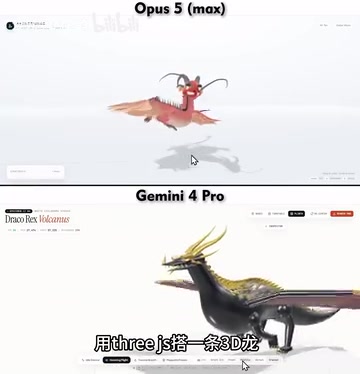
In other words, this is a matchup between a "pre-release newcomer" and a "fully-loaded veteran." Understanding that context is essential to appreciating what the results actually mean.

Building a 3D dragon in Three.js is a genuinely comprehensive challenge. It requires understanding WebGL and Three.js geometric modeling, handling materials, lighting, and animation across multiple dimensions — and producing a final result that actually runs in the browser. This kind of task can't be gamed by pattern-matching; it demands real code generation quality and engineering completeness.
Three.js is an open-source JavaScript 3D graphics library built on WebGL that lets developers create complex 3D scenes in the browser without writing low-level GPU instructions directly. Constructing a detailed 3D dragon involves simultaneously managing geometric modeling (skeletal structure, scaled surfaces), material and texture mapping, dynamic lighting and rendering, and skeletal or keyframe animation. The challenge for an AI model isn't just writing syntactically correct code — it's integrating all these subsystems into a single piece that runs correctly in a real browser and looks visually complete. Any missing logic or incorrect API call results in a blank screen or console error, and the output is immediately verifiable. There's nowhere to hide.
The Result: Gemini Hangs Tight
Based on the actual outputs, the conclusion surprised quite a few people: Gemini 4 Pro genuinely kept up — both models landed at roughly the same level.

Given that Opus 5 was running at full Max capacity while Gemini 4 Pro wasn't even finalized, the fact that it managed to stay neck-and-neck is telling. The creator's verdict: the performance was "impressively competitive."
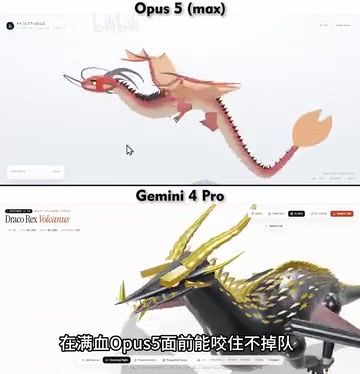
For a version that hasn't officially shipped, matching a top-tier competitor suggests the final release could push the ceiling even higher. It also reflects a broader trend: the gap between leading models in code generation is closing fast.
The "Max mode" for Claude Opus 5 refers to the highest compute inference tier Anthropic offers for the Claude series — typically meaning a longer context window, more internal reasoning steps (extended thinking), and reduced rate limits, at the cost of higher token prices and longer response times. In code generation tasks, Max mode allows the model to do deeper planning and self-verification before output, theoretically producing more structurally complete and logically rigorous code. Directly comparing this against a pre-release Gemini 4 Pro is essentially asking the latter to compete against an "overclocked" opponent under resource constraints. The fact that Gemini held its own suggests its underlying code generation ceiling is genuinely competitive.
Why This Kind of Comparison Matters
Benchmark scores are useful, but real developers care more about whether a model can write complex, runnable code in one shot. A Three.js 3D scene is exactly that kind of litmus test — it compresses abstract modeling ability, API familiarity, debugging logic, and aesthetic judgment into a single visual artifact.
Does the dragon look good? Is the animation smooth? Does the code throw errors? Users can judge all of this at a glance. That "what you see is what you get" quality makes this kind of comparison far more persuasive than dry benchmark numbers, and far more relevant to real productivity.
Two trends emerge clearly from these results. First, leading models have entered a phase of close-quarters competition in code generation — the differences between the top tier are increasingly subtle. Second, the compute tier and configuration a model runs at has a material impact on its output, and any fair evaluation needs to disclose that context upfront.
Closing Thoughts
A fully-loaded Opus 5 and an unreleased Gemini 4 Pro fought to a draw on the 3D dragon challenge — a testament to Gemini's potential, and a snapshot of the broader leap in code generation capability across the large model landscape. Whether the final release will tip the scales remains to be seen with more testing.
Who would you bet on? Drop your take in the comments.
Note: This article is based on a single comparison test by one content creator. The sample size is limited, and the results should be taken as a reference point only — not as a comprehensive ranking of either model's capabilities.
Related articles

JobRunner MCP Server: AI Agents Can Now Fix Failed Java Jobs
JobRunner launches an open-source MCP server enabling AI agents to view cluster status, diagnose failures, and recover Java jobs—incident response from any cloud coding environment or existing agent.

MLAI Digital Launches 9 Security Agents: MCP Server Safeguards the Full Lifecycle of Agentic AI
MLAI Digital launches Security MCP Server with nine built-in specialized security agents covering vulnerability discovery, attack simulation, prompt injection detection, API and infrastructure assessment, and accelerated remediation—embedding security validation across the full Agentic AI lifecycle from development to production.

Running Isaac Lab on H100 GPUs: Exploring Better Approaches
Exploring optimization methods for running Isaac Lab on NVIDIA H100 GPUs, including MIG configuration, mixed precision, TensorRT acceleration, and community experience to improve robotics simulation and reinforcement learning efficiency.