Gemini 4 Teaches a Humanoid Robot to Play Cornhole: A Breakthrough in Video Learning and Self-Iteration
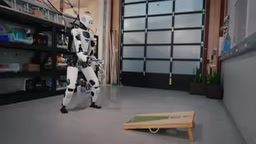
Gemini 4 taught a humanoid robot to play Cornhole from one demo video and simulator trial and error, making seven straight shots.
This article introduces a Google Gemini 4 Argon robot learning experiment: Gemini 4 was shown only one human Cornhole-throwing video, then practiced repeatedly in the Mojoku simulator. Instead of running a preset program, the robot watched failure replays to diagnose motion errors and adjust its stance, arm swing, and release timing. On a real humanoid, it made centimeter-level tweaks based on landing points and sank seven consecutive throws. The article argues the real value is validating a new paradigm—video-driven error diagnosis, cross-modal reasoning, and Sim-to-Real online calibration forming a self-improvement loop without handcrafted reward functions, pointing toward general-purpose robot learning.
From Video to Motion: Gemini 4's Robot Learning Experiment
How many lines of code does it take to teach a humanoid robot that has never touched a beanbag to play Cornhole? Google's Gemini 4 Argon team gave a surprising answer: just one human demonstration video, plus a simulator.
In this experiment, the research team showed Gemini 4 a video of a human completing a throwing task, then prompted it to run the Mojoku simulator to practice. The robot did not execute fixed motions according to a preset program; instead, it gradually corrected its behavior through repeated trial and error, observing video replays of each failure.
The core of this process is "learning from experience"—the robot extracts information from the outcome of each throw, analyzes the source of deviation, and adjusts its strategy in the next round. This closed-loop learning mechanism allowed Gemini 4 to demonstrate adaptive capabilities beyond traditional robot programming paradigms.
Cornhole is a popular outdoor throwing game in North America: players stand a certain distance away and toss small beanbags filled with corn kernels into a circular hole on an inclined wooden board, scoring points for each successful throw. What appears to be a simple motion actually places comprehensive demands on the thrower's stance, arm-swing trajectory, release timing, and force control, which is why it is often used as a task vehicle for testing a robot's integrated perception–decision–control capabilities. Its challenge lies in this: the target is small, the distance is long, and it is extremely sensitive to release-point error—a deviation of just a few centimeters can mean the difference between a hit and a complete miss. This precisely exposes a robot's shortcomings in visual estimation and fine motor control, and also makes the ability to "iteratively adjust from failure" quantifiable and observable.
Humanoid Robot refers to a bipedal robot whose appearance and motion structure mimic the human body, typically featuring a head, two arms, two legs, and multi-degree-of-freedom joints. Compared with wheeled or robotic-arm-style robots, humanoid robots have a clear advantage in throwing tasks: they can directly draw on human demonstration motions, and behavioral patterns such as stance, arm swing, and torso rotation can naturally map onto their own joint coordinates. But their difficulties are equally prominent—bipedal balance, serial joint errors, and motor response delays all compound and amplify motion deviations. Therefore, for humanoid robots, Sim-to-Real transfer is typically harder than for fixed-base robotic arms.
Self-Optimization in the Simulator: Finding Answers in Failure Videos
The Mojoku simulator played a key role in this experiment. It was not just a practice ground but also a data generator—each throw produced a video record, and Gemini 4 needed to "understand" the problem from these videos.
According to the experiment description, Gemini 4 was able to reason through its video understanding capabilities and precisely pinpoint the cause of failure. For example, after one simulated practice session, it summarized: "Third, I practiced the throwing simulation, widening my stance and adjusting my arm swing so that my hand could clear my hip cleanly and throw a smooth arc."
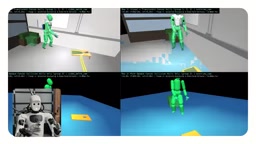
This self-description reveals Gemini 4's reasoning chain: it can not only identify motion deviations but also translate correction plans into specific bodily instructions—stance width, arm-swing trajectory, release timing. This cross-modal mapping from visual understanding to motor control is precisely a frontier challenge in the current field of robot learning.
Cross-modal Mapping refers to a model's ability to establish semantic correspondences between different information modalities. In this experiment, it specifically manifests as follows: Gemini 4 identifies problems such as a too-narrow stance and an unsmooth arm-swing trajectory from the "visual modality" of video frames, then translates this visual diagnosis into executable parameters in the "motor modality," such as hip width, arm-swing arc, and release timing. This process is difficult because there is no natural correspondence between visual language descriptions ("cleanly clearing the hip") and robot joint control commands (angles, angular velocities, torque curves); the model must establish a shared abstract representation of the two during training. Only a model with this capability can directly turn "understanding the problem" into "correcting the motion."
The Mojoku simulator plays a dual role in the text as both a "practice ground" and a "data generator." Compared with traditional rigid-body physics simulators, it additionally provides video replay output, so that each attempt leaves behind a visual record of failure. In this way, Gemini 4 does not need to rely on numerical reward signals handcrafted by engineers; it can directly extract information about "what went wrong" from the video. This approach of replacing scalar rewards with video is precisely the technical basis for the experiment's claim of "reducing dependence on manual reward function design": the learning signal is generated by the model's own video understanding capability rather than specified by external rules.
Centimeter-Level Adjustments on a Real Robot
Success in the simulator does not automatically equal victory in the real world. When Gemini 4 controlled a real humanoid robot, it faced the uncertainties of the physical world: subtle changes in friction, response delays in joint motors, and slight differences in beanbag weight.
Experiment records show that Gemini 4 adopted a progressive adjustment strategy on the real robot: "I observed the landing point of each beanbag and adjusted the release point by a few centimeters until we made seven consecutive throws into the hole."
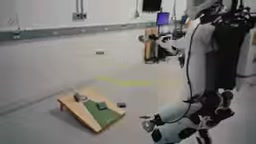
The transfer from simulation to reality (Sim-to-Real) has always been a difficult problem in robotics. Gemini 4's approach was to perform online calibration through real-time visual feedback rather than relying on precise physical modeling. This method is closer to how humans learn—first establishing a rough motion framework, then fine-tuning parameters based on actual results.
Seven consecutive hits is a noteworthy achievement for a robot that was not preprogrammed with a throwing trajectory. It means Gemini 4 not only learned "how to throw" but also learned "how to adjust the throw according to the environment."
Sim-to-Real transfer refers to the process of deploying a policy trained or optimized in a simulated environment onto a real physical system. It is difficult because simulation cannot perfectly reproduce physical details in reality: friction coefficients, air resistance, object mass distribution, motor dead zones and response delays, sensor noise, and so on can all cause motions that are "perfect" in simulation to deviate from expectations in reality. Traditional solutions usually fall into two categories: one is "domain randomization," deliberately adding large perturbations to physical parameters in simulation so that the policy becomes more robust to uncertainty; the other is building accurate physical models for calibration. Gemini 4 took a third path—abandoning precise modeling and instead relying on real-time visual feedback after deployment for online calibration, treating the real world as just another round of "practice" and continuously correcting release parameters using observed landing-point deviations. This approach places higher demands on the model's online inference speed and visual feedback loop, but it eliminates the cumbersome process of physical parameter calibration.
Why Self-Iteration Is So Exciting
Perhaps the most striking part of the experiment is not how many balls the robot ultimately made, but the self-iteration capability it demonstrated.
"Gemini 4 is able to reason through video understanding, narrow down the problem, and identify where things went wrong. It learns from its own experience, which is very exciting."

The significance of this capability is that it reduces dependence on manual reward function design. Traditional reinforcement learning requires engineers to carefully design reward signals, whereas Gemini 4 directly understands the visual difference between "success" and "failure" from video, turning video understanding capability into a learning signal.
Of course, this experiment is still early-stage exploration. There is still a huge distance between one successful throwing task and general-purpose robot skills. But it points to a direction: when large models possess sufficient video understanding and reasoning capabilities, robot learning may no longer require massive annotated data or complex reward engineering—a single human demonstration video plus a trial-and-error loop may be enough to initiate the learning process.
Reward Function Design is one of the most critical and labor-intensive parts of traditional reinforcement learning. To teach an agent a task, engineers must write "what is good and what is bad" as a computable numerical signal, for example, "the closer the beanbag is to the hole, the higher the score." If the reward is poorly designed, the model may learn to exploit loopholes (such as shaking in place to cheat for points), or it may fail to learn because the signal is too sparse. In this experiment, Gemini 4's approach bypasses this step: it does not need artificially defined scores but directly judges success or failure and locates errors from the video replay of each throw, treating the result of video understanding as the learning signal. This means that "what counts as success" is judged by the model's visual common sense rather than written out item by item by engineers. For general-purpose robot scenarios with many task types and success criteria that are difficult to quantify into formulas, this path that eliminates reward engineering has clear scalability advantages.
Implications for the Robot Learning Paradigm
Gemini 4's Cornhole experiment is essentially testing a hypothesis: can multimodal large models become a general engine for robot learning?
From the experimental results, the answer is preliminarily yes. Gemini 4 demonstrated three key capabilities:
- Video-understanding-driven error diagnosis—identifying motion deviations from replays
- Cross-modal reasoning—translating visual analysis into specific motor parameter adjustments
- Sim-to-Real adaptation—fine-tuning motions in the physical world through real-time feedback
Combined, these capabilities form a self-improvement loop that requires no human intervention. For the robotics research community, this may be more valuable than the robot making a Cornhole shot itself—it demonstrates a potential path toward general-purpose robot skills.
As video understanding models continue to advance, we may see more experiments like this in the future: not teaching robots to complete specific tasks, but teaching them how to learn tasks on their own.
One-line Summary
With just a single human demonstration video and trial and error in a simulator, Gemini 4 taught a humanoid robot to play Cornhole and make seven consecutive shots.
Paragraph Summary
This article introduces a robot learning experiment by Google's Gemini 4 Argon team: the team showed Gemini 4 only one video of a human throwing a Cornhole bag, then had it practice repeatedly in the Mojoku simulator. The robot did not execute a preset program; instead, by watching video replays of each failure, it autonomously diagnosed motion deviations and adjusted its stance, arm-swing trajectory, and release timing. On a real humanoid robot, it further made centimeter-level fine adjustments based on the beanbag's landing point, ultimately sinking seven consecutive throws. The article notes that the value of this experiment lies not in the throwing itself, but in validating a new paradigm: video-understanding-driven error diagnosis, cross-modal reasoning, and Sim-to-Real online calibration combine to form a self-improvement loop that requires no manually designed reward function, pointing to a potential path for general-purpose robot learning.
Related articles

FlexBudget: Fair Comparison of KV Cache Eviction Strategies Under a Unified Compute Budget
AMD engineer proposes FlexBudget at PyTorch Conference: a training-free fair comparison method for KV cache eviction rules using fixed kernels and memory budgets, all in core PyTorch.

Anthropic's $2 Trillion Valuation Deconstructed: Why the AI IPO Wave Keeps Faltering

Anthropic IPO Countdown: The Compute Cost Ledger Behind a $2 Trillion Valuation
Anthropic's IPO targets up to $2 trillion — double its Series H valuation. We break down the timeline, compute cost logic, and the key question investor day must answer.