Gemini Audio Classification in Practice: Real-Time Emotion and Topic Recognition
Gemini's native audio capabilities enable real-time multi-dimensional audio judgments through a lightweight Streamlit app, but accuracy remains limited.
The article introduces Gemini's native audio modality and demonstrates it via a Streamlit demo using uv. The app feeds browser audio to Gemini in real time, outputting emotion, sentiment, whisper, and topic judgments in parallel. While the model uses paralinguistic features for emotions and semantics for topics, limitations include whisper detection being misled by the word "whispering" and topic drift with insufficient context. The author suggests it's best as a pre-screening tool for real-time interaction, content rough screening, and multi-dimensional tagging, rather than a high-accuracy arbiter.
When Large Models Learn to "Listen": Gemini's Native Audio Capabilities
Most people associate Gemini with text chat and image understanding, but its decision model natively supports the audio modality. This means the model can directly receive sound signals and output structured judgments without first going through speech-to-text and then processing. The video presenter summed up the value in one sentence: it enables "real-time classification or decision-making based on voice input."
The scenarios this opens up are concrete—customer service quality inspection, live content moderation, accessibility interactions, emotion-aware applications—all fall under the need to "listen and judge on the fly." Traditional solutions often require stitching together ASR (automatic speech recognition) and downstream classification models, resulting in long pipelines and high latency, whereas native audio input allows judgment to occur in sync with speech.
Native Audio Modality refers to the model treating audio signals as an input form on par with text and images during pre-training, rather than indirectly processing sound through an external speech recognition module. Native audio models typically encode based on spectrograms or raw waveforms, preserving paralinguistic information such as intonation, speech rate, pauses, and timbre—features that are largely lost when ASR transcribes to text. This is why Gemini can judge sadness from a single sigh, while a cascaded "ASR + text classification" approach almost cannot. Another advantage of native audio input is lower latency: by eliminating the transcription step, the path from sound to judgment is shorter, closer to real-time interaction requirements. However, native audio models face higher training data scale and annotation difficulty than pure text, and their robustness in noisy environments, diverse accents, and mixed-emotion scenarios remains an active research area.
A Streamlit App Puts the Capability to Work
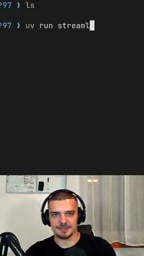
The presenter didn't stop at the conceptual level but directly ran a web application: uv run streamlit run app.py. After launch, users speak in the browser, and the app feeds the audio stream into the Gemini decision model, providing multi-dimensional judgments in real time.
The tech stack choice is lightweight—uv handles environment and dependency management, Streamlit handles the interactive interface, and Gemini handles inference. This combination keeps the development cost of a real-time audio demo very low, suitable for rapid idea validation. For developers wanting to reproduce it, this is almost the shortest path.
You might not have noticed that a low barrier to entry for such demos doesn't mean weak capability. Real-time audio stream processing typically involves chunking, buffering, and concurrent requests, and the app's response to spoken content in the demo is continuous and immediate, indicating the entire pipeline is working.

uv is a Python package and environment management tool launched by the Astral team (developers of Ruff), written in Rust, known for extremely fast dependency resolution and installation speed. It consolidates the functionality of tools like pip, virtualenv, and pip-tools, supports declaring dependencies via pyproject.toml or inline script metadata, and can automatically create isolated environments. The uv run command ensures dependencies are ready before executing the script, eliminating the need to manually activate virtual environments. Streamlit is a Python framework for data and AI applications; developers can build interactive web interfaces with ordinary scripts without frontend code. It has built-in support for components like audio recording and file upload, and achieves near-real-time refresh through session state management. Combined with the Gemini API, the code for a real-time audio demo can be kept within dozens of lines, making it ideal for rapid prototyping.
What the Model Judges in Real Time
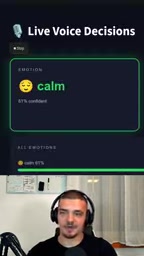
The most interesting part of the demo is the four types of signals the model outputs in parallel: emotion, sentiment, whether whispering, and topic. These four actually cover two layers of audio understanding—paralinguistic features and semantic content.
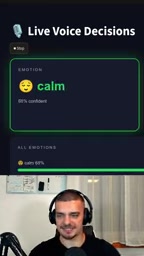
- Paralinguistic features: Emotion and whispering detection belong to "how it's said." The presenter noted that the model relies not only on word choice but also on tonality. When he makes specific sounds, it triggers corresponding emotion recognition: a sigh is identified as sadness, an exclamation as surprise.
- Semantic content: Topic judgment belongs to "what is said." When discussing AI, the model gives related topics; when discussing pizza, it identifies "food." There was also a deviation in the demo—the model labeled the topic as "philosophy," showing that topic classification can drift when context is insufficient.
This multi-task parallel design allows a single audio input to simultaneously produce labels across multiple dimensions, providing higher information density for downstream applications.
Paralinguistic Features are the information layer in speech that does not carry literal semantics but conveys the speaker's state and intent, including intonation curves, speech rate, volume, pause patterns, and voice quality (such as breathiness or trembling). Emotion recognition and whispering detection essentially rely on this layer: the same sentence spoken with different intonations can express completely opposite emotions. In contrast, semantic content is the meaning conveyed by the words themselves, and topic classification mainly relies on this layer. Native audio models can utilize both channels simultaneously, but therefore face a "channel crosstalk" problem—when semantic cues (such as saying the word "whispering") conflict with acoustic features, the model may erroneously prioritize semantics. This phenomenon is called "semantic-acoustic inconsistency" in speech emotion recognition research and is an important test dimension when evaluating audio classification models.
Where the Boundaries Are: Honestly Assessing the Demo's Limitations
The presenter repeatedly emphasized that "this is not perfect." The most typical example is whispering detection: when he explicitly mentions the word "whispering" in speech, the model immediately judges it as whispering—it was led astray by semantic cues. Additionally, during actual whispering, detection also intermittently triggers and disconnects.
This exposes a common challenge in audio classification: paralinguistic judgments are easily contaminated by semantic content. When the model hears the word "whispering," even if the voice is not quiet, it may output a positive judgment. True whispering detection requires the model to rely more on acoustic features rather than textual cues.
Emotion triggering is similar. The presenter uses voice to trigger sadness and surprise, and the effect is intuitive, but this triggering is based on obvious changes in timbre and intonation. For real conversations with flat tones and mixed emotions, the stability of judgments will be a greater test.
Implications for Developers
The real value of this demo is not in listing features like "the model can recognize emotions," but in validating an engineering path: using an extremely thin wrapper layer to connect native audio models into real-time interactive applications. For teams wanting to add voice understanding capabilities to their products, this means they don't need to build complex audio processing pipelines themselves.
Applicable scenarios can be grouped into several categories: interactions requiring immediate feedback (such as emotion-aware conversational assistants), content scenarios requiring batch rough screening (such as live streaming topic and emotion tagging), and analysis scenarios requiring multi-dimensional labels. The premise is to have reasonable expectations for accuracy—treating it as a "pre-screener" rather than an "arbiter" is closer to the actual level of current capabilities.
Audio as a native input modality for models is moving from "can recognize" to "can judge in real time." This demo shows one small step in that direction, but the direction is clear enough.
One-line Summary
Gemini's native audio capabilities can enable real-time multi-dimensional audio judgments through a lightweight Streamlit app, but accuracy remains limited.
Paragraph Summary
The article introduces the native audio modality capabilities of the Gemini decision model and demonstrates its practical effects through a Streamlit demo. The app uses uv for environment management and Streamlit for the interface, feeding audio streams recorded in the browser to Gemini in real time, outputting four types of judgments in parallel: emotion, sentiment, whether whispering, and topic. The model can recognize sadness and surprise based on paralinguistic features like intonation, and judge topics based on semantic content, but the demo also exposes clear limitations: whispering detection is disturbed by the semantic cue of the word "whispering," and topic classification drifts when context is insufficient. The author concludes that this solution is currently better suited as a pre-screening tool, providing a low-cost engineering path for real-time interaction, content rough screening, and multi-dimensional tagging scenarios, rather than a high-accuracy adjudication system.
Related articles

Did the Iran War Accidentally Accelerate the Clean Energy Transition? An Energy Expert's Deep Dive
Columbia professor Jason Bordoff analyzes how the Iran war unexpectedly accelerated the global clean energy transition: the Strait of Hormuz crisis, diesel price shocks, China's strategic reserves, and why energy security drives green tech adoption more than climate goals.
Immortality of Consciousness: How Scientists Aim to Let the Brain Outlive Life
MIT Technology Review roundtable on 'mind immortality': scientists explore brain preservation and consciousness continuation, confronting identity and ethical dilemmas.
Databricks Releases 70 Industry-Specific Interactive Reference Architectures
Databricks launches interactive reference architectures covering 70 industries, helping data teams explore lakehouse components and data flows by industry and use case—no more one-size-fits-all architecture slides.