Databricks Releases 70 Industry-Specific Interactive Reference Architectures
Databricks launches an interactive reference architecture library covering 70 industries, moving architecture design from generic templates to scenario-specific implementation.
Databricks released an interactive reference architecture library covering 70 industries, addressing the pain point that traditional generic architecture slides fail to reflect industry differences. The library lets users browse recommended components and data flows by industry and use case, lowering design costs and aiding pre-sales and internal reviews. Coverage of 70 industries signals Databricks' expansion beyond internet and finance into manufacturing, healthcare, retail, and the public sector. The article cautions that reference architectures are only a starting point and must be tailored to each enterprise's stack, governance, and team capabilities.
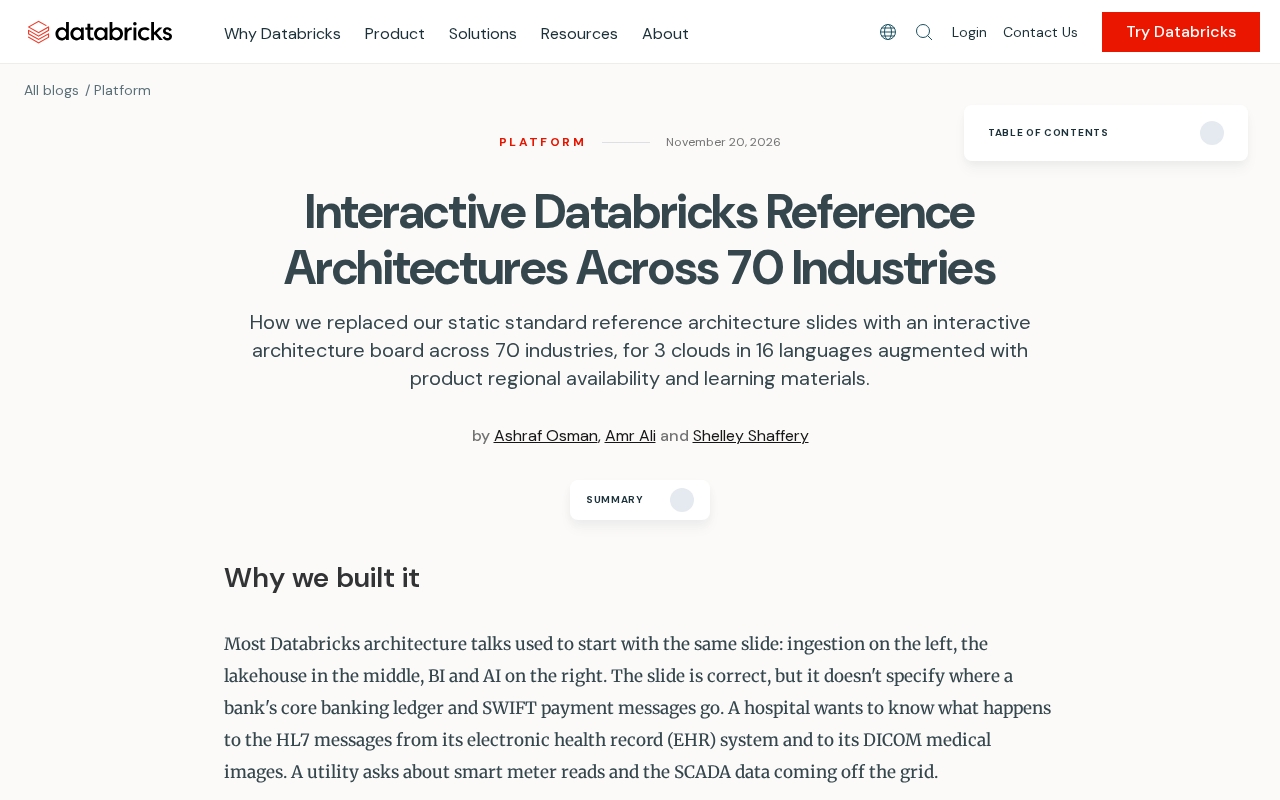
In the world of data and AI platforms, architecture design often determines whether a project succeeds or fails. Databricks recently launched an interactive reference architecture library covering as many as 70 industries, attempting to solve a problem that has long plagued data teams: how to quickly adapt a generic lakehouse architecture to specific business scenarios.
Starting from the cookie-cutter architecture diagram
According to Databricks' official explanation, most Databricks architecture discussions in the past began with the same slide—data ingestion on the left, data consumption on the right, and the lakehouse in the middle. While this generic template is clear, it struggles to reflect the enormous differences across industries in data sources, compliance requirements, and processing workflows.
The newly released interactive reference architectures are a direct response to this pain point. Users can explore targeted architecture components and data flows based on their industry and specific use case, rather than having to mentally fill in implementation details on an abstract diagram.
Lakehouse Architecture is an architectural paradigm that combines the strengths of data lakes and data warehouses. Data lakes excel at storing massive amounts of raw data at low cost and support structured, semi-structured, and unstructured formats, but lack transactional guarantees and efficient query capabilities; data warehouses are more mature in data governance, SQL performance, and consistency, but struggle to handle diverse data. Lakehouse architecture introduces open table formats (such as Delta Lake, Apache Iceberg, Apache Hudi), a metadata layer, and a transaction log on top of the data lake, giving raw storage ACID transactions, schema evolution, time travel, and efficient indexing capabilities. Different consumption scenarios—data marts, BI reports, machine learning training—can share the same data foundation, reducing data movement and redundant copies. Understanding this layer helps grasp the core positioning of "the lakehouse in the middle" in Databricks reference architectures—it is not merely a storage component, but a data foundation that unifies batch processing, stream processing, and AI workloads.
What 70 industries means
Covering 70 industries is a noteworthy number. It shows that Databricks is no longer serving only data-mature sectors like internet and finance, but is expanding into a broader range of industries including manufacturing, healthcare, retail, and the public sector.
For data engineers and architects, the value of reference architectures lies not in copying them wholesale, but in providing a starting point. The interactive format allows users to browse recommended components across ingestion, transformation, and serving by industry, lowering the cognitive cost of designing an architecture from scratch.
Reference Architecture is a standardized architectural blueprint for a specific problem domain, typically published by vendors or standards organizations, describing recommended technical components, data flows, integration approaches, and deployment constraints. It differs from a directly runnable product or solution template—it is a "validated design starting point" that helps teams align with industry conventions and avoid common pitfalls early in solution design. Reference architectures often include logical architecture diagrams, component selection recommendations, and descriptions of non-functional requirements (such as availability, compliance, and scalability), but do not bind to specific implementation details. Therefore, their value lies in reducing cognitive and communication costs rather than replacing customized design for an enterprise's actual situation. In data platform projects, reference architectures are often used in pre-sales solution discussions, architecture reviews, and migration planning; teams must tailor them to their own data scale, technology stack, and governance requirements to turn them into actionable implementation plans.
The practical value of interactive design
Traditional reference architectures are mostly published as static diagrams or PDFs, which are slow to update and hard to search. An interactive architecture library allows filtering by industry and use case, helping teams quickly locate relevant patterns.
This format is also practically useful for pre-sales consulting and internal solution reviews: discussions can start from an industry-specific architecture view rather than repeatedly returning to that generic slide.
Ingestion, Transformation, Serving is a typical three-stage data flow division in data platforms. The ingestion layer is responsible for collecting raw data from business databases, logs, message queues, SaaS APIs, or file systems, with common methods including batch extraction, CDC (change data capture), and streaming ingestion; the transformation layer handles data cleaning, standardization, aggregation, and modeling, usually through declarative pipelines or a mix of SQL and code, with emphasis on data quality validation and lineage tracking; the serving layer faces downstream consumers, including BI queries, ad-hoc analysis, feature stores, application APIs, and report distribution. The boundaries between the three layers are not absolute—modern lakehouse platforms often support landing data directly in open formats after ingestion, then completing transformation and serving through a unified engine, thereby reducing ETL movement. Understanding this layering helps quickly identify the responsibilities and interactions of components when browsing industry reference architectures.
What it means for data teams
The expansion of industry reference architectures reflects that enterprise data platform construction is shifting from generic capabilities to scenario-specific implementation. When planning lakehouse projects, teams can use these architectures to quickly align with industry best practices, then tailor them to their own data situation.
It is worth noting that reference architectures are only a starting point. Real architectural decisions still need to consider the existing technology stack, data governance requirements, and team capabilities; industry templates cannot be directly equated with implementation plans.
Conclusion
Databricks' interactive reference architecture library advances architecture discussions from generic slides to the industry scenario level. The coverage of 70 industries is worth the attention of data teams, but how to turn reference architectures into actionable plans still depends on understanding one's own business and data situation.
One-line Summary
Databricks launches an interactive reference architecture library covering 70 industries, driving architecture design from generic templates toward scenario-specific implementation.
Paragraph Summary
Databricks released an interactive reference architecture library covering 70 industries, addressing the pain point that traditional generic architecture slides struggle to reflect industry differences. The article notes that most architecture discussions in the past began with the same generic "ingestion—lakehouse—consumption" diagram, which could hardly capture differences across industries in data sources, compliance, and processing workflows. The new architecture library allows users to browse recommended components and data flows by industry and use case, lowering the cognitive cost of designing architectures from scratch and facilitating pre-sales consulting and internal solution reviews. The coverage of 70 industries shows that Databricks is expanding from internet and finance into manufacturing, healthcare, retail, and the public sector. The article also reminds that reference architectures are only a starting point; real implementation still requires tailoring to an enterprise's existing technology stack, data governance requirements, and team capabilities, and industry templates cannot be directly equated with implementation plans.
Related articles

Did the Iran War Accidentally Accelerate the Clean Energy Transition? An Energy Expert's Deep Dive
Columbia professor Jason Bordoff analyzes how the Iran war unexpectedly accelerated the global clean energy transition: the Strait of Hormuz crisis, diesel price shocks, China's strategic reserves, and why energy security drives green tech adoption more than climate goals.

Gemini Audio Classification in Practice: Real-Time Emotion and Topic Recognition
Build a real-time audio classification app with Streamlit and Gemini audio decision model, demonstrating emotion, sentiment, whisper detection, and topic recognition, plus its technical path and current limitations.
Immortality of Consciousness: How Scientists Aim to Let the Brain Outlive Life
MIT Technology Review roundtable on 'mind immortality': scientists explore brain preservation and consciousness continuation, confronting identity and ethical dilemmas.