Gemini Carbon Released: Google's New Flagship for Agents and Security Defense

Gemini Carbon is a specialized flagship model for agents, software engineering, and cybersecurity.
Google DeepMind launched Gemini Carbon just two weeks after Gemini Argon. Positioned for continuously running agentic workflows, long-horizon software engineering, and cybersecurity, it offers a 1M-token context, native multimodality, and gains in long-horizon execution, end-to-end security, and hallucination reduction. It ranks impressively on intelligence and speed but is costly, with a cautious, limited first-week release for security teams.
Google DeepMind is at it again. Just two weeks after the launch of its previous-generation model Gemini Argon, the company has released a new flagship model, Gemini Carbon. Such a rapid cadence of updates has left the outside world curious about its positioning. Drawing on official information and third-party evaluations, this article breaks down Carbon's core capabilities, its target use cases, and what it means for ordinary users.
Clear Positioning: Built for Continuously Running Agents
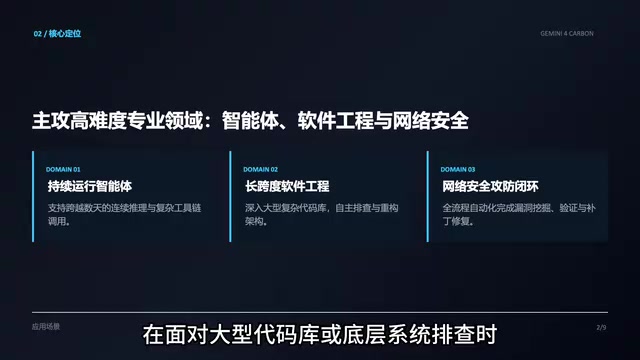
Google is unambiguous about Gemini Carbon's positioning: it is designed for continuously running agentic workflows, long-horizon software engineering, and cybersecurity defense. This sets it sharply apart from general-purpose chat models aimed at the masses.
The release strategy is notably cautious as well. Because Carbon demonstrates extremely strong capabilities in system vulnerability detection and analysis, Google proactively took part in the relevant model testing process before the public launch, and chose to open it in the first week only to professional cybersecurity teams and security researchers on a limited basis, gradually extending it to enterprise and developer markets afterward.

On the technical side, Carbon retains a 1-million-token long context window and natively supports multimodal processing of text, images, video, and speech. This provides the foundation for long-cycle tasks—whether it's a large codebase or low-level system troubleshooting, the model can maintain sufficient informational coherence within a single context.
Agentic Workflow refers to a model that no longer just does single-turn Q&A, but instead acts like an executor: autonomously planning steps, invoking tools, reading feedback, and looping tasks forward. Compared with chat models, it requires the model to maintain goal consistency over long time spans, remember context, and handle intermediate failures. Long-horizon software engineering involves changes spanning multiple files and multiple commits, requiring the model to understand the overall structure of a codebase rather than isolated fragments. Cybersecurity defense scenarios place even greater emphasis on caution: the model must both discover vulnerabilities and assess risk levels and generate remediation suggestions—any false positive or overconfidence can carry real risk. Together, these three scenarios point to one core requirement: the model must remain reliable over long cycles and high uncertainty, rather than chasing fluency in a single response.
Three Major Technical Improvements: Long-Horizon Execution, Security Closed Loop, and Hallucination Suppression
Enhanced Long-Horizon Autonomous Execution
According to the official description, Carbon is designed to support workloads that run for days. When tackling a large codebase or low-level system troubleshooting, if it hits a roadblock in its reasoning, it can autonomously adjust its strategy and try a new path instead of simply halting with an error. This ability to "pivot when blocked" is a key threshold for agents moving from demos to production environments.
Breakthrough in End-to-End Cybersecurity Capabilities
In automated cybersecurity testing, Carbon can not only uncover hidden vulnerabilities but also analyze whether a vulnerability carries risk and attempt to automatically generate remediation patches, forming a closed loop from discovery to fix. This explains why Google was so restrained in its release cadence—with greater capability comes greater responsibility.
Safety Alignment and Reduced Hallucination
Compared with the previous-generation model, Carbon has improved in the rigor of its logical reasoning. Official data shows that its fabrication of unsupported information has decreased by about 5%. When evidence is insufficient, the model explicitly lists the missing information rather than forcing out an uncertain answer. For engineering and security scenarios that demand high reliability, this restraint—knowing what it knows and acknowledging what it doesn't—is more valuable than fluent expression.
Hallucination refers to a model generating content that appears plausible but lacks factual basis, and it is especially harmful in engineering and security scenarios—for example, fabricating nonexistent vulnerabilities or incorrect remediation code. Safety Alignment refers to training and policy constraints that make model behavior conform to expected safety boundaries, including refusing dangerous requests and exercising restraint when evidence is insufficient. The "about 5% reduction in fabricated unsupported information" mentioned in the article is a relative improvement, meaning hallucination has not been eliminated but only reduced in probability; in high-reliability scenarios, key conclusions still require human review. When evidence is insufficient, the model listing the missing information is essentially an ability to "express uncertainty," which is more conducive to subsequent human judgment than forcing an answer.
Third-Party Evaluations: Top-Tier Reasoning, Impressive Speed, Relatively High Cost
According to comprehensive assessments by organizations such as Artificial Analysis, Gemini Carbon has achieved a very impressive ranking on the overall intelligence index, demonstrating top-tier reasoning. Its output speed exceeds 100 tokens per second, which is excellent among large models of comparable scale.
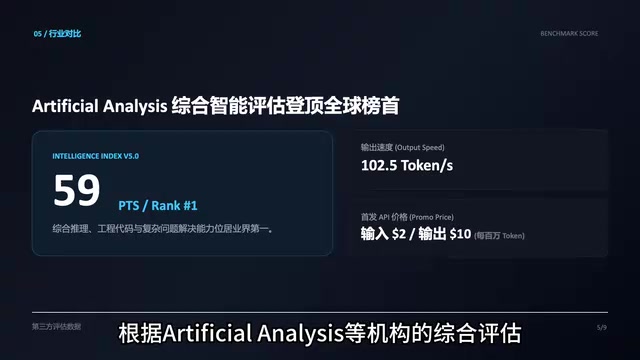
On cost, however, as a high-end reasoning model, its API pricing is relatively high. Because its reasoning process is fairly detailed, the volume of text output when handling complex tasks tends to be long, further driving up the actual cost of use.
Artificial Analysis is an independent large-model evaluation organization that conducts horizontal comparisons of mainstream models' intelligence index, output speed, and pricing through standardized tests, and its rankings are often used as a reference for model selection. The overall intelligence index is typically derived from multi-dimensional benchmarks covering reasoning, knowledge, coding, and more, reflecting a model's overall capability rather than performance on a single task. Output speed, measured in tokens generated per second, directly affects interaction experience and batch task throughput; however, speed and reasoning depth often involve a trade-off—high-end reasoning models take longer per task and cost more because they need to generate a longer thought process. Understanding these metrics helps clarify that Carbon's impressive ranking does not mean it is optimal in every scenario; cost and latency are equally critical constraints in production environments.
What It Means for Ordinary Users: Indirect Ecosystem Benefits
To put it plainly, you probably won't use Carbon directly for everyday typing and chatting. It is not meant for casual conversation or short essays; its responses lean toward lengthy exposition and deep reasoning, and it is costly. In the Gemini app day to day, people will still use lighter, lower-cost models.
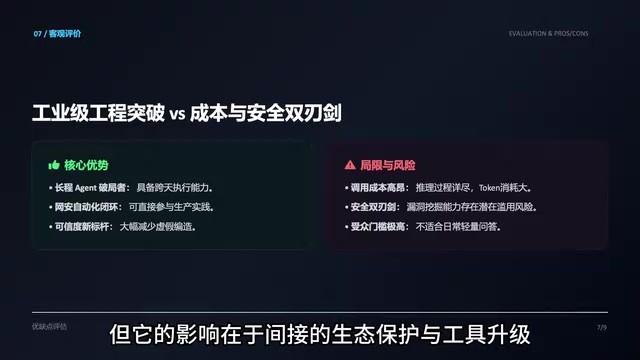
But its impact is indirect and far-reaching. On the one hand, software will be safer—developers use it to automatically detect code in the background, so the software and apps we use daily will have fewer security vulnerabilities. On the other hand, productivity tools will become more powerful—AI coding assistants or automated workflow tools will be able to help you tackle longer-spanning, more complex engineering problems in the future.
Objectively speaking, Gemini Carbon is not an all-purpose entertainment assistant for mass consumers, but a hard-hitting card that Google DeepMind is playing for enterprise-grade cybersecurity defense and complex software engineering. It marks large models accelerating from merely generating text toward autonomously solving engineering challenges.
One-line Summary
Gemini Carbon is a specialized flagship model for agents, software engineering, and cybersecurity.
Paragraph Summary
Just two weeks after the launch of Gemini Argon, Google DeepMind introduced a new flagship model, Gemini Carbon, positioned as a dedicated model for continuously running agentic workflows, long-horizon software engineering, and cybersecurity defense, setting it apart from mass-market chat models. It retains a 1-million-token long context and native multimodal capabilities, with improvements in long-horizon autonomous execution, an end-to-end cybersecurity closed loop, and hallucination suppression. Third-party evaluations show an impressive overall intelligence index ranking and output speed exceeding 100 tokens per second, but API pricing is relatively high and output text volume is large. The release strategy is cautious, limited in the first week to security teams and researchers. Ordinary users won't use it directly day to day, but will benefit indirectly from a safer software ecosystem and stronger AI coding and automation tools.
Related articles

AI Tools Quietly Altering Settings: Postman Silently Installs Plugin, Codex Sharing Option Auto-Resets
AI Daily reports: Postman silently installs a Mac plugin and self-approves startup hooks, logged as auto-existing upgrade; Hacker News developers say Codex data-sharing opt-out flips back. Plus Simon Willison's raw float weight experiment with QEN 3.8-27B.

AI Learns to Rewrite AI: MIT's "Weightspace Programming" Redraws the Path to Recursive Self-Improvement
MIT team proposes weightspace programming: GPT-6 Astra reads and edits AI model weights directly. Math scores jump several-fold, hand-written networks beat trained models. Eight experiments analyzed, plus Anthropic's same-day warning and the real boundaries of recursive self-improvement.

Running Qwen 3.8 on a Laptop to Read Raw Weights: 46 Minutes Per Answer
Simon Willison reproduced weight space programming with Qwen 3.8 27B on a laptop: a 17GB model file, 46 minutes per answer, 43,506 reasoning tokens, Pong over an hour, Freeway failed. Suited for interpretability researchers.