Gemini Daily Brief Feature Explained: How Google's AI Assistant Proactively Plans Your Daily To-Dos

Google Gemini launches Daily Brief to proactively generate daily to-do lists for users
Google Gemini has launched "Daily Brief," a feature that automatically analyzes users' schedules, emails, and tasks each day to generate a concise to-do list. This marks a major shift in AI assistants from passive response to proactive service. Google leverages its complete ecosystem including Gmail and Calendar for data integration advantages, though it also faces privacy protection challenges. Proactive AI is becoming the new competitive focus among Google, Apple, Microsoft, and other tech giants.
Overview
Google Gemini has recently launched a new feature called "Daily Brief" that proactively organizes the most important tasks of the day for users, presenting them in a concise, easy-to-read to-do list format. This means users can have a clear picture of their day's schedule even before finishing breakfast.
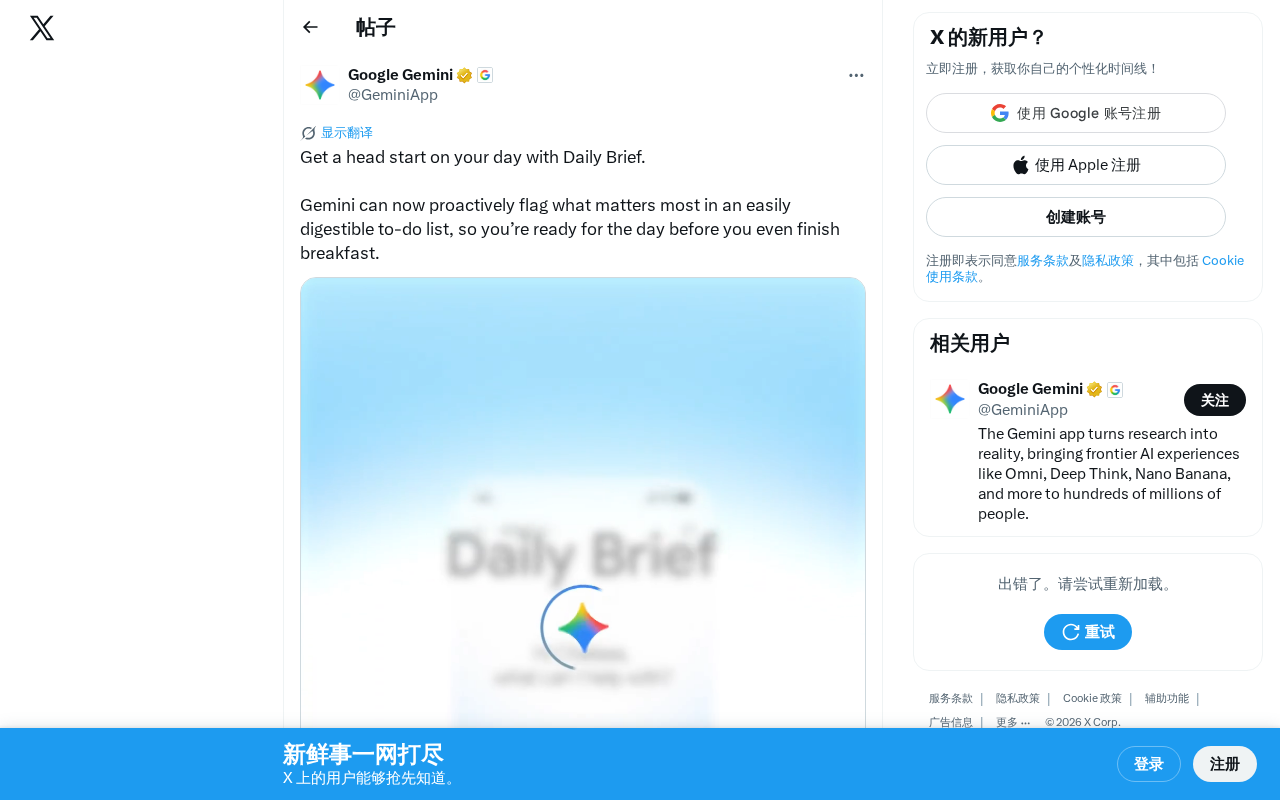
From Passive Response to Proactive Service: The Core Philosophy of Gemini Daily Brief
What is Gemini Daily Brief?
Daily Brief is a new proactive intelligence feature added to Gemini. Unlike traditional AI assistants that require users to ask questions first, Daily Brief automatically analyzes users' schedules, emails, tasks, and other information at the start of each day, distilling the most important items into a concise to-do list.
This design philosophy of "proactively flagging important items" marks the transition of AI assistants from "passive response tools" to "proactive service partners." Users no longer need to manually check their calendars, emails, and various notifications one by one—Gemini handles the information filtering and priority sorting for you.
Why Daily Brief Deserves Attention
In an era of information overload, everyone faces a deluge of notifications, emails, and to-do items daily. Cognitive Load Theory, proposed by educational psychologist John Sweller in 1988, describes the capacity limitations of human working memory when processing information. The average modern professional receives approximately 120 emails per day, dozens of instant messages, and countless app notifications. This information flood leads to "decision fatigue"—as the number of decisions made throughout the day increases, decision quality significantly declines. Research from Stanford University shows that information overload can reduce work efficiency by approximately 40%.
Studies show that merely deciding "what to do first" consumes significant cognitive resources. The value of Daily Brief lies in reducing users' "meta-decision" costs through AI preprocessing, specifically manifested in:
- Reducing cognitive load: AI handles information filtering and priority judgment for you, reducing working memory consumption
- Saving switching time: No need to jump between multiple apps to check various information
- Boosting execution: A clear to-do list gives each day a stronger sense of direction
Technical Implementation of Proactive AI
Proactive AI and traditional Reactive AI have fundamental architectural differences. Reactive AI relies on user input to trigger reasoning chains, while Proactive AI requires continuously running background scheduling systems, event-driven triggering mechanisms, and long-term user context modeling capabilities.
Implementing features like Daily Brief technically requires integrating multiple modules: Natural Language Understanding (NLU) for parsing email and document content; time series analysis for recognizing scheduling patterns; personalized ranking algorithms for determining task priority; and Large Language Models (LLM) for generating natural language summaries. Google has a natural advantage in this area because Gemini can directly access APIs from Gmail, Google Calendar, Google Tasks, and other products, forming a complete data loop—a core moat that competitors find difficult to replicate.
Industry Comparison: Proactive AI Assistants Become the New Battleground
How Major Players Are Positioning Themselves
Google is not the only company exploring proactive AI. Apple Intelligence's notification summaries, Microsoft Copilot's daily recaps, and similar features are all moving in a similar direction. However, Gemini's Daily Brief goes further—it's not just an information aggregation but "action recommendations" that have been understood and evaluated by AI.
The deep integration of Google's ecosystem is the underlying foundation that enables Daily Brief to deliver high-quality proactive services. Google has over 1.8 billion active Gmail users globally, more than 500 million Google Calendar users, along with Google Drive, Google Tasks, Google Meet, and other products covering both work and life scenarios. This "data flywheel" effect means Gemini can understand user behavior across products: for example, identifying that a certain email involves tomorrow's meeting, associating it with a calendar event, and reminding users to prepare relevant documents in advance.
| Product | Feature Format | Proactivity Level | Data Ecosystem Advantage |
|---|---|---|---|
| Gemini Daily Brief | Daily to-do list + action recommendations | High | Full coverage of Gmail, Calendar, Drive |
| Apple Intelligence | Notification summaries | Medium | Strong on-device privacy, limited cloud data breadth |
| Microsoft Copilot | Daily recap | Medium | Primarily enterprise office scenarios, limited consumer coverage |
Balancing Privacy and Convenience
To deliver a truly valuable daily brief, AI needs deep access to users' emails, calendars, files, and other personal data. In this context, privacy protection technology becomes the key variable determining user trust. The industry currently adopts three main technical approaches:
- On-device Processing: The approach championed by Apple Intelligence, executing AI inference entirely on local devices so data never leaves the user's device
- Federated Learning: Models train on local data, uploading only gradient updates rather than raw data to servers—an area where Google has deep expertise
- Differential Privacy: Protecting individual privacy by adding mathematical noise to data while preserving statistical patterns
Google's challenge is that Daily Brief's high-quality output depends on powerful cloud computing and cross-product data integration, which creates inherent tension with pure on-device processing. This is both an advantage for Google (possessing a complete ecosystem with Gmail, Google Calendar, etc.) and a challenge (user privacy concerns). How to protect user privacy while providing personalized services will be the key to whether such features gain widespread acceptance.
Practical Use Cases for Gemini Daily Brief
For users who regularly use Google ecosystem products, Daily Brief has the potential to become a genuinely useful productivity tool. Typical use cases include:
- Upon waking up in the morning, Gemini has already prepared a list of key items for the day
- Important meetings, emails requiring replies, and tasks with approaching deadlines are all visible at a glance
- You can complete your daily planning in just the few minutes it takes to drink your coffee
This experience transforms AI from "a tool that needs to be actively invoked" into "an intelligent butler always at the ready," representing an important evolutionary direction for AI assistant product design. From a broader perspective, this is also a microcosm of AI assistants progressing from "tool attributes" to "agent attributes" (AI Agent)—AI no longer just executes commands but begins to actively perceive environments, anticipate needs, and take action.
Conclusion
The launch of Gemini Daily Brief may seem like just a minor feature update, but it reflects a major trend in the AI assistant space: the shift from passive response to proactive service. Behind this transformation is the combined result of cognitive science's deep insights into human decision-making costs, technological breakthroughs in LLM and multi-source data integration capabilities, and the long-term accumulation of ecosystem data advantages by major tech giants. As AI's understanding of user habits and needs continues to deepen, future intelligent assistants will increasingly resemble a personal secretary who truly understands you. For users heavily reliant on the Google ecosystem, this feature is worth keeping an eye on.
Key Takeaways
- Gemini launches Daily Brief, proactively generating daily to-do lists for users
- This feature marks the shift of AI assistants from passive response to proactive service, essentially an implementation of AI Agent capabilities
- AI automatically filters and prioritizes important items by analyzing users' schedules and emails, effectively reducing cognitive load
- Google's complete ecosystem including Gmail and Calendar creates a data flywheel advantage that serves as the foundation for Daily Brief's high-quality output
- Proactive AI is becoming a new competitive focus among giants like Google, Apple, and Microsoft
- The choice between technical approaches such as on-device processing, federated learning, and differential privacy will determine the balance point between privacy protection and personalized service
Related articles
 Tech Frontiers
A Rare Quiet Day in AI: Recursive Self-Improvement Stirs Beneath the Surface
A rare quiet day in AI sees multiple sources go silent simultaneously. Behind the calm, Recursive Self-Improvement (RSI) research continues. What this means for the industry.
 Tech Frontiers
Reve 2 vs. Ideogram 4: A Deep Dive into Layout Control in AI Image Generation
A deep comparison of Reve 2 and Ideogram 4's layout control capabilities, covering technical approaches, real-world use cases, and industry trends for designers and creators.
 Tech Frontiers
In the Weights: Check Your Influence Score in the AI World
In the Weights is an AI influence search engine that quantifies your presence in the AI world with a score. Explore how it evaluates practitioners and what it means for digital identity.