Gemini Flash: A High-Efficiency Subagent Powerhouse in Multi-Model Architectures
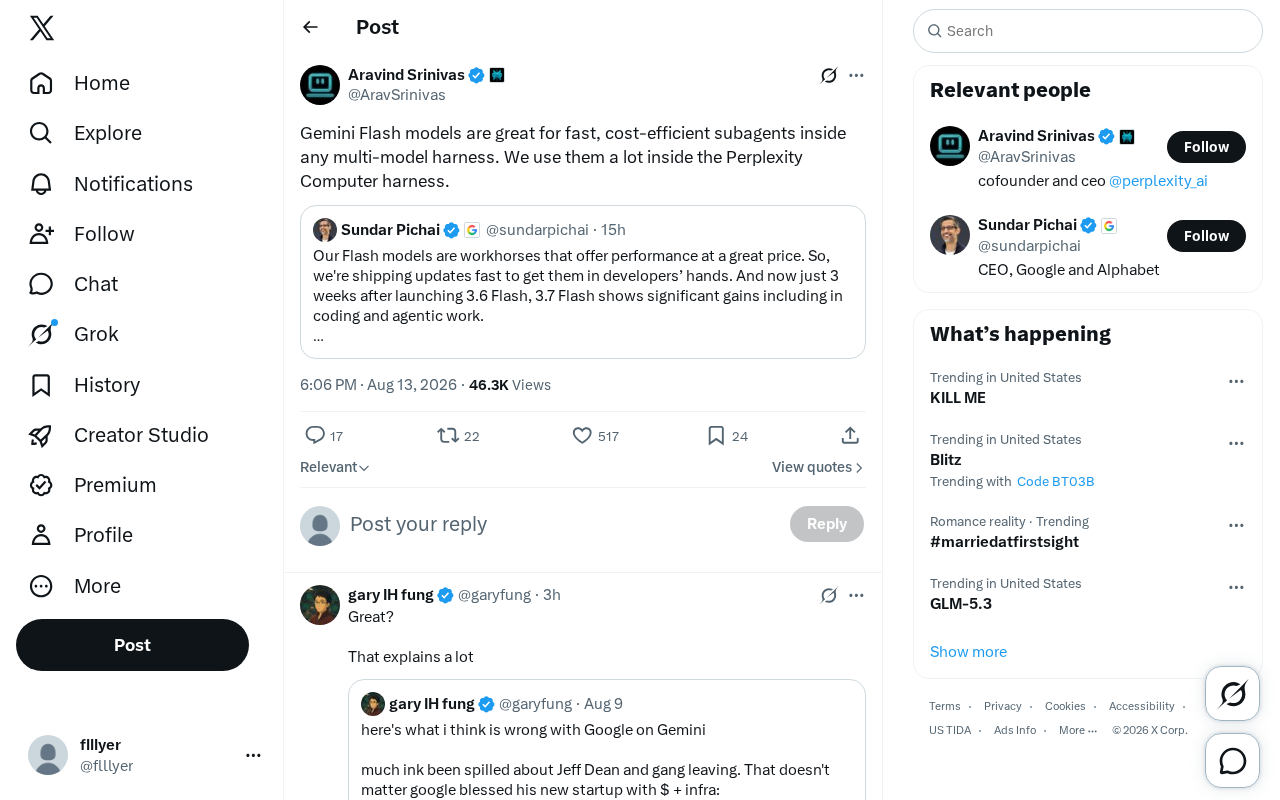
How Gemini Flash excels as a fast, cost-effective subagent in multi-model AI architectures.
This article explores how Google's Gemini Flash serves as an efficient subagent in multi-model harness frameworks, drawing on Perplexity's production experience. It explains the orchestrator-executor architecture, Flash's speed and cost advantages through distillation and sparse activation, and why multi-vendor model strategies are becoming the engineering standard for scalable AI systems.
Introduction: Division of Labor in Multi-Model Architectures
As AI applications evolve from single large models to complex multi-model collaborative systems, striking the right balance between cost, speed, and capability has become a central challenge in engineering practice. Recently, the team at Perplexity shared that Google's Gemini Flash series is particularly well-suited for the role of a fast, low-cost "subagent" within multi-model harness frameworks. This insight reveals an important trend in current AI system design — layered collaboration with clear division of responsibilities.
What Is a Multi-Model Harness?
From Monolithic Models to Collaborative Systems
Traditional AI applications typically rely on a single large language model to handle all tasks, from simple information extraction to complex reasoning and decision-making. This "one-size-fits-all" approach has revealed obvious problems in practice: using the most powerful (and most expensive) model for trivial tasks introduces unnecessary cost and latency overhead.
The multi-model harness approach breaks a complex task into multiple stages, each handled by models of different capability and cost tiers. This architectural pattern stems from the "Separation of Concerns" principle in distributed systems — just as we decompose monolithic applications into microservices, AI systems can be layered by the cognitive complexity of each task.
Typically, a high-capability "main agent" handles overall planning and critical decisions, while multiple "subagents" process specific, relatively simple subtasks in parallel — such as information retrieval, content summarization, and format conversion. The technical implementation follows the "Orchestrator-Executor" pattern: the main agent serves as the orchestrator responsible for task decomposition, result aggregation, and quality control, while subagents serve as executors focused on efficient processing within specific domains. This requires a complete infrastructure stack including task queue management, model routing strategies, result caching mechanisms, and failure retry logic.
The Core Requirements of Subagents: Speed and Cost-Efficiency
In this architecture, subagent invocations tend to be extremely frequent — a single complex query might trigger dozens or even hundreds of subagent calls. Therefore, the two critical metrics for subagent models are response speed and per-call cost. Even tiny differences in per-call cost can be amplified into significant total cost differences at scale under high concurrency.
Subagents typically handle tasks with well-defined inputs and outputs and manageable complexity. Common scenarios include: information extraction (extracting structured data like entities, dates, and amounts from unstructured text), content transformation (format conversion, language translation, summary generation), classification and routing (intent recognition, sentiment analysis, content moderation), and retrieval augmentation (generating search queries, re-ranking search results, judging information relevance). These tasks share common characteristics: low per-call cost (typically a few hundred to a few thousand tokens), relatively relaxed quality requirements (no need for perfect reasoning ability), and high call frequency (a single user session may trigger dozens of calls).
Why Gemini Flash Excels as a Subagent
The Dual Advantage of Speed and Cost
The Gemini Flash series is a lightweight multimodal model launched by Google in 2024, optimized specifically for high-throughput, low-latency scenarios. Its core technical advantage lies in the use of Knowledge Distillation and Sparse Activation techniques, retaining approximately 80-85% of Gemini Pro's capabilities while achieving 3-5x faster inference speed and reducing costs to roughly 1/10.
The Flash series supports context windows of up to 1 million tokens, which is particularly valuable when handling subtasks like large document summarization and multi-turn conversation history. Its API latency typically ranges from 200-500ms, whereas flagship models often require 1-3 seconds. In terms of pricing, Flash's input token cost is approximately $0.075 per million and output is approximately $0.30 per million, offering significant advantages over the Pro model. This perfectly aligns with the subagent use profile of "high-frequency, simple tasks, optimized for cost-effectiveness."
According to the Perplexity team, they "use them a lot" as subagents within their Perplexity Computer framework. This endorsement from an actual production environment is more convincing than any benchmark — it proves that Flash models can reliably handle heavy subtask workloads in real-world, high-concurrency commercial systems.
Engineering Practices in the Perplexity Computer Framework
Perplexity Computer is an internal multi-model orchestration framework developed by Perplexity AI, similar to LangChain or LlamaIndex but deeply optimized for production environments. At its core is an intelligent routing system that dynamically selects the optimal model based on task type, real-time load, and cost budget. It supports multiple concurrency control strategies: independent subtasks are executed in parallel to reduce total latency, while dependent tasks are organized into a DAG (Directed Acyclic Graph) for topologically sorted execution.
The framework also includes comprehensive observability tools that track the latency, cost, and quality metrics of every model call, providing data to support continuous optimization. Perplexity extensively uses this framework in Retrieval-Augmented Generation (RAG) scenarios, where a single user query may trigger 20-50 model calls.
The Engineering Value of Cross-Model Mixing
Here's a noteworthy detail: Perplexity itself is not a downstream Google product, and its framework employs a mix of models from multiple vendors. This demonstrates that in mature AI engineering practice, teams don't "lock in" to a single provider but instead flexibly choose the most suitable model for each component based on specific requirements.
Adopting a multi-vendor strategy in production-grade AI systems has become an engineering best practice. This involves considerations across multiple technical dimensions: first, "vendor risk diversification" — single-vendor dependency can lead to systemic risks from API throttling, service outages, or pricing changes. Second, "capability complementarity": OpenAI's GPT-4 excels at creative writing, Anthropic's Claude is strong in code generation and safety, and Google's Gemini leads in multimodal understanding.
On the technical implementation side, a unified abstraction layer is needed, typically using the Adapter Pattern to encapsulate API differences across vendors. For cost optimization, requests can be dynamically routed based on real-time pricing. The main agent might use one vendor's flagship model while subagents use another vendor's most cost-effective option — matching capability to task, matching cost to budget — this is the rational engineering choice.
It's worth noting that this strategy also introduces engineering complexity: managing multiple sets of API keys, handling different rate-limiting policies, and standardizing output formats across different models.
Implications for AI Application Developers
Rethink Your Model Invocation Strategy
For developers building AI applications, this practice offers a clear optimization direction: don't use a single large model for everything. Examine your task pipeline, identify those high-frequency but simple stages, delegate them to fast and economical models like Flash, and reserve expensive flagship model resources for critical decisions that truly require deep reasoning.
When selecting subagent models, you need to establish a quantitative cost-effectiveness evaluation framework. Core metrics include: "cost efficiency" (effective tasks processed per dollar, considering input/output token ratios), "latency performance" (P50, P95, P99 latency distributions, with particular attention to tail latency's impact on user experience), and "quality-cost curve" (for a specific task, how much quality metrics like accuracy and F1 score drop for every 10% reduction in cost).
A common practice is to build test sets and run A/B tests across candidate models. For example, if Flash achieves 92% accuracy on an information extraction task at 1/10 the cost of Pro, while Pro achieves 95% accuracy, then Flash is clearly the better choice for most non-critical scenarios.
This layered strategy not only significantly reduces operational costs but can also improve overall system response speed through parallelized subagent calls, enhancing the end-user experience.
Multi-Model Architectures Will Become the Norm
Perplexity's practice shows that future AI system design is shifting from "pick the one best model" to "compose multiple suitable models." Current AI application architecture is undergoing a paradigm shift from the "monolithic model era" to the "heterogeneous model orchestration era."
This trend is driven by multiple factors: the maturation of the model ecosystem (various vendors have established comparative advantages in different niche scenarios), increasing cost pressure (as AI applications scale, optimizing the cost of every call becomes a survival necessity), and rising real-time requirements (user tolerance for response latency continues to decrease).
This paradigm shift means:
- Finer granularity in model selection: from the application level down to the task level or even sub-task level.
- Increased engineering complexity: requiring an orchestration framework (harness) to manage calls, routing, and result integration across different models.
- Greater vendor neutrality: developers prioritize each model's cost-effectiveness on specific tasks rather than brand loyalty.
Future architectural evolution will include: "adaptive routing" (dynamically selecting models based on real-time performance and cost), "model caching" (reusing historical results for frequent queries), "tiered SLAs" (allocating different quality models for requests of different importance), and "edge deployment" (pushing lightweight models to edge nodes to reduce latency). The maturation of these technologies will take AI systems from "functional" to "effective and affordable."
Conclusion
The successful use of Gemini Flash as a subagent is a microcosm of the current trend toward more refined and specialized AI engineering. It reminds us that building efficient AI systems is no longer just about pursuing the ultimate capability of a single model — it's about making smart architectural trade-offs between cost, speed, and quality. For any team designing multi-model systems, using fast and economical models for high-frequency subtasks is an optimization path well worth serious consideration.
Note: The core insights in this article are derived from public sharing by the Perplexity team on Twitter. As single-source information, the technical assessments presented are for reference only.
Key Takeaways
- Multi-model harness frameworks decompose complex tasks into a layered architecture of main agents (strategic decisions) and subagents (high-frequency simple tasks)
- Gemini Flash achieves 3-5x speed improvement and 1/10 cost through knowledge distillation and sparse activation, making it ideal for subagent scenarios
- The Perplexity Computer framework uses intelligent routing and DAG orchestration, with a single query potentially triggering 20-50 model calls
- Multi-vendor strategies balance risk diversification, capability complementarity, and cost optimization, at the expense of increased engineering complexity
- Cost-effectiveness evaluation requires quantifying cost efficiency, latency distribution, and quality-cost curves, with A/B testing to select the optimal solution
- AI architecture is evolving from monolithic models to heterogeneous orchestration, with future trends including adaptive routing, model caching, and tiered SLAs
Related articles

Design Intelligence and Engineering Insights from Singapore's MRT Information Display System
In-depth analysis of Singapore's MRT information display system's layered architecture, real-time data processing, and scenario-based design philosophy, exploring how public transit systems achieve efficient UX through engineering intelligence.

Former Meta Employee Reveals: Highly Paid Engineers Are Actually Doing Data Labeling for AI
Former Meta employee exposes Big Tech's AI transformation: highly paid engineers assigned to RLHF data labeling, flat orgs where employees report to AI systems, and knowledge workers facing self-replacement.
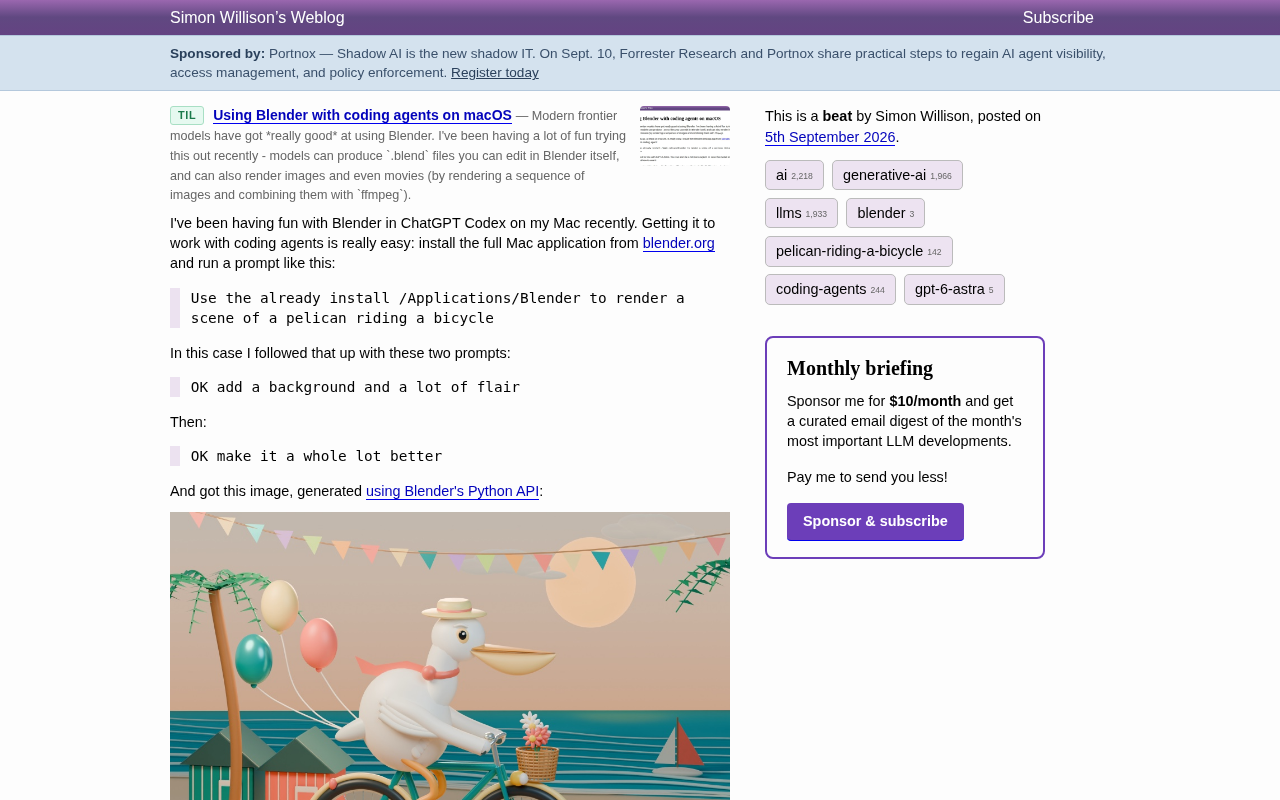
Natural Language Drives Blender: Generating 3D Scenes with AI Coding Assistants
Use AI coding assistants like ChatGPT Codex to drive Blender's Python API and generate stunning 3D scenes with just a few natural language prompts.