Gemini Flash Upgrades in Three Weeks with 50% Price Cut, DeepSeek Open-Sources Agent Framework Harness

AI giants enter close-quarter combat: Google cuts prices, DeepSeek open-sources, OpenAI accelerates inference 14x.
In a single evening, Google released Gemini 3.7 Flash with halved prices targeting developers, DeepSeek open-sourced its plugin-based Agent framework Harness under MIT license, OpenAI previewed UltraFast with 14x inference speedup via Cerebras chips, and AI solved frontier math problems. As model capabilities converge, competition shifts to cost, speed, ecosystem, and developer experience.
Gemini 3.7 Flash: Three-Week Iteration Cycle, Prices Slashed in Half
Google's iteration pace is getting increasingly aggressive. Gemini 3.7 Flash, released last night, came just three weeks after the previous generation 3.6 Flash, targeting code generation and Agent scenarios. The launch pricing is notably aggressive—$0.75 per million input tokens and $3.75 per million output tokens, exactly half the previous generation's prices.
It's worth explaining the economics of token pricing here. A token is the basic unit by which large language models process text, roughly equivalent to three-quarters of an English word or one Chinese character. API calls are billed separately for input and output tokens, with output prices typically higher than input because generating text requires far more compute than understanding it. Pricing per million tokens directly determines developers' operational costs—for an Agent application processing a million requests daily, a 50% price reduction means saving tens of thousands of dollars monthly. This is why price wars are so effective in the developer market: cost-sensitive applications quickly migrate to cheaper models.
Behind the price cut lies genuine capability improvements. On the web development Arena leaderboard, Gemini 3.7 Flash jumped from 19th place to 8th. Three-week iterations, halved prices, and performance leaps—this combination sends a crystal-clear signal: Google is determined to capture the developer market.

From a product strategy perspective, the Flash series targets low-latency, low-cost, high-frequency calling scenarios—precisely the cost-sensitive sweet spot for Agent and code generation applications that require massive token interactions. Google's model family employs a tiered strategy: the Pro series pursues maximum performance, while the Flash series uses techniques like model distillation and quantization to dramatically reduce inference latency and compute costs within acceptable accuracy trade-offs. Distillation refers to using a large model's outputs as training signals for a smaller model, enabling the smaller model to inherit some of the larger model's capabilities while being more compact and faster. This tiered strategy lets developers in different scenarios get what they need: Pro for maximum accuracy, Flash for high-frequency rapid calls. Google's choice to trade price for market share in this segment reveals clear intent: lock in the developer ecosystem first, then figure out long-term monetization.
DeepSeek Open-Sources Agent Framework Harness: Everything Is a Plugin
The same evening, DeepSeekAd also made a major move—the preview version of their Agent framework Harness was officially open-sourced under the MIT license, open for global testing.
The MIT license is one of the most permissive open-source licenses, allowing anyone to freely use, modify, and distribute the code, including for commercial purposes, with the only requirement being to retain the original copyright notice. By comparison, the GPL requires derivative works to also be open-sourced, while the Apache license includes patent grant provisions. DeepSeek's choice of MIT means enterprises can embed Harness directly into closed-source commercial products without worrying about legal risks. The business logic behind this strategy: maximize adoption to establish a de facto standard, then monetize through value-added services (such as cloud hosting and enterprise support).
Harness's core philosophy is "everything is a plugin": models, tools, skills, sandboxes, and interfaces can all be freely combined and swapped. An Agent refers to an AI system capable of autonomously perceiving its environment, making decisions, and executing actions—distinct from simple Q&A-style LLM interactions. An Agent framework is the foundational infrastructure for building such systems, responsible for coordinating model inference, tool invocation, memory management, and multi-step planning. Harness's "everything is a plugin" architecture is essentially the microkernel design philosophy applied to AI frameworks—the core system only handles message routing and plugin lifecycle management, with all functional modules connecting through standardized interfaces. The entire framework core is written using REST (Representational State Transfer), a widely-used Web API design style, meaning any programming language capable of making HTTP requests can interact with it, drastically lowering the integration barrier. The framework includes over a hundred official plugins and comes with a plugin marketplace. For developers, this is essentially a complete set of "building blocks" for constructing Agents—no need to reinvent the wheel, just assemble your own Agent application from standardized components.

This forms an interesting contrast with Google's approach of using price to capture market share: one lowers barriers through open source, the other lowers costs through pricing, and both are competing for the same pool of Agent developers. As underlying model capabilities increasingly converge, whoever provides better developer experience and lower migration costs will claim the ecosystem high ground.
OpenAI UltraFast: Inference Speed Soars 14x
OpenAI made its move on inference speed, previewing a new service called UltraFast, powered by chip company Cerebras. On the flagship model GPT-5.6, UltraFast achieves output speeds of 750 tokens/second—14 times faster than standard mode—with no quality degradation. It will initially be available in limited access through the OpenAI API.
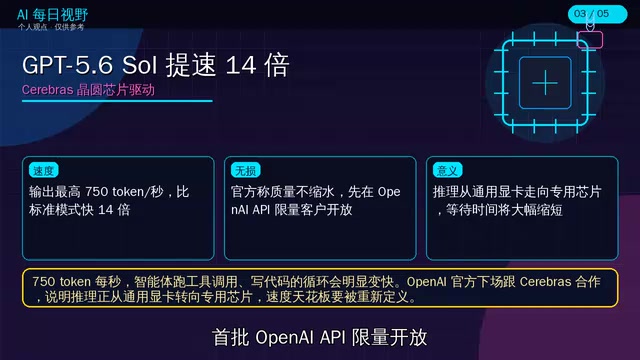
The choice of compute provider is noteworthy here. Cerebras is known for its Wafer-Scale Engine, an architecture with inherent advantages for low-latency inference scenarios. Traditional chips are cut from silicon wafers into hundreds of individual dies, each typically no larger than a few hundred square millimeters. Cerebras's revolutionary approach turns an entire 12-inch wafer into a single chip, with an area of 46,225 square millimeters—over 50 times larger than the biggest GPU. This architecture integrates hundreds of thousands of AI compute cores with large-capacity on-chip SRAM storage, eliminating the need for data transfer between chips and fundamentally removing the communication bottlenecks of distributed systems. For inference, this means intermediate results can remain entirely on-chip, avoiding the latency of accessing external DRAM (typically 10-100x slower), enabling extremely low per-token latency. This architecture is particularly advantageous for autoregressive inference that requires extensive sequential generation. OpenAI's adoption of Cerebras signals that the trend of "inference isn't just about GPU clusters" is now being formally embraced by industry leaders.
For Agent applications, speed equals experience. For an Agent requiring multiple rounds of tool calls and reasoning, every reduction in wait time directly impacts usability. A 14x speedup is essentially paving the way for real-time interaction in the Agent era.
AI Cracks Math Problems: From Tool to Teammate
On the frontier research front, AI's mathematical capabilities have broken through again. A problem related to the 668th Hadamard conjecture was solved by Anthropic's mathematics team, comprising three human researchers working with Claude.
The Hadamard conjecture is a classic unsolved problem in combinatorial mathematics, proposed by French mathematician Jacques Hadamard in 1893, concerning whether matrices of specific orders (Hadamard matrices) exist. Hadamard matrices contain only +1 and -1 elements, with all row vectors pairwise orthogonal, and have broad applications in signal processing, error-correcting codes, and quantum computing. The conjecture holds that when the matrix order is a multiple of 4, such a matrix must exist, but this has never been fully proven. Last year Claude only managed the order-64 version; this time the final step was completed, clearing all cases below order 2000.

On Frontier Math, considered the litmus test for mathematical ability, 4 out of 50 open problems have been solved, with GPT and Claude each claiming 2. Frontier Math is a mathematics benchmark created by EpochAI, containing hundreds of open problems authored by professional mathematicians with no known solutions, considered the most rigorous standard for measuring AI mathematical reasoning capabilities. Previously, AI models achieved less than 2% pass rates on this test, meaning each problem solved represents AI genuinely participating in frontier mathematical discovery. While 4 may seem like a small number, the significance is profound—these were previously unsolved open problems. AI's role in mathematical research is shifting from a "tool" for retrieval and computation to a "teammate" capable of participating in collaborative reasoning.
Brin Steps In Personally: Gemini Competition Reaches White Heat
Movements at the personnel level also reveal the urgency of competition. Google co-founder Sergey Brin has been urging core AI employees to go all-in on Gemini development in recent months. When Anthropic previewed a new model and briefly took the lead in April this year, Brin explicitly demanded at an all-hands meeting that DeepMind accelerate its pace.
Gemini briefly topped the rankings last November but has since fallen behind. With the co-founder personally pushing for faster progress, the pressure in this round of competition is evident. Combined with the Flash series' aggressive three-week iteration cycle, Google has clearly elevated the LLM race to the highest priority at the company strategy level.
Summary: AI Giants Enter Close-Quarter Combat
From this single evening's dense wave of developments, it's clear that competition among AI giants has entered a close-quarter combat phase: Google uses pricing and iteration speed to capture developers, DeepSeek uses open source to lower Agent barriers, OpenAI uses heterogeneous compute to widen the inference speed gap, and AI breakthroughs in hardcore domains like mathematics continue raising the capability ceiling.
This competitive landscape closely mirrors the evolution of the cloud computing market. As mainstream LLMs narrow the gap on core capability metrics—GPT, Claude, and Gemini increasingly converge on general tasks like code generation and text understanding—developer choices no longer depend on the model itself but shift to peripheral factors: API stability, documentation quality, SDK coverage, community activity, pricing strategy, and migration costs. Just as competition among AWS, Azure, and GCP shifted to developer toolchains and ecosystems after compute resources became standardized commodities, the AI industry is undergoing the same transformation: from "whose model is strongest" to "whose developer experience is best." As model capabilities homogenize, cost, speed, ecosystem, and developer experience are becoming the true decisive factors in the next phase.
Related articles

JobRunner MCP Server: AI Agents Can Now Fix Failed Java Jobs
JobRunner launches an open-source MCP server enabling AI agents to view cluster status, diagnose failures, and recover Java jobs—incident response from any cloud coding environment or existing agent.

MLAI Digital Launches 9 Security Agents: MCP Server Safeguards the Full Lifecycle of Agentic AI
MLAI Digital launches Security MCP Server with nine built-in specialized security agents covering vulnerability discovery, attack simulation, prompt injection detection, API and infrastructure assessment, and accelerated remediation—embedding security validation across the full Agentic AI lifecycle from development to production.

Running Isaac Lab on H100 GPUs: Exploring Better Approaches
Exploring optimization methods for running Isaac Lab on NVIDIA H100 GPUs, including MIG configuration, mixed precision, TensorRT acceleration, and community experience to improve robotics simulation and reinforcement learning efficiency.