Gemini Omni 1.1 Hands-On Review: 40-Second Long Video Generation Compared with Seedance 2.5
Gemini Omni 1.1 Flash tested: 40-second video, keyframe control, and real-world quality vs. Seedance 2.5.
Google's Gemini Omni 1.1 Flash brings 40-second scene extension, first/last frame control, 360p draft workflows, and video reference input. Hands-on tests on Higgsfield reveal strong aesthetics but weak physics and motion graphics. Compared to Sora and Runway, it trades top-tier quality for speed and cost-efficiency, making it ideal for quick B-roll and budget-friendly AI video creation.
Google recently released the Gemini Omni 1.1 Flash video generation model, a major upgrade over its predecessor. The most notable change is that video length can now reach up to 40 seconds, along with a series of new features that open up exciting creative possibilities. This article walks through hands-on testing of each new feature and compares the model against the current competitive landscape including Sora, Runway, and other leading tools to assess its real-world capabilities.
Gemini Omni Model Series Background
Gemini is a multimodal large language model series launched by Google DeepMind in late 2023, designed to compete with OpenAI's GPT-4. The Omni series is the branch within the Gemini family focused on video generation, built on a Diffusion Model architecture — the dominant technical approach in AI video generation today. Diffusion models work by gradually adding structural information to random noise, ultimately producing coherent video frame sequences. The Flash suffix indicates this version has been optimized for inference speed, trading some generation quality for faster response times. This is particularly important in commercial applications, where inference costs directly impact the economic viability of a service.
Gemini Omni 1.1 Flash: Core New Features Breakdown
Compared to the previous generation, the 1.1 Flash version brings a dense set of updates spanning multiple dimensions from duration extension to workflow optimization.
Scene Extension: From 10 Seconds to 40 Seconds
The biggest highlight of this upgrade is the "Extended Scenes" feature, specifically designed to support longer narratives. The model analyzes an existing 10-second clip, then continues generating an additional 10 seconds based on it. This process can be repeated to extend the video up to a cumulative length of 40 seconds. For creators who need continuous storytelling or want to deliver more complete expressions within a single video, this is an extremely practical capability.
The Duration Challenge in Video Generation Models: Duration extension has always been a technical challenge in AI video generation. The reason is that video is fundamentally high-dimensional temporal data: a 10-second video at 30fps contains 300 frames, and at 1080p resolution per frame, the data volume is enormous. Models need to simultaneously maintain temporal coherence (smooth transitions between adjacent frames) and semantic consistency (characters and objects maintaining consistent features throughout the entire duration). There are currently two mainstream approaches: one is to directly train models that support longer durations, but computational costs grow exponentially; the other is to adopt a "continuation" strategy — generating short clips and then extending them based on context. Gemini Omni 1.1 uses the latter approach, which represents a compromise between technical feasibility and cost.
First and Last Frame Control: Giving Creators More Precise Directorial Power
The 1.1 Flash adds a "first frame + last frame" feature. Users simply provide the starting and ending frames of a video, and the model automatically generates a smooth transition connecting the two images. Compared to relying solely on text prompts, this approach gives creators much stronger control over the video's direction.
Technical Significance of First/Last Frame Control: Keyframe conditioning is a classic concept from computer graphics reimagined for the AI era. In traditional animation, animators would first draw keyframes, and then assistants or software would fill in the intermediate frames (in-betweening). AI video models automate this workflow: users provide start and end images, and the model generates transitions using learned motion priors. This is more controllable than pure text prompts because visual information is more precise than language descriptions — "a red sports car" could correspond to countless designs, but a specific image corresponds to only one appearance. Implementing this feature relies on the model's conditional generation capability — sampling outputs that meet given constraints. Technically, this requires the model to simultaneously understand image semantics and video dynamics.
In testing, a regular car was uploaded as the first frame and a Transformers robot as the last frame, asking the model to generate a mechanical transformation process. The results were quite impressive — the transition was natural, the mechanical feel was well-handled, and though there was slight visual distortion, the overall effect was already usable. Generating a few variants would almost certainly yield a perfect result.
360p Draft Videos: A Workflow That Dramatically Improves Iteration Efficiency
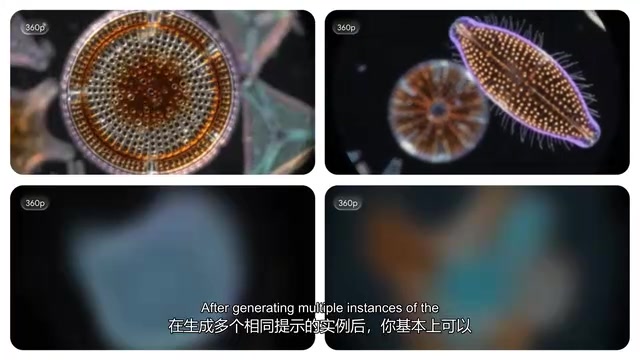
Personally, I consider the most valuable feature — and the one I most hope future models will adopt — to be "Draft Videos." It allows users to quickly generate lightweight previews at 360p low resolution, with speed improvements of up to 60%. Since Gemini Omni is already a "Flash" fast model, generating at such low resolution is nearly instantaneous. Creators can batch-generate multiple versions with the same prompt, select the best one, and then upscale it for the final project.
360p Drafts and Resolution Upscaling Technology: Resolution-tiered generation is an important workflow innovation in the video AI space. 360p (640×360 pixels) contains roughly 1/9 the data of 1080p (1920×1080), meaning generation speed can improve dramatically. The subsequent upscaling process uses Super-Resolution technology, typically implemented using Generative Adversarial Networks (GANs) or diffusion models. The key point is that upscaling is not simple pixel interpolation — it leverages high-frequency detail priors learned by the model to reconstruct textures and edge information that didn't originally exist. This "quick preview first, refine later" paradigm is similar to preview render modes in traditional rendering, significantly reducing creative iteration costs. It's worth noting that upscaling quality is highly dependent on whether the model was exposed to sufficient high-resolution data during training.
It's worth mentioning that the model supports upscaling videos to 4K, and the upscaling quality is excellent. The quality improvement from 720p to 4K is very noticeable, and this "draft first, refine later" workflow significantly reduces the cost of trial and error.
Video Reference Input: Easily Reuse Motion Styles
Another exciting feature is support for video as reference input. If you want a specific type of motion, simply feed the model a reference video, and it will integrate that motion into the newly generated result. This is extremely helpful for projects that require style consistency.
Video Reference Input and Style Transfer: Video reference conditioning is a manifestation of multimodal model capabilities. Technically, the model needs to extract motion features from the reference video — such as optical flow, camera motion, or character action patterns — and then inject these features into the new video's generation process. This is similar to style transfer in the image domain, but video adds the complexity of a temporal dimension. Implementation typically involves using attention mechanisms to let the model reference the corresponding time points in the input video while generating each frame, or using architectures like ControlNet to explicitly encode motion information. This feature is extremely valuable for maintaining brand visual consistency or replicating specific directorial styles.
Gemini Omni 1.1 vs. Sora, Runway, and Other Competitors: Hands-On Comparison
Current AI Video Generation Market Landscape: The current AI video generation market features multi-polar competition. OpenAI's Sora demonstrated impressive long video generation capabilities (up to 60 seconds) in February 2024, but hasn't been fully released to the public; Runway's Gen-3 series leads in commercialization, offering multiple modes from text-to-video to image-to-video; Pika Labs is known for rapid iteration and community friendliness; and ByteDance's Seedance occupies an important position in Asian markets. These models have different technical focuses: some emphasize physical realism, others prioritize motion fluidity, and still others like Gemini Omni focus on speed and cost optimization. No absolute leader has emerged yet, and each company is exploring differentiated positioning.
The new features sound appealing, but the model's actual generation quality is what truly matters. Below are multiple test groups conducted on the Higgsfield platform, compared against competitors like Sora and Runway under identical conditions (same prompts, 10-second duration, HD quality).
Higgsfield Platform Overview: Higgsfield is a cloud platform focused on AI video generation, similar to Midjourney or Stability AI in the image generation space. The value of such platforms lies in lowering barriers to entry: users don't need to configure GPU servers, install complex dependencies, or tune model parameters — they can use the latest models through a web interface. These platforms typically adopt subscription or pay-per-use models and provide unified interfaces for different models, facilitating side-by-side comparisons. For developers and creators, this Model-as-a-Service (MaaS) approach dramatically reduces technical barriers and accelerates the adoption of AI tools. Higgsfield supports multiple mainstream video models, making it an ideal environment for evaluation and comparison.
Test 1: Knight vs. Samurai Realistic Duel
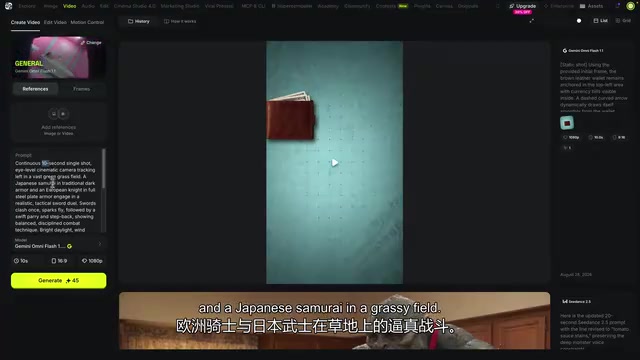
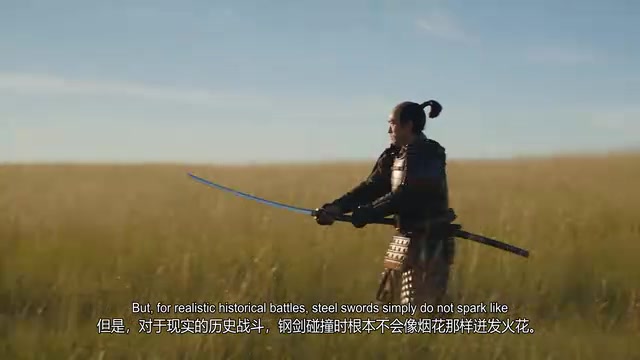
The first prompt asked for "a realistic duel between a European knight and a Japanese samurai on a grass field." Gemini Omni's overall aesthetic was impressive — the grass looked very realistic, and both suits of armor had rich detail. However, the combat movements felt unnatural: when swords clashed, anime-style massive sparks appeared, which wouldn't happen in a real fight. The swords also showed slight distortion, and character movements were somewhat stiff.
Switching to competitors like Sora and Runway, the character movement was noticeably more realistic and natural. However, they exhibited the same sword-clash sparks issue — unless this was a fantasy duel involving magic and knights, steel swords shouldn't spray sparks like fireworks. Despite sharing the same flaw, Sora and its competitors did outperform Gemini Omni in character motion realism.
Test 2: Unicycle Juggling — A Major Test of Physics Understanding
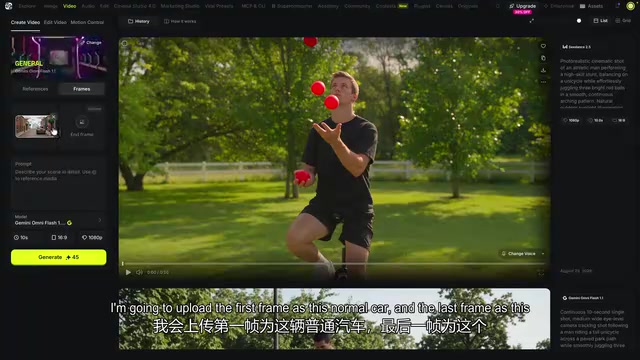
The second test specifically targeted physics understanding: a person riding a unicycle while juggling three red balls using a classic cascade pattern. Since juggling heavily relies on dynamic motion and object permanence, this is an excellent test for evaluating a model's physical intuition.
Physics Understanding and World Models: An AI video model's physics understanding reflects whether it possesses a "world model" — an internal representation of how the real world operates. Physical phenomena like throwing balls, collisions, and gravity follow Newtonian mechanics, but most current video models learn statistical correlations from large-scale data rather than truly understanding physical laws. This causes them to perform well in common scenarios (like a person walking), where training data is abundant, but fail in rare or complex physical interactions (like juggling), where there aren't enough samples and no physics engine is built in. Some cutting-edge research attempts to combine neural networks with physics simulators, or use reinforcement learning to let models "experience" physical rules in virtual environments, but these methods haven't yet been widely adopted in commercial models. Physical accuracy remains one of the core bottlenecks in current AI video generation.
Neither model delivered satisfactory results. In Gemini Omni's output, the unicycle riding looked decent, but the balls kept melting and disappearing. In the output from Sora and its competitors, the balls didn't distort, but the juggling motion was completely unrealistic — the balls hovered in the air for too long, and the motion physics completely broke down. It's fair to say that for complex physics scenarios, both models are still far from mature.
Test 3: Motion Graphics Generation
The final test evaluated motion graphics capability, requesting a 10-second Vox-style editorial animation introducing the features of Gemini Omni 1.1 itself. Unfortunately, there was almost no improvement over the previous generation — transitions and text still exhibited significant distortion.
Conclusion: A Well-Positioned, Cost-Effective AI Video Tool
Overall, the upgrade direction of Gemini Omni 1.1 Flash is clear and practical. The three major features — scene extension, first/last frame control, and the 360p draft workflow — genuinely improve creative efficiency and controllability.
However, in terms of generation quality, it's better suited for relatively simple tasks. If you just need to quickly produce some B-roll footage for YouTube videos, or want to generate basic AI visuals at extremely low cost, it's a great tool. For complex motion graphics or high-intensity action scenes, however, it still falls short.
Considering its significantly lower operating costs compared to Sora, Runway, and other competitors, this "value-oriented" positioning actually makes a lot of sense — it's not chasing ultimate visual quality, but rather seeking the optimal balance between speed, cost, and controllability.
Key Takeaways
Related articles

Natural Language Drives Blender: Generating 3D Scenes with AI Coding Assistants
Use AI coding assistants like ChatGPT Codex to drive Blender's Python API and generate stunning 3D scenes with just a few natural language prompts.
CAPI-DINO: A Combinatorial Approach to Adding Global Representations to Self-Supervised Learning
CAPI-DINO stacks DINO's global objective onto CAPI's local representations, achieving 68.7% linear probing accuracy on ViT-B/14 at only 16% compute cost.
Google Teams Up with AMD to Build Next-Gen TPU Hybrid AI Chip: CPU Cores Integrated On-Package
Google is reportedly partnering with AMD to design a next-gen hybrid TPU with on-package CPU cores, optimized for reinforcement learning and emerging AI workloads.