Gemini Omni 1.2 Flash Launches: What Does ByteDance's C-Dance Have to Hold Its Ground?

Google's Gemini Omni 1.2 Flash reshapes AI video production with conversational editing and 8 RMB per video.
Google released Gemini Omni 1.2 Flash, topping both text-to-video and image-to-video leaderboards at 70% of the previous generation's price—about 8 RMB for a 15-second video, one-third of competitor C-Dance 2.5. The article argues the real impact isn't image quality but interaction and cost structure: multi-turn conversational editing lets the same clip be refined iteration by iteration with performance and composition intact, no prompt rewriting needed; combined with a low-res draft, conversational refinement, and one-click upscaling workflow, users only pay for the final shot. The author notes C-Dance remains top-tier in single-generation aesthetics and Chinese-style quality, but Google has opened a dimensional gap in cost control and engineering for production—domestic models must make a strategic trade-off between ultimate aesthetics and low-price, multi-turn infrastructure.
Google has just released Gemini Omni 1.2 Flash, topping both the text-to-video and image-to-video leaderboards, with pricing slashed to 70% of the previous generation—just 8 RMB per video, one-third the price of competitor C-Dance 2.5. This isn't an ordinary model iteration; it simultaneously upends both the cost structure and the operational logic of AI video.
From "Gacha" to "Conversation": The Interaction Paradigm Has Shifted
The most frustrating part of making videos with AI used to be the gacha-style generation: if you got something wrong and wanted to change one detail, you had to scrap the entire clip and start over, burning both money and time. Omni 1.2 Flash completely replaces this logic—it supports multi-turn conversational editing.
Background wrong? Just say "change it." Lighting too dark? Say "brighten it." Want to post to Douyin? Say "switch to vertical." The same 15-second video can be refined turn by turn, with the performance and composition from earlier rounds staying completely intact—no need to rewrite prompts or regenerate from scratch.
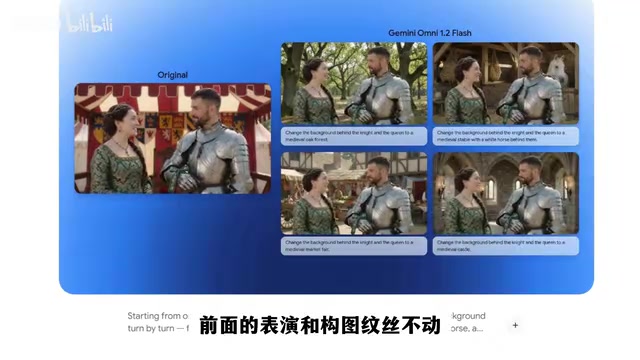
What does this mean? Build one template video, and you can "chat" out dozens of ad variants targeting different audiences and platforms, just like having a conversation. Workflows that used to be measured in days are now measured in minutes. Video generation has gone from a "single gamble" to an "iterable engineering process"—this is a fundamental change at the interaction level, not just an improvement in image quality.
The term "gacha" originates from the random draw mechanics in mobile games, and in the AI generation space it's been borrowed to describe a typical workflow: every generation carries randomness, and users can only repeatedly submit prompts, relying on volume to stumble upon a satisfactory image or video. The core pain point of this model is uncontrollability—there's no stable mapping between prompt and output, and changing one word can cascade into changes to composition, lighting, and character poses, resulting in "change one thing, break everything." The hidden costs of gacha-style workflows are extremely high: every failed generation costs money, creators burn enormous time on filtering and retrying, results are hard to reproduce, and teams can't accumulate reusable production standards for collaboration. The significance of multi-turn conversational editing lies precisely in converting this probabilistic output into deterministic iteration, so that each modification only affects the target dimension—bringing video generation into a controllable engineering process.
Pricing and Workflow: Cost Reduction by Design Throughout
On pricing: 720p at $0.07 per second, so a 15-second clip comes to $1.05 (about 8 RMB). More importantly, the workflow itself is a cost-reduction design: draft quickly at 360p or 720p, refine through conversation until it's right, then one-click upscale to 1080p or even 4K. You're no longer paying for gacha pulls—only for that final shot that's actually correct.

Quality and consistency have kept pace too: characters, products, and brand colors don't drift across different camera angles, lip sync is more natural, and jump cuts in FPV fly-throughs and orbiting shots are greatly reduced. For teams that need to produce ad assets at scale, this "draft—refine—upscale" pipeline has more commercial value than the wow factor of any single generation.
Text-to-video models are typically priced by "seconds of output" rather than per-call or per-token, because video compute consumption grows roughly linearly—or even superlinearly—with duration and resolution. Resolution's impact on cost is especially pronounced: total pixel count grows roughly with the square of resolution, so going from 720p to 1080p more than doubles per-frame computation, and 4K is higher still. This is exactly why the "low-res draft, high-res final" pipeline makes economic sense—it spends expensive compute only on the version already confirmed to be correct. By contrast, in traditional one-shot generation, every retry on a low-quality result is billed at the final resolution, amplifying waste. Understanding this pricing structure makes it clear why "draft—refine—upscale" isn't just a tweak to operating habits, but a direct restructuring of the video generation cost curve.
Where Does the Real Gap Lie for Domestic Models?
At this point some will say: there are so many domestic AI video models, especially ByteDance's C-Dance—its Chinese-style aesthetics and visual quality make it an absolute star, and many feel domestic AI video has long been neck-and-neck with the Americans.
But when facing Omni 1.2 Flash, we need to talk objectively about the gap behind it. In terms of the visual wow factor of a single generation, C-Dance is absolutely top-tier—its aesthetic sensibility and its Chinese style are things Google, the "foreigner," may not necessarily be able to learn. But when it comes to controlling costs and engineering for production, Google has flipped the table this time: sub-8-RMB cost, plus foolproof multi-turn conversation operations, plus a directly open underlying API.

To use an analogy: C-Dance is an exquisitely crafted, peerless sword, while Google has rolled out an assembly line of firearms. A single-point aesthetic advantage versus systematic engineering capability—these are two different dimensions of competition.
"Engineering for production" in AI model competition typically means three things: first, controllable cost—the price per unit of output can support commercial-scale use; second, integrable workflow—embedding the model into a company's existing content production and distribution systems through a stable API; third, reproducible results—identical inputs yield consistent outputs across multiple calls, enabling quality management and scaled replication. The visual wow factor of a single generation represents the model's "ceiling," while engineering determines the "floor" and "throughput"—and the latter directly corresponds to real budgets in advertising, e-commerce, and other industries. Even if a model produces more beautiful images, if it's expensive, has unstable interfaces, and drifts on every result, it will struggle to enter mass production. So the gap between them isn't a contest of aesthetic superiority—it's about whether model capability can be converted into calculable, schedulable, scalable productivity.
ByteDance's Next Move: Aesthetics or Infrastructure?
So here's the question: when Google has driven costs down to a few RMB and turned operations into pure conversation, what should domestic models like ByteDance's C-Dance rely on next to stay at the table?
Should they keep grinding away at极致 visuals and Chinese-style aesthetics, or quickly catch up on dirt-cheap pricing and multi-turn conversational engineering infrastructure?

More critically: if C-Dance slashed prices by half tomorrow, or even opened up the same multi-turn conversation features, what would you do as a creator—keep supporting the domestic localized ecosystem, or turn to Google's近乎白嫖 compute pool?
From the perspective of real content creator decisions, the answer may not be either-or. The localized ecosystem has natural advantages in Chinese prompt understanding, Chinese-style assets, and platform adaptation; while Google's pricing and multi-turn editing capabilities are enormously tempting for ad teams doing batch distribution. The real dividing line is: whoever can deliver both "cheap" and "controllable" will retain creators.
The second half of this competition isn't about whose first frame is more stunning—it's about who can turn video production into a stable, inexpensive, conversational pipeline.
Related articles
 Tech Frontiers
Coldframe: A Honeypot Disguised as a Supermarket Freezer Controller
Coldframe is a honeypot disguised as Danfoss AK-SM 800A and Dixell XWEB freezer controllers, built as a single Python file that detects CVE-2025-41450 attempts and is identified as real devices on Shodan.
 Tech Frontiers
GRFNet: A Lightweight PyTorch Model Designed for Multichannel Time-Series Classification
GRFNet is a lightweight PyTorch model for multichannel time-series classification, originating from EEG decoding research. With only 3,847 parameters, it is based on the ROCKET architecture, combining random convolution kernels with learnable spatial filters, supports arbitrary input lengths, and will soon be evaluated on the PhysioNet dataset.
 Tech Frontiers
CUDA-Accelerated Rocket League Simulator: A Player-Made Hardcore Experiment
A Reddit post shows a "100% Accurate" Rocket League simulator accelerated with CUDA. We analyze its technical context, CUDA's value in game physics simulation, and the significance and limitations of such community projects.