Gemini Omni 1.2 Flash Leads: Key AI Morning Digest Highlights

Gemini video model upgraded to 15-second conversational editing, alongside dense releases of security models, open-source models, and hosted agents.
This digest shows video generation shifting from single-shot demos to conversational, editable production workflows: Google Gemini Omni 1.2 Flash extends native duration from 10 to 15 seconds, supporting multi-turn edits and joint guidance from images, motion, and audio. Security and open source advance in parallel: GPT-6 Cyber verifies thousands of exploits in Firefox and the Linux kernel, while Thinking Machines and Baidu release Inkling 2 Small and Ernie 5.5 Flashbase respectively. Agent infrastructure accelerates toward platformization, with Kimi Hosted Agents and Cursor Live Apps letting enterprises shift from building frameworks to describing requirements. On the research side, Struct RFM and TCS Exam are open-sourced, while METR's estimate of Anthropic's R&D acceleration and the removal of report evidence spark transparency controversy.
Video Generation Advances: Gemini Omni 1.2 Flash
Google has launched its video model Gemini Omni 1.2 Flash, extending the native video duration from 10 seconds to up to 15 seconds, and adding support for multi-turn dialogue and frame editing. Users can combine images, motion clips, and audio to guide generation, improving consistency of characters and scenes. The new model enhances dialogue, lip sync, and camera control capabilities, and is gradually rolling out across Flow, Google Viz, Gemini, and the Gemini API.
The core of this iteration lies in "controllability": moving from single-shot text-to-video toward a conversational, editable generation workflow, signaling that video models are shifting from demo tools to production tools. The multimodal guidance combo (image + motion + audio) also lowers the barrier to professional-grade video creation.
Multimodal guidance and consistency are the two main technical tracks in current video generation models. Consistency means the same character, object, or scene maintains its appearance and motion logic across shot changes and multiple rounds of edits, typically achieved through reference image encoding, identity embedding, or inter-frame attention constraints; earlier single-shot text-to-video models often suffered from character drift due to a lack of cross-turn memory. Multimodal guidance refers to simultaneously accepting images (for style and subject), motion clips (for motion trajectory), and audio (for rhythm and lip sync) as conditions, expanding the generation task from purely text-conditioned to multi-condition joint modeling—at the cost of higher demands on paired training data quality and condition fusion mechanisms during inference.
Security and Open Source: Two Parallel Tracks of Model Capability
OpenAI has released its cybersecurity model GPT-6 Cyber, which is stronger at finding vulnerabilities and more reliably stays within researcher-defined boundaries. The model has discovered and verified thousands of vulnerability exploits in Firefox and the Linux kernel, and is currently available to select approved Daybreak Red customers. This demonstrates the real-world value of specialized security models in actual codebases.
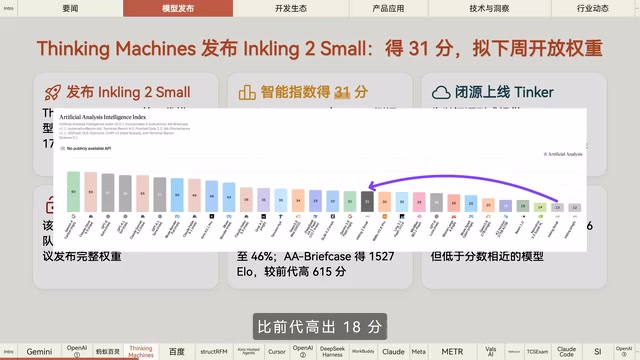
The open-source side is equally active. Thinking Machines released Inkling 2 Small, scoring 31 on the Artificial Analysis intelligence index—18 points higher than its predecessor. The model is first available in coin-source form on its Tinker platform for fine-tuning and inference, with plans to release full weights under the Apache 2.0 license after external safety testing is complete. Baidu released Ernie 5.5 Flashbase, with 280B total parameters and 14B activated parameters, trained on 33.5T tokens, opening the training-end checkpoint, domain adaptation, and instruction fine-tuning for subsequent training use.
Total parameters and activated parameters are common terms for Mixture-of-Experts (MoE) architectures: total parameters refers to the sum of all expert weights in the model, while activated parameters refers to the number of parameters actually involved in computation during a single forward pass. Ernie 5.5 Flashbase's 280B/14B is a typical sparse MoE configuration, where inference cost is approximated by activated parameters while capacity is determined by total parameters. Training-end checkpoint refers to releasing only the weights at the completion of pre-training, excluding post-training results such as instruction fine-tuning and alignment—a lower degree of openness than full Apache 2.0-style weight releases, intended to preserve differentiation space in the post-training phase.
Agents and Developer Tools Moving Toward Managed Services
Kimi launched its hosted agent service Kimi Hosted Agents, moving the Harness framework that supports agent operation to the cloud. Enterprises can obtain a 24/7 managed environment without building their own framework, with support for long-horizon tasks and multi-agent collaboration, initially offering 8 financial agent templates. Cursor launched Live Apps, where users can describe requirements through Cloud Agent to build and deploy web applications; the system configures databases, soundness, and managed security checks on demand, and generates a shareable link upon approval and confirmation.
Both product lines point to a common trend: agent infrastructure is being taken over by platforms, and the focus of developers and enterprises is shifting from "building frameworks" to "describing requirements." Tencent Hunyuan 4 debuted on WorkBuddyAd, and on the first day a large number of users hit usage limits due to a surge in calls. The WorkBuddy team has urgently expanded its inference cluster 10x and increased free experience quotas, with the Hunyuan three-line free tier extended to November 15—a side confirmation of explosive demand.
Harness (agent runtime framework) refers to the execution shell wrapping large models, responsible for tool call parsing, multi-turn loop control, context truncation and retry, sandbox execution, and state persistence—key to whether an agent can run stably over long horizons. Previously enterprises had to build or modify open-source harnesses themselves; with managed services, this part is handled by the platform, which also provides session state storage and multi-agent orchestration needed for long-horizon tasks. Cloud Agent refers to executing coding and deployment actions in a cloud sandbox, where users only submit natural language requirements and the platform handles environment configuration, dependency installation, and deployment, with security boundaries uniformly enforced by the platform.
Research and Evaluation: RNA Models, TCS Benchmark, and Safety Alignment Controversy
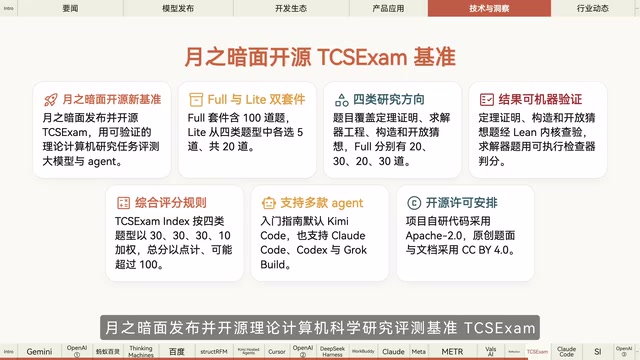
A team from the University of Science and Technology of China released the open-source RNA sequence foundation model Struct RFM, with results published in Nature. The model completed structure-guided pre-training using approximately 21 million sequence-structure paired data, and can predict RNA structure and infer function; data, models, weights, and source code are all open. Moonshot AI released and open-sourced the TCS Exam benchmark for theoretical computer science research, including a 100-question heavy suite and a 20-question light suite, covering four directions: theorem proving, solver engineering construction, and open conjectures.
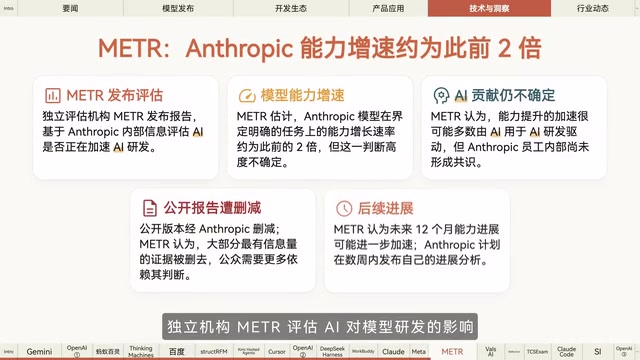
On the safety front, a noteworthy signal has emerged. METR evaluated AI's impact on model R&D, and after investigating Anthropic's internal data, estimated that the company's model capability improvement rate is about twice the previous rate, with AI involvement in R&D likely the main reason, though the magnitude remains uncertain; Anthropic removed a large amount of key evidence from the public report, and co-founder Sam McCandlish explained that disclosing acceleration methods could leak trade secrets and could help other companies accelerate R&D, increasing safety risks.
Valse AI stated that public and internal models from multiple frontier labs have safety alignment issues, which could be misused in high-risk areas and could increase the risk of catastrophic misalignment. The relevant labs are investigating and mitigating, and the organization will disclose its findings within weeks. Reflection published a blog post and technical report introducing the safety training and evaluation of Beam, its first open-weight model, and launched the open safety research initiative Project IRIS.
Structure-guided pre-training refers to using known molecular structure information as supervision or conditioning signals during the pre-training phase, rather than only performing autoregressive or masked prediction on sequences. Struct RFM uses approximately 21 million sequence-structure paired data, enabling the model to internalize spatial conformation rules while learning sequence distributions, thereby inferring structure from sequence input alone and using structural information to assist functional annotation. Safety alignment issues refer to the possibility that refusal behaviors constrained during training may fail under specific prompts, fine-tuning, or out-of-distribution inputs; the evaluation challenge lies in constructing reproducible jailbreak and misuse scenarios, which is why relevant labs are investigating and plan to disclose findings.
Other Quick Updates
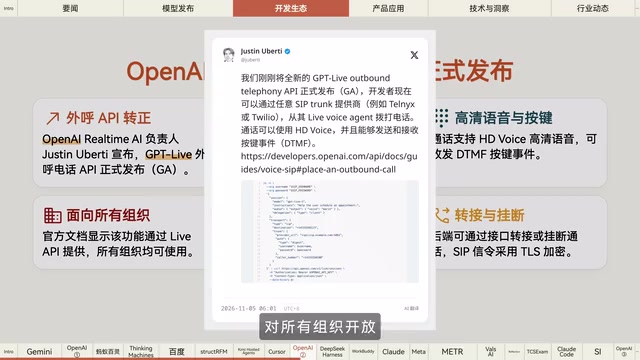
OpenAI announced the official release of the GPT Live outbound call API, open to all organizations. Developers can have voice agents make calls through any SIP trunk provider, with support for HD voice and DTMF sending/receiving. DeepSeekAd Harness announced product and community progress: as of November 4, daily active users reached 1.54 million based on official API user statistics, with daily token consumption of approximately 92 trillion; the company also stated it will build an official plugin marketplace and prepare a support program for plugin authors.
Anthropic launched personal finance features for Claude, gradually rolling out to US Pro, Max, and Ultra subscribers in beta this cycle. After connecting bank and credit card accounts, users can ask about spending in everyday language; the feature is read-only throughout and cannot transfer, manage, or invest funds. Meta officially launched the MUSE Real-Time Avatar technology introduced at the Connect conference; US users can now have voice and video conversations with AI agents in the MUSE app.
On product security, users discovered that CodeCode injects account and email information into the conversation context at login, and emails could be sent to third-party websites with external requests or Git commits; some users reported receiving large amounts of scam emails as a result. Anthropic has added a pre-send confirmation check in V2.1.317. On policy, US Democratic Representative Yasamin Ansari called for pausing advanced AI development, regulating this runaway industry, and banning artificial superintelligence as top priorities on the new Congress's first-day agenda; the related bill she co-sponsored was previously introduced and is still under review in congressional committee. OpenAI published a national community compact and compute campus policy blueprint, committing to fully bear the electricity and grid expansion costs of future self-operated campuses, and disclosing water, electricity, and noise data.
Related articles
 Tech Frontiers
MuJoCo: An Analysis of DeepMind's Open-Source General-Purpose Physics Simulator
An in-depth analysis of Google DeepMind's open-source physics simulator MuJoCo: high-performance C++ kernel, MJCF modeling format, contact solving principles, MJX GPU acceleration, and robot reinforcement learning use cases.
 Tech Frontiers
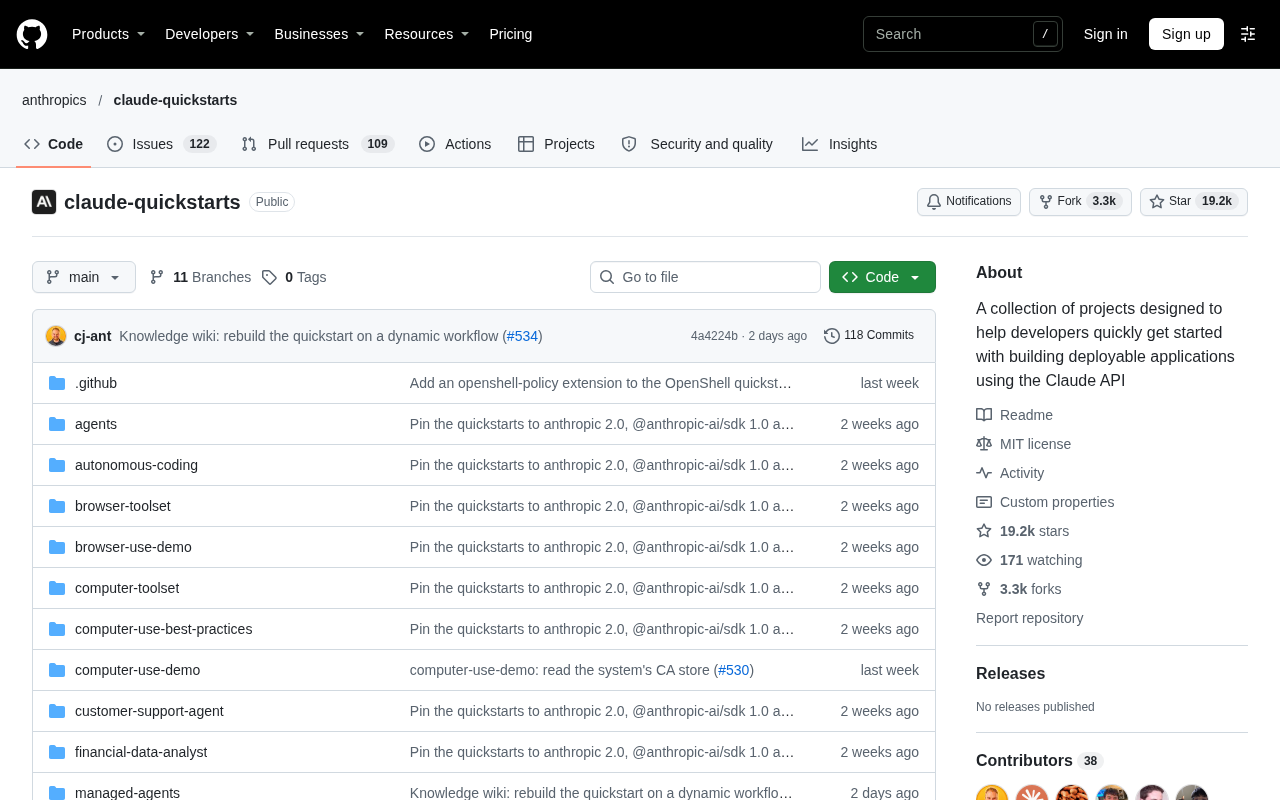
Claude API Quick Start: The Official Quickstarts Project Collection
Anthropic's official claude-quickstarts project collection helps developers quickly build deployable apps with the Claude API. Nearly 20k stars, Python-based, great for beginners and prototyping.
 Tech Frontiers
AI Agents Connecting Directly to APIs: Which Calls Can Be Safely Allowed?
AI agents can call any API, but the real challenge is deciding which calls can be safely allowed. This article analyzes allowance decisions from three dimensions—intent matching, least privilege, and controllable impact—and argues that the control layer should sit outside the agent, combined with audit traceability to build a trustworthy API call governance mechanism.