Gemini Omni 1.2 Flash Tops Two Leaderboards: Is AI Video Done With the Gacha Era?
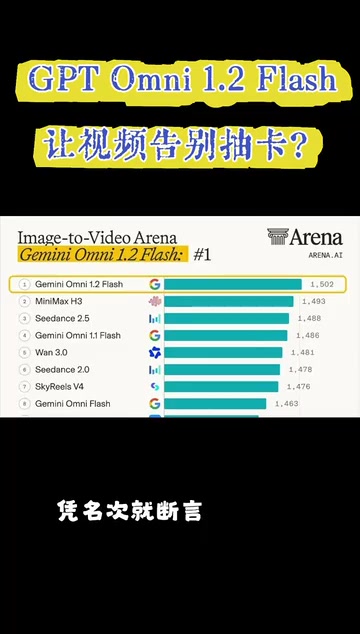
Gemini Omni 1.2 Flash tops two leaderboards, but its real value is the 15-second duration and iterative editing workflow
Google's new video model Gemini Omni 1.2 Flash debuted atop Arena's text-to-video and image-to-video leaderboards, but results are preliminary with narrow gaps among top models, so ranking doesn't mean overall leadership. Three directional shifts matter more: duration extends from a 10-second max to a native 15 seconds with per-second adjustment from 3 to 15, expanding narrative space for short ads; the workflow moves from "redo the whole clip" gacha mode to round-by-round local revision, with demos showing continuous text-based background replacement and consistent virtual try-on; and 720p pricing drops to $0.07 per second, 30% lower, making low-res draft then high-res export workflows more economical. Fast motion, complex physics, and frequent script changes remain weak spots, so frame-by-frame quality checks are still needed before delivery.
Google's new video model Gemini Omni 1.2 Flash debuted at the top of both the Arena text-to-video and image-to-video leaderboards. But leaderboard rankings and real-world creative experience aren't the same thing—the results are currently labeled "preliminary," and the gap to the models right behind it is narrow, so it's too early to claim a "complete sweep" based on rankings alone. What's genuinely worth watching are the directional shifts this update reveals in duration, editability, and price.
What the Double #1 Really Means: Looking Beyond the Ranking
According to a breakdown by Bilibili creator "如约而至" (As Promised), Omni 1.2 Flash simultaneously holds the top spot on both Arena's text-to-video and image-to-video leaderboards. It's a fairly high-profile entrance for Google in the video generation race.
However, the creator also cautions that the leaderboard results are marked preliminary and that the top models' scores are close. Arena-style leaderboards reflect a composite ranking of human preference, not absolute dominance in any single capability. For creators, the more practical question is: can it reliably produce usable shots with their own footage?
Arena (LMArena / Video Arena) is a class of model evaluation platforms based on blind human voting: users see videos generated by two anonymous models for the same prompt, vote for the better one, and the system accumulates rankings using a chess-like Elo scoring system. Its value lies in being close to real human aesthetic preference—it reflects "which one does the general public find better looking." Its limitations are also obvious: vote sample size, prompt distribution, and voter composition all affect results, and the leaderboard only provides a composite preference ranking without breaking out individual capabilities like "physical consistency," "instruction following," or "motion stability." New models have small sample sizes early on and are often officially labeled "preliminary," with rankings still subject to fluctuation as votes accumulate. So "double #1" is better understood as "a slight edge in human preference among the current batch of voting samples" rather than across-the-board technical leadership.
Duration Extended to 15 Seconds—Short Ads Can Finally Tell a Complete Story
The most intuitive upgrade is duration. The previous generation maxed out at 10 seconds; Omni 1.2 Flash extends this to a native 15 seconds and supports adjustment between 3 and 15 seconds in one-second increments.
This change seems like just a bigger number, but what it actually affects is narrative capacity. 10 seconds is often only enough for a single action or a mood shot, while 15 seconds can fit a small "setup—development—turn" structure. For duration-sensitive scenarios like short ads and social media clips, the adjustable increments also mean you don't have to pad shots just to fill time.
The Real Watershed: From "Redo the Whole Thing" to "Revise Round by Round"
If I had to pick the single most valuable change in this update, it's neither duration nor ranking—it's the workflow shifting from "gacha" to "editable."
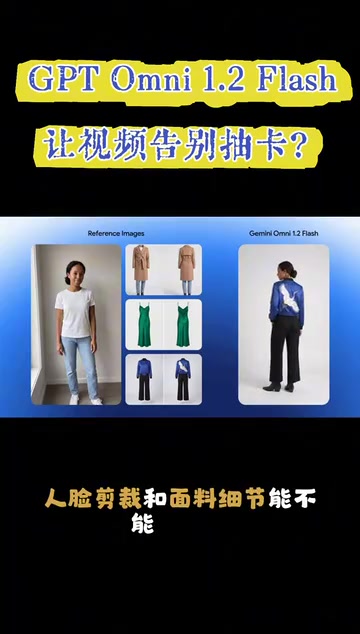
In the official virtual try-on demo, given only a photo of a model and front/back images of three outfits, the model completed turning and outfit changes. The point isn't whether the clothes look good, but whether facial features, tailoring, and fabric details stay consistent across shot transitions—this is where video generation most often breaks down.
Another demo is closer to a real editing bay: the same performance segment, with the background continuously changed via text into a forest, a stable, a marketplace, and a castle. Previously, if you weren't happy with the background, you had to redo the entire clip; now you can iterate round by round along the same footage. This ability to "modify locally + keep what you're satisfied with" is the key to turning video models from toys into production tools.
The "gacha" mode in video generation refers to: users input a prompt, the model outputs an entire video in one shot, and if unsatisfied, they modify the prompt and regenerate until they happen to draw a usable one. The problem with this mode is uncontrollable randomness—the same prompt generates wildly different results across runs, and if even one detail (background, clothing, motion) is wrong, the entire clip must be scrapped and redone, multiplying time and compute costs. The alternative "editable/iterative" workflow breaks video into locally replaceable elements (background, character, shot segments) and changes only the unsatisfactory parts while preserving what's already good—similar to layer and clip operations in traditional editing software. The latter places higher demands on the model: it needs to maintain character identity, lighting, and perspective consistency across frames, otherwise local replacements cause flickering, jumps, or "face swaps." This is also a key indicator of whether a video model has production-tool qualities.
Still Patching Old Problems: Lip Sync, Jump Cuts, and Complex Camera Moves
Google is also addressing traditional weaknesses of video models this time: whether audio and lip movements match during multi-person dialogue, and whether the picture suddenly jump-cuts during complex camera moves.
The official showcase includes a one-take demo: entering the Pantheon from the plaza, then rising up to the dome, continuous throughout with no breaks.
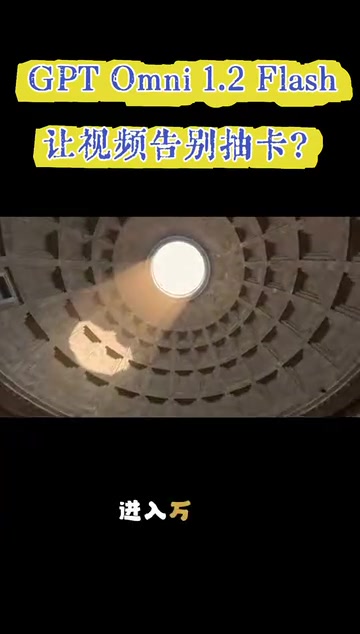
But demo reels don't equal stable reproduction. Google itself admits that three scenarios—fast motion, complex physics, and frequent script changes—are still being improved.

This means that before actual delivery, frame-by-frame checks for distortion in characters, text, and objects remain a necessary step. Leaderboard results are a reference, but they can't replace quality control.
Price Down 30%—Draft Workflows Are More Cost-Effective
There's also movement on the cost side. Google's published 720p price is $0.07 per second, 30% lower than the previous generation; at 15 seconds, that's about $1.05 per clip.
A more economical approach is to first generate a low-resolution draft, make local edits on the draft, and export in high definition once satisfied. This workflow pairs with the "editable" capability mentioned above: the lower the iteration cost, the more creators dare to experiment repeatedly, and the higher the ceiling on final output quality.
Conclusion: Image Quality, Price, or Editability—Which Matters More to You?
Omni 1.2 Flash's double #1 is worth noting, but its real significance isn't the ranking—it's pushing video creation from repeated gacha draws toward an editable workflow. 15-second duration, round-by-round revision, and a 30% price cut all point in the same direction: making AI video generation feel more like editing and less like gambling.
As for whether it can reliably deliver in real projects, more creators will need to verify with actual footage.
One-line Summary
Gemini Omni 1.2 Flash tops two leaderboards, but its real value lies in 15-second duration and an iterative editing workflow
Paragraph Summary
Google's new video model Gemini Omni 1.2 Flash debuted atop Arena's text-to-video and image-to-video leaderboards, but results are marked preliminary with narrow gaps among top models—ranking doesn't equal overall leadership. The article argues three directional shifts deserve more attention: generation duration extends from a previous max of 10 seconds to a native 15 seconds with per-second adjustment from 3 to 15, significantly expanding narrative space for short ads; the workflow moves from "redo the whole thing if unsatisfied" gacha mode to "round-by-round local revision," with official demos showing continuous text-based background replacement on the same performance and virtual try-on maintaining facial and fabric consistency after outfit changes; and 720p pricing drops to $0.07 per second, 30% lower than the previous generation, making a "low-res draft first, high-res export later" workflow more economical. Meanwhile, fast motion, complex physics, and frequent script changes remain weak spots, and frame-by-frame quality checks are still needed before delivery.
Related articles
Google's Gemini 4 Triple Launch: Hydrogen's Cost-Effectiveness Comeback and the Decisions API
Google launches Gemini 4 Argon, Carbon, and Hydrogen. Hydrogen shines on cost-effectiveness at high reasoning tiers, the Decisions API adds audio input for real-time decisions, plus the low-cost Omni 1.2 Flash video model.
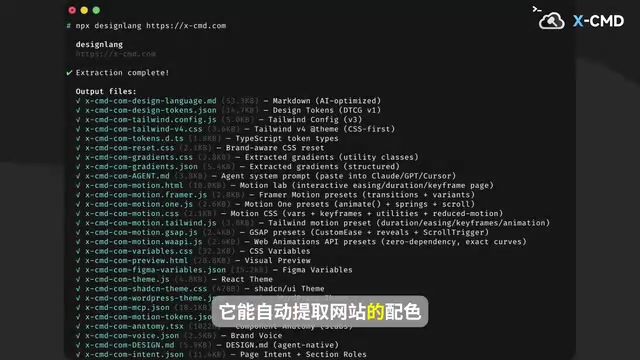
Design Extract: Extract Website Design Styles and Let Claude Code Build Pages to Match
Design Extract automatically extracts a website's colors, fonts, layout, and animations, generating Tailwind CSS configs, Shadcn UI themes, and Figma variables, plus MCP integration for Claude Code.

Sixgill Sharks and the Titanic Digital Twin: How Deep-Sea Exploration Is Rewriting Science
National Geographic's deep-sea team tagged sixgill sharks from a submersible and recorded their hunting behavior, while the Titanic was rebuilt as a digital twin from 700,000 scans.