Sixgill Sharks and the Titanic Digital Twin: How Deep-Sea Exploration Is Rewriting Science

Deep-sea exploration tags sixgill sharks from submersibles and rebuilds the Titanic as a digital twin, turning inference into observation.
National Geographic's deep-sea team achieved two breakthroughs: the first deep-water tagging of sixgill sharks from a submersible with successful data recovery in the Azores, revealing a female-dominated aggregation and a newly recorded tail-slapping hunting behavior; and a full-scale digital twin of the Titanic built from over 700,000 scans and 16TB of data, showing the iceberg breach spanned 6 compartments and that tiny edge breaches were the fatal factor, with details like an open steam valve corroborating historical testimony. Both share one methodology: sending human eyes where they could not previously reach.
Deep-sea exploration is simultaneously rewriting our understanding in two fields: the behavioral science of deep-sea creatures, and the forensic archaeology of historic shipwrecks. National Geographic's deep-sea exploration team, using an advanced research vessel and a crewed submersible, completed the first deep-water tagging of a sixgill shark; meanwhile, another team built a digital twin of the Titanic from over 700,000 scanned images, allowing the giant ship that sank a century ago to be "seen" in full for the first time. These two threads may seem unrelated, but they share the same methodology: sending human eyes to places that were previously unreachable.
Sixgill Sharks: From Tag Data to Direct Observation
Reaching the Sixgill Shark of the Abyss
The sixgill shark lives at depths exceeding 1,200 meters and is believed to have evolved barely at all over roughly 200 million years. Shark biologist Melissa Marquez studied sharks during her PhD but had never come face to face with a sixgill. The goal of this mission was clear: in the waters of the Azores, attach an electronic tag to a sixgill shark from a submersible and recover the data—in the only previous attempt, the data was never retrieved.
Sixgill sharks (Hexanchiformes) are a group of primitive sharks named for the fact that most species have six or seven pairs of gill slits, whereas common sharks have only five. They retain many features from the early evolution of sharks, such as a single dorsal fin positioned far back and no nictitating membrane, and are therefore often called "living fossils." Most sixgill sharks are deep-sea species, inhabiting the deep waters of continental slopes and island margins, distributed globally but sparsely recorded. They reproduce via ovoviviparity, with embryos nourished by yolk inside the mother, and produce few young, which makes population recovery fragile. Because they are extremely difficult to observe in their natural environment, the behavioral ecology of sixgill sharks has long relied on bycatch samples and a small amount of tag data, making this direct observation from a submersible especially valuable.
Nighttime Population Survey
The team collaborated with Azores University shark scientists Jorge Fontes and Pedro Afonso. During the day, sixgill sharks stay in the deep sea; at sunset they begin a vertical migration of about 3 hours, ascending nearly 550 meters to reach the edge of the island shelf to feed. The team waited at the shelf edge for 8 hours and encountered the first adult female sixgill shark after just 20 minutes, measuring about 4.5 meters in length. Over the course of the night's survey, they recorded 11 sixgill sharks, including 1 juvenile male and the rest all female—sharks segregate by sex outside the breeding season, a behavior documented in multiple species.
Diel vertical migration is the largest animal migration phenomenon in the ocean: many organisms stay in deep water during the day to avoid predators, ascend to the surface at sunset to feed, and return to the deep before dawn. The vertical migration of sixgill sharks can span hundreds of meters, ascending to the edge of the island shelf—where the terrain is steep and prey is dense. This migration not only affects the shark's own energy budget but also connects deep-sea and shallow ecosystems. Studying the migration rhythms of sixgill sharks helps us understand how deep-sea predators use diurnal light changes to optimize foraging, and what cascading effects may arise as climate change alters ocean stratification.
What the Tag Revealed About Migration Patterns
On the second dive, the team attempted tagging twice. The first laser aim was off by a few inches, leaving only one spare tag. The second attempt successfully pinned the tag near the shark's dorsal fin; the tag floated about 1.8 meters above the shark, recorded speed, depth, and movement data for 12 hours, then detached automatically and floated to the surface. The recovery was equally dramatic—the tag was carried by currents toward a cliff, and former Royal Navy special forces member Aldo Cain scooped it up in the swell.
Data analysis showed that during foraging, the shark repeatedly ascended and descended, with climbs of up to 200 meters, and continued descending back into the abyss before dawn. The speed curve showed several brief spikes, which the research team speculated might be predatory behavior. The sixgill shark's huge oil-filled liver accounts for more than 20% of its body weight and provides positive buoyancy—some scientists have proposed on this basis that they are ambush predators, gliding up on prey from below.
The Camera Overturns What the Tag Suggested
But footage from the submersible offered another explanation. The team recorded a sixgill shark close to the seafloor, using its positive buoyancy to lift its tail and point its snout toward the sand, then beating its powerful tail fin downward to pin a ray hiding in the sand. The researchers said this behavior had never been recorded by the scientific community before.

The tag data and visual evidence are not contradictory: sixgill sharks may use different strategies for different prey. This mission also confirmed the existence of a large aggregation of female sixgill sharks in the Azores and achieved the first deep-water tagging of a sixgill shark from a submersible with successful data recovery.
The Titanic: A Wreck Site Reconstructed from 700,000 Images
Why It's Hard to "See the Whole Ship"
The Titanic wreck lies at a depth of about 3,800 meters, where pressure is nearly 400 times that at sea level. Previous expeditions over the past 40 years were limited by visibility and could only see fragments, like shining a flashlight in the dark. This scanning project used two unmanned underwater vehicles: Romeo handled high-resolution photography, and Juliet used lasers to record millions of measurement points. Three weeks of offshore operations, over 700,000 scanned images, 16TB of data, and nearly two years of processing ultimately produced a full-scale digital twin.
Digital twin refers to a high-precision digital replica created for a physical entity, originally used in industrial manufacturing and building operations. In shipwreck archaeology, a digital twin is generated by fusing multi-source sensor data (high-resolution photography, LiDAR, sonar) into a 3D model with real spatial coordinates. Unlike ordinary 3D scanning, a digital twin emphasizes measurability and analyzability: researchers can measure real dimensions within the model, run structural simulations, and overlay historical testimony. The Titanic's digital twin had to overcome challenges such as low deep-sea visibility, uneven lighting, and camera pose drift, so it relied on unmanned underwater vehicles capturing dense imagery along predefined routes, then stitching it together using photogrammetric algorithms.
How Big Was the Iceberg's Wound?
Naval architect Edward Wilding estimated from eyewitness testimony after the sinking that the total area of the breach torn in the hull by the iceberg was about 12 square feet. Using blueprint data and a speed of 22 knots, a ship engineering team at University College London recreated the collision with computer simulation: contact time was about 6.3 seconds, and the simulated breach area was about 18 square feet, close to Wilding's estimate.
The key lies in the distribution of the breaches. The digital twin shows that the damage spanned 6 watertight compartments, while the Titanic's design allowed only 4 compartments to flood. What was truly fatal were the tiny breaches "the size of two sheets of paper" beyond the 4 severely damaged compartments. The simulation also verified another of Wilding's judgments: had the ship struck the iceberg head-on instead of turning to avoid it, it might not have sunk—but at the cost of casualties among the personnel in the forward compartments.
Watertight compartment refers to an independent space within a hull separated by transverse and longitudinal watertight bulkheads. The Titanic had 16 watertight compartments, but the bulkheads were of limited height, extending only to a certain level—the design concept was "able to withstand flooding of any 4 compartments without sinking." When the iceberg's breach spanned 6 compartments, seawater flooded in, causing the bow to sink, water spilled over the tops of the bulkheads, overflowed compartment by compartment, and ultimately led to sinking. The digital twin accurately reconstructed the distribution of breaches and the positions of the bulkheads, enabling engineering simulations to verify the failure path of the "4-compartment standard" under a real collision, and explained why the additional distribution of tiny breaches was the fatal factor.
Engineers and the Last Lifeboat
The digital twin allowed investigators to see Boiler Room No. 2—where chief engineer Joseph Bell and 35 engineers held out to the last moment. The dented shape of the boilers indicates that they were still operating when the hull broke apart. A steam valve in the open position near the stern wreckage is evidence that the emergency generator continued to supply power through a manually operated valve, supporting survivors' testimony that the lights stayed on until the ship sank.
Lifeboat davit No. 1 on the starboard side of the bow is in the stowed position, consistent with the testimony of Second Officer Lightoller: First Officer Murdoch was still trying to launch a lifeboat until the very last moment.

The Break Was Not a "Clean Cut"
By stitching together hull fragments from the debris field, the digital twin shows that the Titanic's break-up was far more complex than "neatly folding into two": about 20% of the hull was completely destroyed in a short time, with multiple locations breaking simultaneously. This explains why almost no one in the area where the hull broke could have survived.
Personal Histories in the Debris
The scan also recorded a large number of personal items: a boar's tusk bracelet lying next to a shark-tooth amulet, traced to Scottish businessman John Weir; a collection of shoes and opera glasses that may have belonged to theater owner Henry B. Harris; and the head of an ornate doll that may have belonged to one of the 60 children who died.
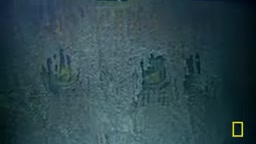
Researchers involved in the investigation noted that this is the most impactful advance since the wreck was discovered in 1985. Rust produced by iron-eating bacteria is continually consuming the hull, and the wreck will eventually collapse—but the digital twin has frozen the evidence in time.
The Common Logic of Deep-Sea Exploration
The two teams are essentially doing the same thing: turning questions that could previously only be answered by indirect inference into objects of direct observation. The sixgill shark's tag data provided a statistical outline of behavioral patterns, while the submersible's camera filled in the details of specific actions; the Titanic's sonar and laser scans provided the spatial relationships of the entire ship, while historical testimony and engineering simulations supplied causal explanations.
The deep sea remains the least explored region on Earth. Every dive may bring back data points that did not exist before—whether it is how a shark pins a ray beneath the sand, or how a manually opened steam valve kept the lights on for two extra hours.
One-line Summary
Deep-sea exploration used a crewed submersible to tag sixgill sharks and a digital twin to reconstruct the Titanic, turning indirect inference into direct observation.
Paragraph Summary
National Geographic's deep-sea exploration team achieved two breakthroughs: in the waters of the Azores, they completed the first deep-water tagging of a sixgill shark from a submersible and successfully recovered the data, confirming a female-dominated aggregation; tag data suggested ambush predation, while submersible footage recorded an entirely new behavior in which a sixgill shark lifted its tail to pin prey in the sand. Another team built a full-scale digital twin of the Titanic from over 700,000 scanned images and 16TB of data; simulations showed the iceberg breach was about 18 square feet and spanned 6 compartments, and that the truly fatal factor was the tiny breaches at the edges of the damaged compartments. Details such as the steam valve and davit provided physical evidence for historical testimony. Both share the same methodology: sending human eyes to places that were previously unreachable.
Related articles

Google's Gemini 4 Triple Launch: Hydrogen's Cost-Effectiveness Comeback and the Decisions API
Google launches Gemini 4 Argon, Carbon, and Hydrogen. Hydrogen shines on cost-effectiveness at high reasoning tiers, the Decisions API adds audio input for real-time decisions, plus the low-cost Omni 1.2 Flash video model.

Gemini Omni 1.2 Flash Tops Two Leaderboards: Is AI Video Done With the Gacha Era?
Google Gemini Omni 1.2 Flash tops both Arena text-to-video and image-to-video leaderboards. We break down its 15-second duration, iterative editing workflow, and 30% price cut at $0.07/sec for 720p—while noting that fast motion and complex physics still need work, and rankings don't equal real creative experience.

Design Extract: Extract Website Design Styles and Let Claude Code Build Pages to Match
Design Extract automatically extracts a website's colors, fonts, layout, and animations, generating Tailwind CSS configs, Shadcn UI themes, and Figma variables, plus MCP integration for Claude Code.