Gemini Omni Flash 1.2 Reportedly Leaked; Kimi Launches Hosted Agents

Google video model rumors, OpenAI voice API, Kimi hosted Agents, Baidu open 280B weights, and more advancing on multiple fronts.
This article rounds up recent AI developments: X users claim Google Gemini Omni Flash 1.2 may support 1080p/4K video generation and launch via API, though unconfirmed; OpenAI opens the GPT Live outbound call API, letting voice agents place calls via any SIP trunk with DTMF support; Kimi launches a hosted agent service with 8 financial templates; Moonshot AI open-sources the TCS Exam benchmark and USTC open-sources the RNA model Struct RFM; Baidu releases open pretrained weights with 280B total and 14B activated parameters. US lawmakers also call for a pause on advanced AI development.
Introduction
Information flows thick and fast in AI. Recently, several threads have pointed to the same trend at once: from new moves in Google's video models, to Kimi putting its Agent runtime framework in the cloud, to Baidu releasing open pretrained weights with 280B parameters. Model capabilities are moving toward multimodality and long-horizon tasks, while infrastructure is moving toward managed services and openness.
Gemini Omni Flash 1.2 Rumors: 1080p/4K Video Generation and API Pending
According to AI evening-news content on Bilibili that aggregated posts from X users, one user claims Google's video model Gemini Omni Flash 1.2 is about to launch and showed videos allegedly generated by the model. The user said the new version may support 1080p and 4K resolution output.
Another user said the model will be offered via API, that it is not yet open, and that it is expected to launch that day. To be clear, Google has not officially confirmed any of these claims. Such leaks are common before a model's official release, and both the resolution and the launch timing are doubtful; readers should defer to official channels.
From a technical standpoint, video models moving toward 4K is an industry-wide direction, but higher resolution comes with trade-offs in compute cost and generation time. If Gemini Omni Flash 1.2 really supports 4K, developers will care more about its inference efficiency and whether API calls are capped.
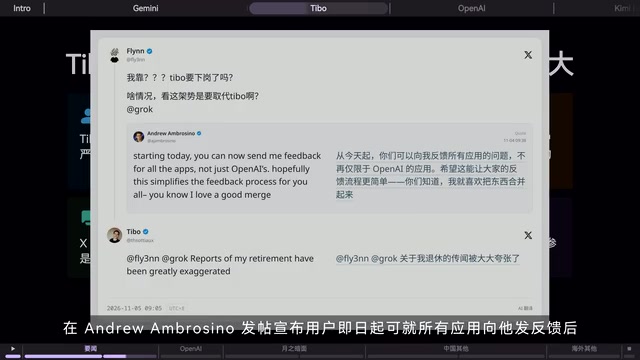
Tibo Responds to Retirement Rumors: Reports Greatly Exaggerated
There is a side note on the Google front. After Andrew Ambrosino posted that users can now send him feedback on all apps, some netizens speculated that Tibo would be replaced, which then led to rumors of his retirement. Tibo later responded that reports of his retirement were greatly exaggerated.
This item carries little information on its own, but it reflects how personnel changes in AI teams are often over-interpreted by outsiders. During sensitive periods in model release cadence, any change in personnel or responsibilities is easily tied to product direction; Tibo's public response effectively put an end to the rumor.
OpenAI Opens GPT Live Outbound Call API
OpenAI announced the official release of the GPT Live outbound call API, open to all organizations. Developers can have voice agents place calls through any SIP trunk provider, with calls supporting HD voice and DTMF key sending and receiving.
The significance of this capability is that it pushes voice agents from closed demo environments onto the real telephone network. Access via SIP trunking means enterprises can reuse their existing telephony infrastructure rather than depend on a single vendor's lines. Support for DTMF key sending and receiving lets voice agents handle traditional IVR scenarios like "press 1 to reach a human," a clear practical improvement.
For developers, the barrier to deploying voice agents is further lowered; for the industry, outbound calling is a high-frequency entry point for scenarios such as customer service, appointments, and collections. With an open API, competition will center on call quality, latency, and compliance strategy.
Technical Background on SIP and DTMF
SIP (Session Initiation Protocol) is an application-layer signaling protocol responsible for establishing, modifying, and terminating voice/video sessions on IP networks; it is the foundation of enterprise VoIP phone systems and carriers' IMS networks. By connecting agents to the telephone network through a SIP trunk, developers effectively reuse the lines and numbers of existing PBXs or cloud call centers without building telecom-grade gateways themselves. DTMF (dual-tone multi-frequency) is the keypad signal encoding used by dial pads; traditional IVR navigation relies on it to convey user selections. For voice agents to truly replace human agents, they must reliably send and receive DTMF signals in addition to speech recognition, so they can interface with existing IVR flows.
Kimi Launches Hosted Agent Service, Starting with 8 Financial Agent Templates
Kimi announced the official launch of its hosted agent service Kimi Hosted Agents, moving the Harness framework that powers agents to the cloud. Enterprises can get a 7x24 hosted environment without building their own framework, with support for long-horizon tasks and multi-agent collaboration.
The first batch offers 8 financial Agent templates. Hosting the Harness means handing over the most labor-intensive parts of Agent engineering—scheduling, state management, and continuous operation—to the platform, while enterprises focus only on business logic and data integration. Financial scenarios demand high stability and auditability, so it is no surprise they are the first template direction.
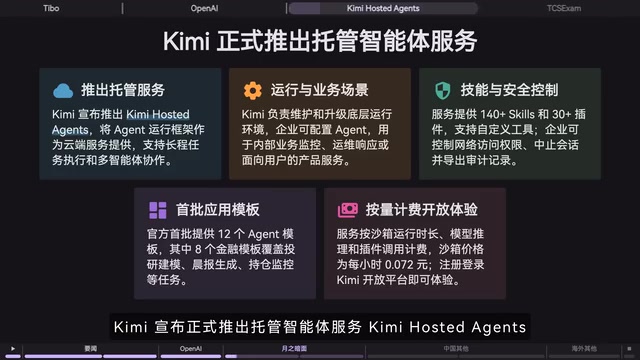
What Is an Agent Harness
A Harness refers to the entire runtime framework that wraps around a large model and drives an Agent through long-horizon tasks, typically including tool-call orchestration, context and memory management, state persistence, error retries, concurrent scheduling, and observability. It does not change the model's own capabilities, but it determines whether an Agent can reliably complete multi-step tasks. Hosting the Harness in the cloud means the platform takes on process residency, failure recovery, and scaling, while enterprises only write business logic and tool interfaces. Compared with the earlier practice of developers assembling LangChain-style frameworks themselves and building their own scheduling services, this significantly reduces operational burden but also creates dependence on the platform's runtime behavior.
Moonshot AI Open-Sources TCS Exam Benchmark
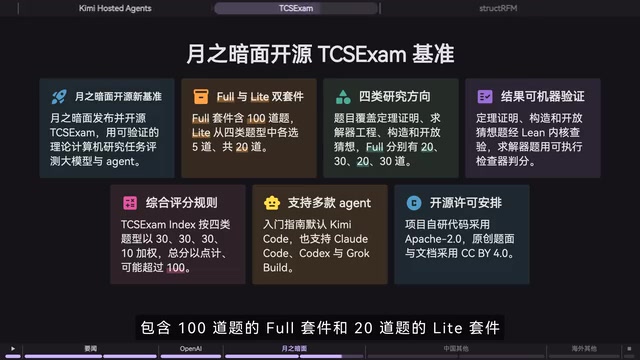
Moonshot AI released and open-sourced TCS Exam, a benchmark for theoretical computer science research, including a negative suite of 100 problems and a light suite of 20 problems, covering four directions: theorem proving, solver engineering, construction, and open conjectures.
Theoretical computer science has long lacked a unified evaluation standard, and existing benchmarks mostly lean toward code generation or math competition problems. TCS Exam brings theorem proving and open conjectures into the same framework, attempting to probe the upper limits of models' formal reasoning. The design of the negative and light suites also makes it easy for teams with different resource constraints to choose as needed.
USTC Open-Sources RNA Sequence Foundation Model Struct RFM
A team from the University of Science and Technology of China released the open-source RNA sequence foundation model Struct RFM, with results published in Nature. The model completed structure-guided pretraining on about 21 million sequence-structure paired data points, can predict RNA structure and infer function, and has released its data, model, weights, and source code.
RNA structure prediction has long been limited by the scale of experimental data, and 21 million paired data points is a considerable amount for similar work. The idea of structure-guided pretraining is to incorporate structural information into sequence modeling as a supervisory signal, rather than only doing sequence-to-sequence generation. The value of open-sourcing all assets to the bioinformatics community may exceed the model's performance numbers themselves.
Structure-Guided Pretraining
RNA function depends heavily on its folded three-dimensional structure, yet experimental structure determination is far slower than sequencing. Structure-guided pretraining adds structure-related supervisory signals on top of the sequence language modeling objective—for example, constructing auxiliary losses from predicted secondary structures or pairing constraints—so that the model internalizes base-pairing and spatial conformation patterns in its representation learning. This follows the same line of thinking as the protein field, from AlphaFold to the ESM series of models. That is exactly where the value of 21 million sequence-structure pairs lies: the denser the structural labels, the better the model can learn the mapping from sequence to function, rather than merely fitting the sequence distribution.
Baidu Releases 280B-Parameter Open Pretrained Weights
Baidu released open pretrained endpoint weights, covering subsequent training uses such as domain adaptation and instruction fine-tuning. The model has 280B total parameters and 14B activated parameters, trained on 33.5T tokens. The company said the post-trained Ernie 5.5 Flash will be released subsequently.
The combination of 280B total parameters and 14B activated parameters indicates a sparse architecture model that activates only part of its parameters during inference to control cost. A training volume of 33.5T tokens is relatively high among open-weight models, and the positioning as "open pretrained endpoint weights" means third parties can build on it for domain adaptation and post-training, rather than receiving only a finished chat model.
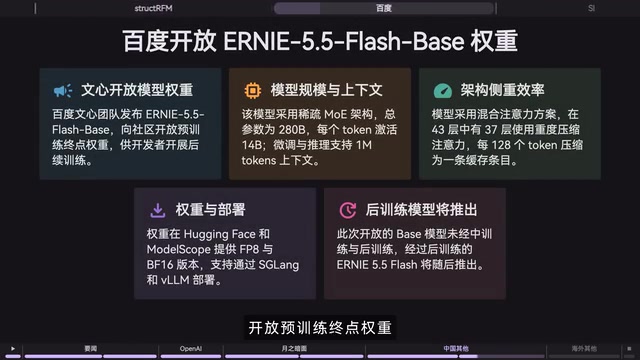
Sparse Architecture and MoE
Total parameters of 280B and activated parameters of 14B mean the model uses a sparse structure such as Mixture of Experts (MoE): during the forward pass, a router selects a small number of expert networks for each token, so the compute cost per inference is close to that of a 14B dense model, while the model's capacity is carried collectively by 280B parameters. This design strikes a compromise between training cost and inference efficiency for open-weight models, but it also places higher demands on memory capacity—all expert weights still need to be loaded or stored in shards. Understanding the pair of metrics "total parameters/activated parameters" is key to evaluating the deployment cost and throughput of such models.
US Lawmakers Call for Pause on Advanced AI Development
US Democratic Representative Yasamin Ansari called for pausing advanced AI development, regulating this runaway industry, and banning artificial superintelligence to be top priorities on the first day of the new Congress. The related bill she co-sponsored was previously introduced and is still under public congressional committee review.
Such legislative initiatives are unlikely to pass in the short term, but they reflect that congressional attention to AI risk is shifting from hearings to concrete bill text. Proposals to pause advanced AI development and ban artificial superintelligence touch on difficult issues such as defining capability thresholds and international coordination; even if they enter review, they will face prolonged wrangling.
Conclusion
Taken together: rumors about Google's video model, OpenAI connecting voice agents to the telephone network, Kimi hosting the Agent framework, Moonshot AI and USTC each open-sourcing a benchmark and a biological model, Baidu releasing sparse-architecture pretrained weights, plus calls for regulation in Congress. Capabilities, infrastructure, and governance are all moving at once, and there is no sign the AI industry's pace is slowing.
One-line Summary
Google video model rumors, OpenAI voice API, Kimi hosted Agents, Baidu open 280B weights, and more advancing on multiple fronts.
Paragraph Summary
This article rounds up several recent developments in AI: X users claim Google Gemini Omni Flash 1.2 may support 1080p/4K video generation and launch via API, though Google has not confirmed it; OpenAI opens the GPT Live outbound call API, letting voice agents place calls via any SIP trunk with DTMF support; Kimi launches a hosted agent service, moving the Harness framework to the cloud with 8 financial templates; Moonshot AI open-sources the TCS Exam theoretical computer science benchmark, and USTC open-sources the RNA structure foundation model Struct RFM; Baidu releases open pretrained weights with 280B total parameters and 14B activated parameters. In addition, US lawmakers call for a pause on advanced AI development. Overall, model capabilities, infrastructure, and governance are advancing in parallel.
Related articles
 Tech Frontiers
MuJoCo: An Analysis of DeepMind's Open-Source General-Purpose Physics Simulator
An in-depth analysis of Google DeepMind's open-source physics simulator MuJoCo: high-performance C++ kernel, MJCF modeling format, contact solving principles, MJX GPU acceleration, and robot reinforcement learning use cases.
 Tech Frontiers
Claude API Quick Start: The Official Quickstarts Project Collection
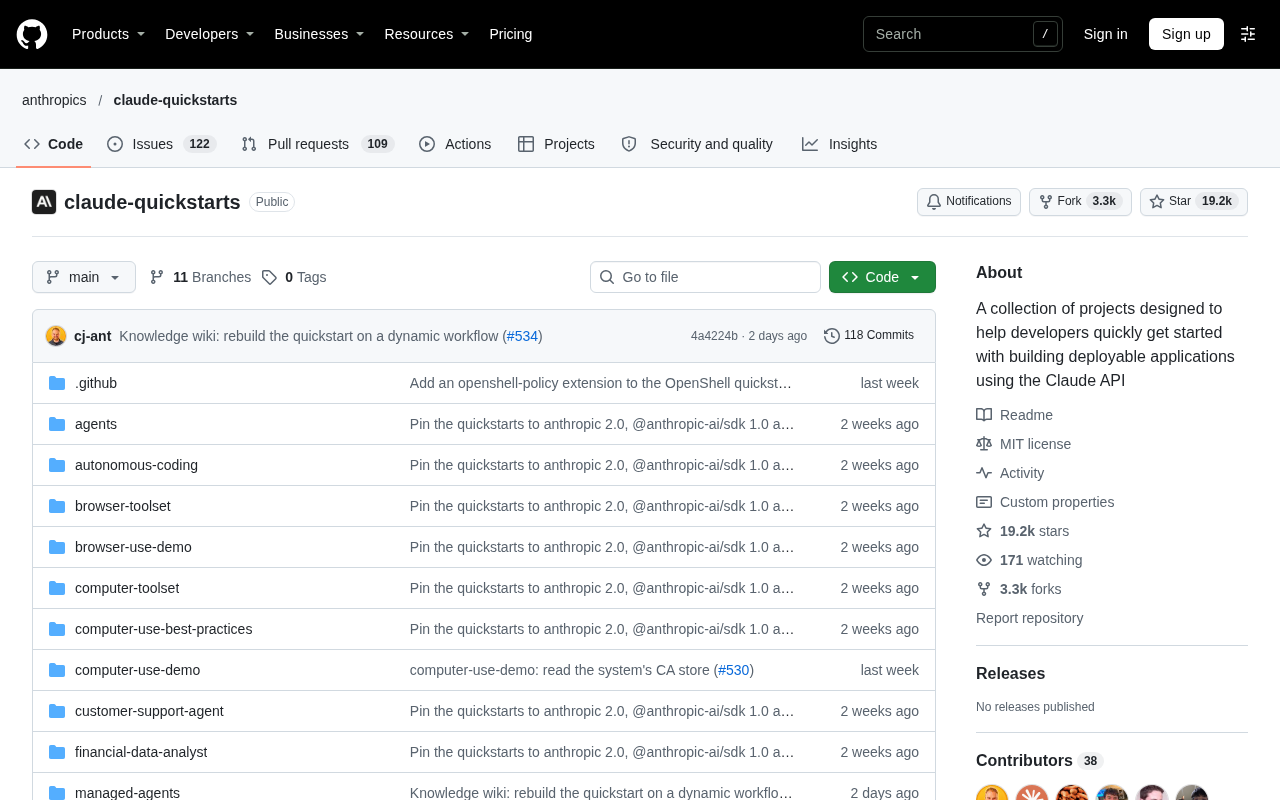
Anthropic's official claude-quickstarts project collection helps developers quickly build deployable apps with the Claude API. Nearly 20k stars, Python-based, great for beginners and prototyping.
 Tech Frontiers
AI Agents Connecting Directly to APIs: Which Calls Can Be Safely Allowed?
AI agents can call any API, but the real challenge is deciding which calls can be safely allowed. This article analyzes allowance decisions from three dimensions—intent matching, least privilege, and controllable impact—and argues that the control layer should sit outside the agent, combined with audit traceability to build a trustworthy API call governance mechanism.