Gemini Omni Flash Sparks Debate: Why No Pro Version?

Google's Omni Flash without a Pro version reveals AI's shift from peak performance to efficiency.
Google's release of Gemini Omni Flash — without a corresponding Pro version — has sparked community debate about product strategy and industry trends. The discussion reveals a broader shift in the AI landscape: as Chinese models like DeepSeek offer competitive capabilities at a fraction of the cost, the industry is moving from chasing benchmarks to prioritizing speed, efficiency, and practical value. Google's Flash-first approach reflects this new reality.
A Community Debate Over Naming
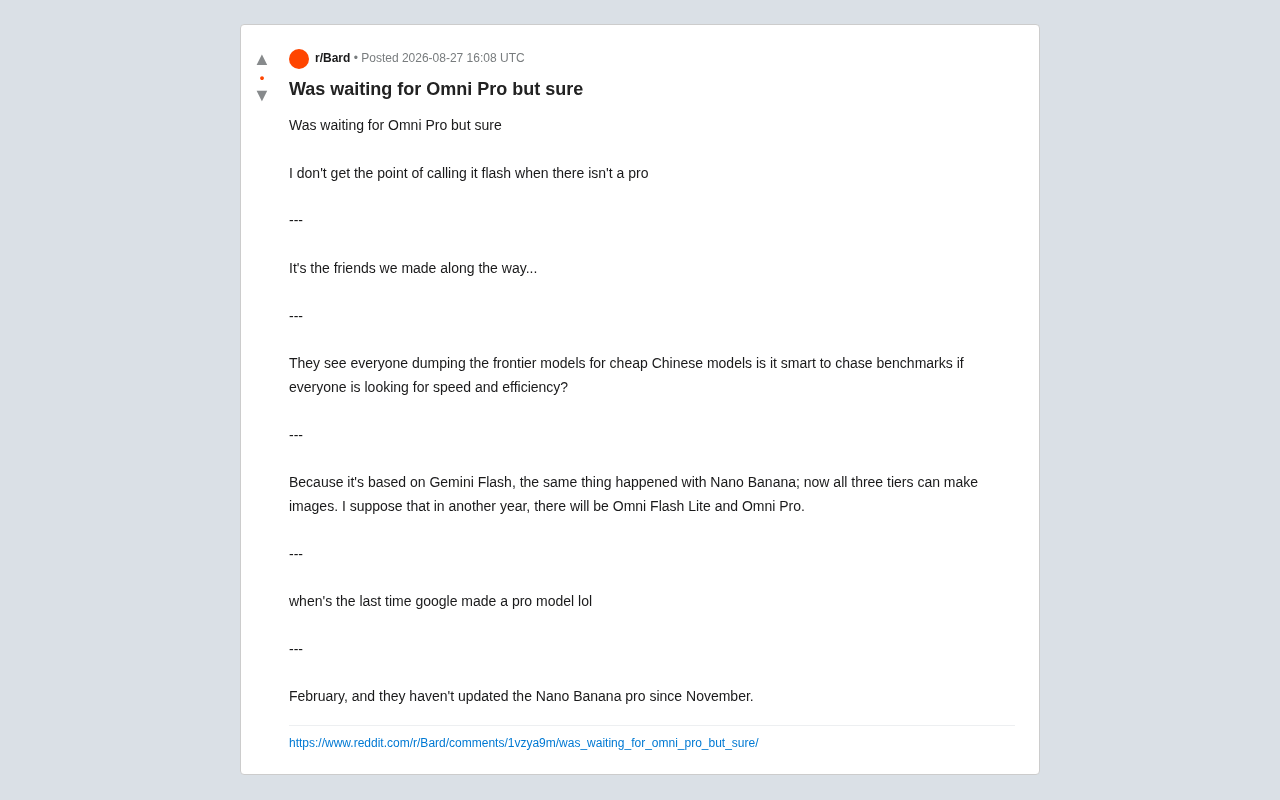
Recently, a discussion about Google's Gemini model naming conventions caught fire on Reddit. One user said they had been waiting for "Omni Pro" to drop, only to get "Omni Flash" instead — leaving many people confused: "If there's no Pro version, why call it Flash?"
What seems like a simple gripe actually touches on a core issue in AI model product design and market strategy. Tiered names like Flash, Pro, and Lite have become the universal language for LLM vendors to differentiate product positioning. But when a tier goes missing, users' expectations inevitably fall short.
The Logic Behind the Flash Name
Some community members offered a reasonable explanation: Omni is called Flash because it's built on the Gemini Flash architecture. This mirrors the earlier Nano Banana situation — it also launched at a specific tier first, then gradually expanded across the full product line.
Google's Gemini model family uses an industry-standard multi-tier product architecture. The Flash series typically employs Knowledge Distillation and inference optimization techniques, compressing a large model's knowledge into a smaller, more efficient architecture to dramatically boost inference speed and reduce costs. This tiering strategy isn't unique to Google — OpenAI's GPT-4o and GPT-4o mini, and Anthropic's Claude Sonnet and Haiku all follow a similar product matrix logic. The core positioning of Flash is to drive per-million-token inference costs down to a fraction of Pro-level pricing while keeping time-to-first-token (TTFT) latency extremely low, making it particularly well-suited for latency-sensitive use cases like high-frequency API calls and real-time interactions.
As one user predicted: "I bet in a year there will be Omni Flash Lite and Omni Pro." This strategy of launching at the middle tier (Flash) first, then extending upward (Pro) and downward (Lite), is becoming a common product iteration cadence among vendors. Flash sits at the sweet spot of speed and cost, making it a natural first stop for technical validation and market testing.
Speed and Efficiency, or Peak Performance?
A deeper point emerged in the discussion: "When everyone is abandoning frontier models for cheap Chinese models, is it still smart to chase benchmarks? What if what people actually need is speed and efficiency?"
AI model benchmarks include standardized evaluation suites like MMLU, HumanEval, GSM8K, and MATH, which measure performance across dimensions such as knowledge comprehension, code generation, and mathematical reasoning. However, there's a significant "evaluation-application gap" between benchmark scores and real-world production performance. A model might score exceptionally high on standard tests yet perform mediocrely on actual tasks like domain-specific long documents, multi-turn conversations, or instruction following. Additionally, some vendors tend to over-optimize for evaluation sets — so-called "benchmark gaming" — resulting in inflated scores but insufficient generalization ability. This is the technical root of why some in the community questioned whether "chasing benchmarks is still wise."
This question highlights an important shift in the AI industry. Over the past few years, major vendors engaged in an arms race over "the most powerful model," with parameter counts and benchmark scores as the marketing centerpieces. But as model capabilities approach saturation, real user demand is shifting from "the strongest" to "good enough and efficient."
The Cost Pressure from Chinese Models
The "cheap Chinese models" phenomenon mentioned in the community is worth noting. Domestic Chinese models like DeepSeekAd, Qwen (通义千问Ad), and Kimi are reshaping the market landscape with highly competitive pricing and solid real-world performance. When a model can deliver 80% of the capability at one-tenth the cost, the scales tip for many practical use cases.
The price competitiveness of Chinese AI models stems from multiple factors. Take DeepSeek as an example: its V3 model uses a Mixture of Experts (MoE) architecture to dramatically reduce actual computation during inference — although the model's total parameters may reach hundreds of billions, only a small subset of expert networks is activated per inference call, achieving an optimal balance between performance and cost. Moreover, Chinese vendors generally adopt aggressive pricing strategies to capture market share, with some API prices at one-tenth or even less than OpenAI's equivalent offerings. The Qwen series has also taken the open-source route, further lowering the barrier to entry across the ecosystem. While this "price war" may sacrifice profits in the short term, it effectively extends large model capabilities from a handful of enterprise users to a much broader community of small and medium developers, accelerating the maturation of the entire application ecosystem.
Against this backdrop, Google's prioritization of products like Gemini Flash — which emphasize speed and cost-effectiveness — may be a direct response to market trends. The era of chasing benchmark scores is giving way to the era of pursuing practical efficiency.
Why Is Google's Pro Version Update Lagging?
Another pointed question in the discussion concerned the update frequency of Gemini Pro models: "When was the last time Google did a Pro model?"
One user replied that it was back in February, and that Nano Banana Pro hadn't been updated since November. This detail reveals that Google's iteration pace for high-end models (Pro tier) is noticeably slower than for its Flash series.
The Trade-offs of Resource Allocation
Behind this phenomenon likely lies a strategic choice in resource allocation. Training and maintaining high-end Pro models is extremely expensive, yet actual usage volumes may not match the more cost-effective Flash series. From a business logic standpoint, channeling more resources toward mid-tier products that drive broader adoption is a rational decision.
The training costs of high-end Pro-level models are staggering — far beyond what ordinary users might imagine. Using GPT-4-class frontier models as a reference, a single full training run may require tens of thousands of high-end GPUs (such as NVIDIA H100) running for months, with compute costs alone reaching tens of millions or even hundreds of millions of dollars. This doesn't include data collection and cleaning, the extensive annotation staff needed for Reinforcement Learning from Human Feedback (RLHF), or the red-teaming investment required for model safety alignment. After training is complete, Pro models also require more compute to serve inference, directly raising the marginal cost per API call. When market demand is more concentrated on Flash-level products, the ROI of continuously pouring massive resources into Pro-level models naturally comes into question — which explains the business rationale behind Google slowing its Pro update cadence.
However, this also raises brand-level concerns. When users see "Flash" but can't find a corresponding "Pro," they easily get the impression of an incomplete product line, or even question whether the vendor is still committed to frontier research. As one slightly sardonic community quip put it: "The real treasure was the friends we made along the way" — when technical promises go unfulfilled, users can only resort to self-deprecating humor.
What Naming Conventions Reveal About Industry Shifts
This seemingly minor debate about "naming" is actually a mirror reflecting deeper changes in the AI industry.
First, tiered naming has become an industry standard, but it also creates expectation management challenges. The three-tier Flash/Pro/Lite framework gives users a clear choice structure, but when a tier is absent, it actually amplifies the psychological gap.
Second, the market is shifting from "performance worship" to "efficiency first." The rise of affordable Chinese models is forcing all vendors to reassess the balance between benchmark scores and practical utility. Speed, cost, and reliability are replacing raw capability ceilings as the focal points of competition.
Third, the lag in Pro-level model updates may signal a cooling of the high-end market. When the majority of user needs can be met by mid-tier products, the business case for investing heavily in maintaining top-tier models is being reevaluated.
Beneath these changes lies an even deeper industry trend: the core capabilities of foundation models are entering a phase of "diminishing marginal returns." The leap from GPT-3.5 to GPT-4 amazed the industry, but subsequent iterations have brought increasingly marginal perceived improvements. Some researchers call this the "slowdown of scaling laws" — the performance gains from simply increasing parameter counts and training data are plateauing. In this context, the competitive focus is shifting from "whose model is the strongest" to "whose product experience is the best." Multimodal fusion (such as Gemini Omni unifying vision, speech, and text capabilities in a single model), Agent tool-calling capabilities, context window length, and on-device deployment are becoming the new battlefields for differentiation. This is precisely why Google chose to enter the Omni multimodal direction with Flash first — multimodality itself is the frontier of product innovation, and Flash's low cost and high speed allow more developers to experiment and iterate rapidly.
Conclusion
From a simple complaint of "I was waiting for Omni Pro" to reflections on the entire industry's trajectory, this community discussion distills a key question in today's AI product competition: In an era where capabilities are approaching saturation, should vendors keep scaling the performance summit, or pivot to embrace efficiency and accessibility?
The answer may not be either/or. The strategy of launching Flash first with Pro to follow is itself a pragmatic balance. But one thing is certain: the era where "the most powerful model" alone determined the winner is quietly turning the page.
Related articles

Chain of Thought Isn't Just for AI: How Humans Can Use CoT to Improve Thinking Quality
Chain of Thought isn't just a prompt trick for large models. Starting from a Hacker News discussion, this article analyzes why CoT works for human thinking too, breaks down actionable ways to transfer it, and highlights the key differences between human CoT and machine CoT.
Cloudflare Teams Up with OpenAI: Closi…
Cloudflare Teams Up with OpenAI: Closing the Loop from Vulnerability Discovery to Defense with AI
Cloudflare uses OpenAI Daybreak to investigate security vulnerabilities and generate reviewable remediation plans, while developers use Codex to boost coding efficiency and quality.

Orca Multi-Agent Orchestration in Practice: A Guide to Parallel Collaboration with Claude and Codex
Orca is Stable AI's free open-source agent workbench supporting 34 agents like Claude Code and Codex in parallel. Learn its Git worktree isolation, multi-model orchestration, and mobile management.