Gemini Personalized Image Generation: Connecting the Google Ecosystem So AI Truly "Gets You"

Gemini now generates personalized images by connecting to your Google apps — for free in the U.S.
Google has expanded free access to Gemini's personalized image generation for U.S. users, integrating data from Gmail, Google Photos, and Calendar to let the AI automatically understand user preferences. This marks a shift from generic text-to-image generation to contextual creation, while raising important questions about privacy, data transparency, and competitive strategy.
Gemini Opens Free Personalized Image Generation
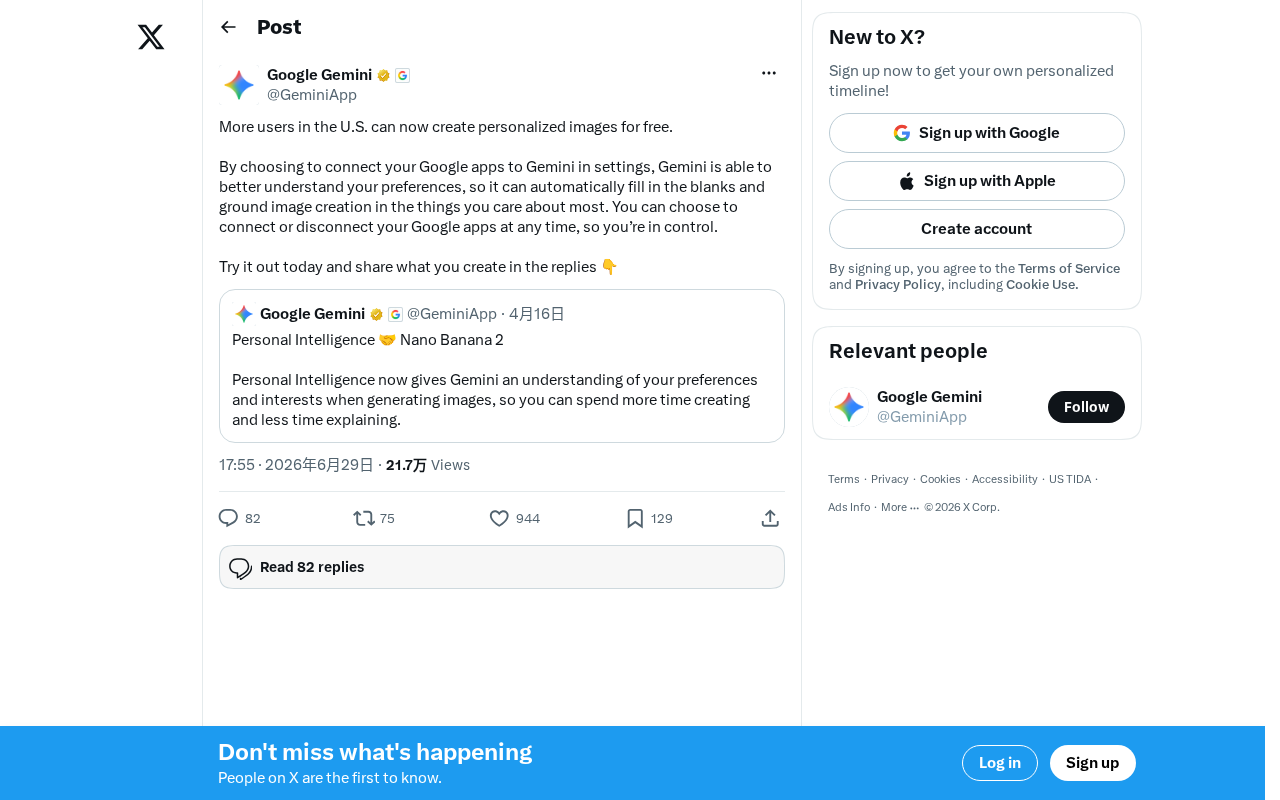
Google recently announced that more users in the United States can now access Gemini's personalized image generation feature for free. The core of this update isn't simply an upgrade to image generation capabilities — it introduces an entirely new interaction paradigm. By integrating with users' Google app ecosystem, the AI can genuinely understand personal preferences and generate visual content that better fits real-world needs.
The key here is "personalization." Traditional Text-to-Image (T2I) tools require users to describe every detail in their prompts. Powered by Diffusion Models and GANs, products like Stable Diffusion, DALL-E, and Midjourney brought image generation to the masses — but the complexity of "prompt engineering" has always been a steep barrier for everyday users. Gemini's new approach attempts to leverage Google app data so the model can "automatically fill in the blanks," shifting the burden of prompt refinement from the user to the system and anchoring image creation in what the user actually cares about.
How Data Connectivity Transforms the Creative Experience
From "Describe Everything" to "Understanding You"
According to Google's official announcement, users can choose to authorize their Google apps to Gemini in the settings. Once connected, Gemini can better understand user preferences and automatically fill in details that weren't explicitly stated when generating images.
The product thinking behind this is quite illuminating. When the AI has access to a user's contextual information — such as calendar schedules, stylistic preferences from their photo library, or frequently visited locations — it can automatically incorporate real-life elements when you type something as simple as "make me a birthday party invitation." This is a meaningful shift from "generic generation" to Contextual Generation.
Contextual generation is one of the frontier directions in AI development today: rather than being a "stateless" system that starts from scratch every conversation, the AI builds and maintains a user's "digital profile," continuously sensing their history, preferences, and real-time context. Google has a natural advantage here — Gmail, Google Photos, Google Maps, YouTube, and other products have accumulated years of behavioral data from billions of users. Feeding this cross-product context into generative AI is essentially an early realization of a Personalized Foundation Model: layering individual preference on top of the general capabilities of a large foundation model.
Users Always Stay in Control
Google specifically emphasized the control design in its announcement: users can connect or disconnect Google app authorization at any time. This "opt-out anytime" mechanism is the balance Google is striking between personalization convenience and data privacy.
For AI features involving personal data, privacy is an unavoidable topic. Connecting personal user data to an AI system raises several key technical considerations: the Data Minimization principle requires the system to access only the minimum data necessary to complete a specific task; privacy-preserving technologies like Federated Learning and On-device Inference allow models to process data on the user's device, avoiding the upload of raw personal data to the cloud — Google has implemented similar approaches in Pixel devices and the Chrome browser. However, Google's announcement has not yet clarified the specific privacy-computing architecture used for Gemini's personalization feature. Whether data leaves the device and how it's isolated in the cloud are factors users should carefully weigh before granting authorization — and they are areas that regulators under frameworks like GDPR will scrutinize closely.
By making data connectivity opt-in rather than on by default, and providing a clear disconnection option, Google has addressed some user concerns about data usage transparency.
The Strategic Significance of Personalized AI
Ecosystem Integration Builds a Competitive Moat
The deeper logic behind Google's move is to convert its vast app ecosystem into a competitive moat for AI experiences. From a business competition standpoint, this aligns with the Data Moat theory — in the AI era, companies with high-quality, highly relevant proprietary data will have a competitive edge that far exceeds algorithmic advantages alone. The massive user context data accumulated by Gmail, Google Photos, Google Calendar, Maps, and other products is precisely the core asset competitors cannot easily replicate.
This ecosystem competition isn't unique to Google: Microsoft is integrating Azure, Office 365, and GitHub data into Copilot; Apple is weaving iCloud, Health, and Siri conversation history into Apple Intelligence. The underlying logic is the same. The fundamental competition is: who can first integrate fragmented user data silos into a coherent personal context — and who can first deliver a truly "personal AI assistant."
It's worth noting that this trend will also significantly increase Switching Costs — the deeper a user's personalized data is embedded in one platform, the greater the cost of leaving. When image generation is no longer a standalone tool but a capability woven into the user's daily digital life, Gemini's differentiated advantage becomes clear: a deeply ecosystem-integrated AI assistant that offers a more "you-aware" experience, effectively boosting user retention.
Free Strategy Accelerates Mass Adoption
Opening the feature to more U.S. users for free is a classic Google playbook move to expand its user base in the generative AI race. By lowering the barrier to entry, Google hopes to let more people experience the value of personalized AI creation firsthand, creating a virtuous cycle of habit formation and data accumulation.
This also aligns with the common path taken by leading AI companies: rapidly capture market mindshare with free or low-cost offerings, then explore diverse monetization strategies once the ecosystem matures.
Questions Worth Watching
While personalized image generation paints an exciting picture of the future, several core questions are worth tracking:
- Privacy boundaries: AI "automatically filling in the blanks" means actively accessing user data. Whether the data minimization principle is rigorously enforced and whether the privacy-computing architecture is sufficiently transparent are long-term challenges.
- Generation quality and relevance: Whether personalization truly improves the usefulness of generated results still needs to be validated across a large number of real-world use cases.
- Regional restrictions: The feature is currently limited to U.S. users; the timeline for global rollout and localization remains unknown.
Overall, this Gemini update is a microcosm of the broader evolution of generative AI from "tool" to "assistant" — AI is no longer just passively executing commands, but actively trying to understand and connect with you. How this trend will reshape human-computer interaction is something every person following AI developments should continue to watch.
Key Takeaways
Related articles

Databricks Genie: The AI Analytics Assistant That Tripled a Marketing Team's Data Usage
Databricks' AI analytics assistant Genie tripled marketing team data usage. Discover how this conversational NL2SQL tool lowers the data access barrier and what it means for enterprise AI adoption.

How The Oregon Trail Became a Cultural Icon for Generations
How The Oregon Trail grew from educational software into a multigenerational cultural icon — through classrooms, "You have died of dysentery," and shared childhood memories.

Health Benefits Platform Thatch Hits $1B Valuation as Healthcare Costs Surge
Thatch raises $108M and hits a $1B valuation, backed by a16z, Index Ventures, and General Catalyst, as surging U.S. healthcare costs drive demand for flexible benefits platforms.