Gemini Reportedly Sends Personal Drive Files and Emails to Human Annotators
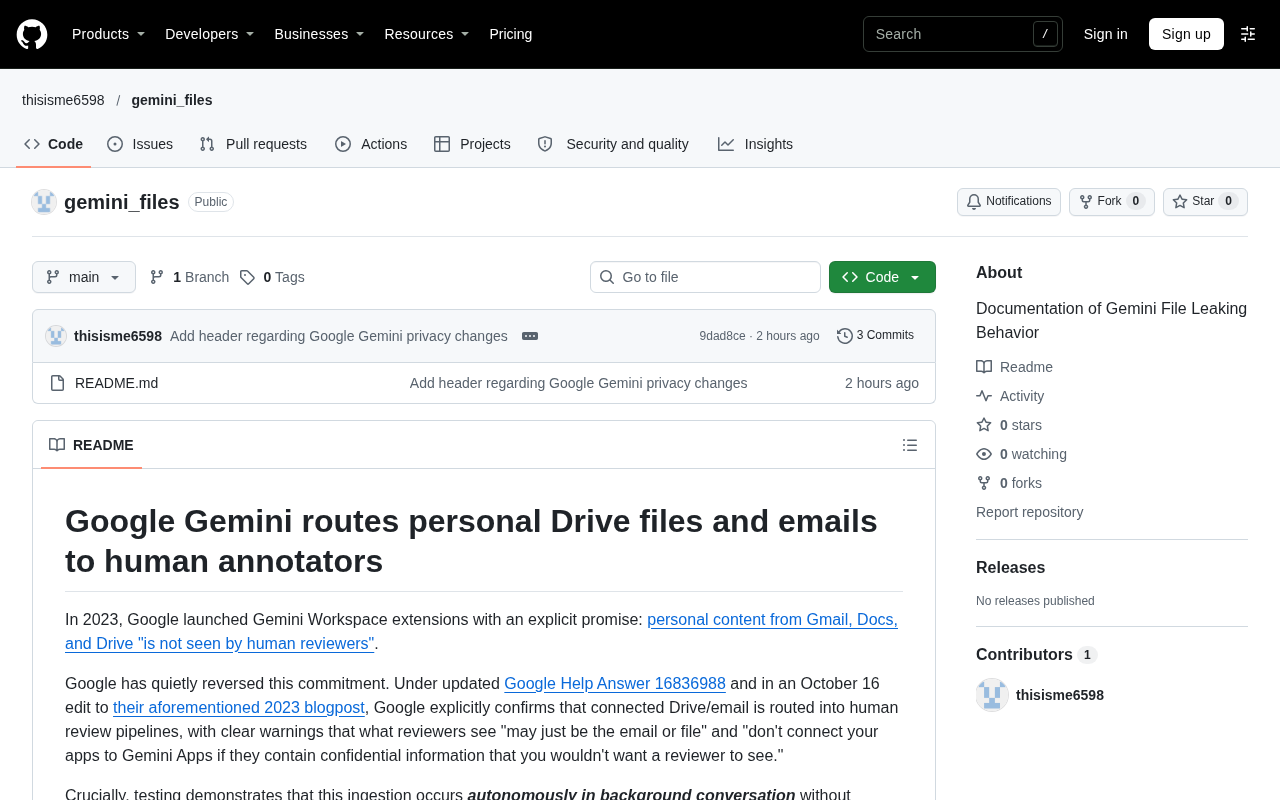
Google Gemini is reportedly routing personal Drive files and Gmail to human annotators, sparking privacy boundary controversy.
The article centers on headline-level information from Hacker News: Google Gemini is reportedly routing users' personal Google Drive files and Gmail email content to human annotators. The author notes that the original material only provides a headline-level description without disclosing the annotation process, anonymization mechanisms, or scope, but this allegation touches on the privacy boundary issue when AI assistants deeply integrate with personal data. The article analyzes that large model quality optimization relies on real-world corpus, while personal documents and emails differ fundamentally in sensitivity from public data; consumer-grade product data usage descriptions lean toward legalistic language and lack transparency, creating a gap with users' intuitive expectation of "AI automatic processing." The article concludes with user advice such as adjusting integration permissions and reducing storage of sensitive data, and notes that transparency in human intervention is a shared industry challenge.
Event Overview: The Boundary Dispute Between Gemini and Human Annotation
According to a discussion on Hacker News (from a headline about Google Gemini), Google Gemini is reportedly routing users' personal Google Drive files and Gmail email content to human annotators for processing. The post received 4 points on Hacker News with no comments yet, but the headline itself already points to a key question: when an AI assistant deeply integrates with personal data, where exactly is the privacy boundary?
The core information in this report is limited. The original material only provides a headline-level description, without disclosing the specific annotation process, data anonymization mechanisms, or the scope of affected users. However, from a product architecture perspective, Gemini is deeply integrated with the Google ecosystem, and Drive and Gmail are precisely its important sources of context. This also explains why such news quickly draws attention—users find it hard to determine under what conditions their files would enter human review processes.
Why Personal Data Enters the Human Annotation Pipeline
Quality optimization of large model products typically relies on real-world scenario data. When models deviate in understanding user documents and email semantics, human annotation and evaluation become important means of improving the model. For Gemini integrated into Google Workspace, Drive files and Gmail emails are the corpus sources closest to real usage scenarios.
The problem is that this type of data is fundamentally different in nature from public web text. Personal documents and emails often contain highly sensitive content such as identity information, trade secrets, and private communications. Even if Google reserves the right in its terms of service to use data for improving services, ordinary users still have very limited awareness of the fact that "human annotators may see my files."
Human Annotation is a common step in machine learning pipelines: trained personnel read, classify, score, or correct data samples to produce high-quality "gold labels" used for training models, evaluating model outputs, or troubleshooting model defects. In the era of large models, annotation work includes not only traditional classification and labeling but also extends to human scoring of the usefulness, safety, and factuality of model responses (often referred to as human preference data in RLHF). In addition, when model outputs trigger safety policies or user reports, vendors may also arrange human review of the relevant conversations and their context. This means that if a product is to continuously improve its model and handle abuse and compliance issues, human contact with some real user data is an engineering step that is difficult to completely avoid. The key lies in whether the scope of contact, anonymization methods, and notification mechanisms are adequate.
The Gap Between Privacy Promises and Product Reality
Google has long emphasized Gemini's privacy design externally, such as data isolation commitments for the enterprise version. But for consumer-grade products aimed at individual users, data processing policies are often more complex. If the situation described in the headline is true, it means that usage data from the personal version of Gemini may enter human review processes, which is clearly at odds with users' intuitive expectation of "AI automatic processing."
This gap itself deserves industry reflection. User agreements for AI products are usually presented as long texts, with descriptions of data usage leaning toward legalistic language, making it difficult for ordinary users to accurately understand who may access their files and in what manner. Insufficient transparency will continue to erode user trust.
The data processing differences between consumer-grade and enterprise-grade products deserve separate explanation. For free or subscription versions aimed at individuals, vendors typically reserve the right in their terms of service to "use user content to improve services," and data may be used for model training and quality evaluation. Workspace Enterprise, Education, and similar editions usually come with a Data Processing Addendum (DPA), committing that customer data will not be used to train general models, and supporting controls such as data residency and audit logs. The privacy baselines of the two are not the same, and users easily mistake enterprise-version commitments for the default treatment of personal versions—this is precisely the structural reason for the "gap." When judging the data flow of a certain AI feature, you should confirm which version you are using and which terms apply.
Practical Advice for Users
Before more details are disclosed, users can reduce risk from several directions. First, review Gemini's integration permissions with personal Google accounts and turn off unnecessary data access. Second, avoid storing highly sensitive files and emails long-term in cloud drives linked to AI assistants. Third, pay attention to whether Google subsequently issues a formal privacy statement or policy clarification on this matter.
For enterprise users, the situation is relatively clear: Workspace Enterprise editions usually have stricter data processing agreements, but it is still necessary to check the specific AI feature switches and data usage terms.
Signals at the Industry Level
Although this news contains limited information, it points to a broader trend: the deeper AI assistants integrate into personal data, the harder it becomes to completely avoid human intervention steps. Whether for model evaluation, safety review, or quality annotation, there is an inherent tension between the value of real data and the protection of user privacy. How to make this tension transparent at the product design level will be an unavoidable issue for all AI vendors.
One-line Summary
Google Gemini is reportedly routing personal Drive files and Gmail to human annotators, sparking privacy boundary controversy.
Paragraph Summary
The article centers on headline-level information from Hacker News: Google Gemini is reportedly routing users' personal Google Drive files and Gmail email content to human annotators for processing. The author notes that the original material only provides a headline-level description, without disclosing the annotation process, anonymization mechanisms, or scope involved, but this allegation touches on the privacy boundary issue that arises when AI assistants deeply integrate with personal data. The article analyzes that large model quality optimization relies on real-world scenario corpus, while personal documents and emails are fundamentally different in sensitivity from public data; data usage descriptions for consumer-grade products lean toward legalistic language and lack transparency, creating a gap with users' intuitive expectation of "AI automatic processing." The article concludes with user advice such as adjusting integration permissions and reducing the storage of sensitive data, and points out that transparency in human intervention steps is a common challenge for the industry.
Related articles

Gemini 4 Neon Released: A Balance Between Frontier Intelligence and Efficient Task Execution
Google DeepMind releases Gemini 4 Neon, focused on frontier intelligence and fast end-to-end task execution. This article breaks down its benchmark performance in coding, enterprise analysis, scientific reasoning, and cybersecurity, its four thinking levels, pricing, and safety alignment data.

Is AI the Culprit Behind Global Outages? The Trust Crisis Behind the NSA and FAA Failures
Fourth major failure in five days hits NSA classified network. Microsoft blames a software bug, FAA denies its new AI system, NSA says routine maintenance. Senator Warner suggests AI accelerates vulnerability discovery, leading to rushed fixes — while 39% of Americans already view AI negatively, exposing a deepening trust crisis.

Robot Developer Builds Custom B-rep Kernel with 3,487 Tests
A robot developer builds a custom B-rep geometry kernel with 3,487 tests, exploring why robotics needs dedicated CAD tools and the barriers to building one.