Gemini Returns Outdated Information: Understanding the Knowledge Cutoff Problem and How to Deal With It

Why Gemini returns outdated info despite extended thinking, and how users can work around it.
Even with extended thinking enabled, Gemini frequently returns outdated information due to the fundamental knowledge cutoff limitation of LLMs. This article explains why reasoning ability doesn't equal knowledge updates, how RAG and retrieval triggers fail, and provides practical strategies — like explicitly requesting web search and providing contextual anchors — to help users get accurate, timely answers.
An Overlooked AI Pain Point
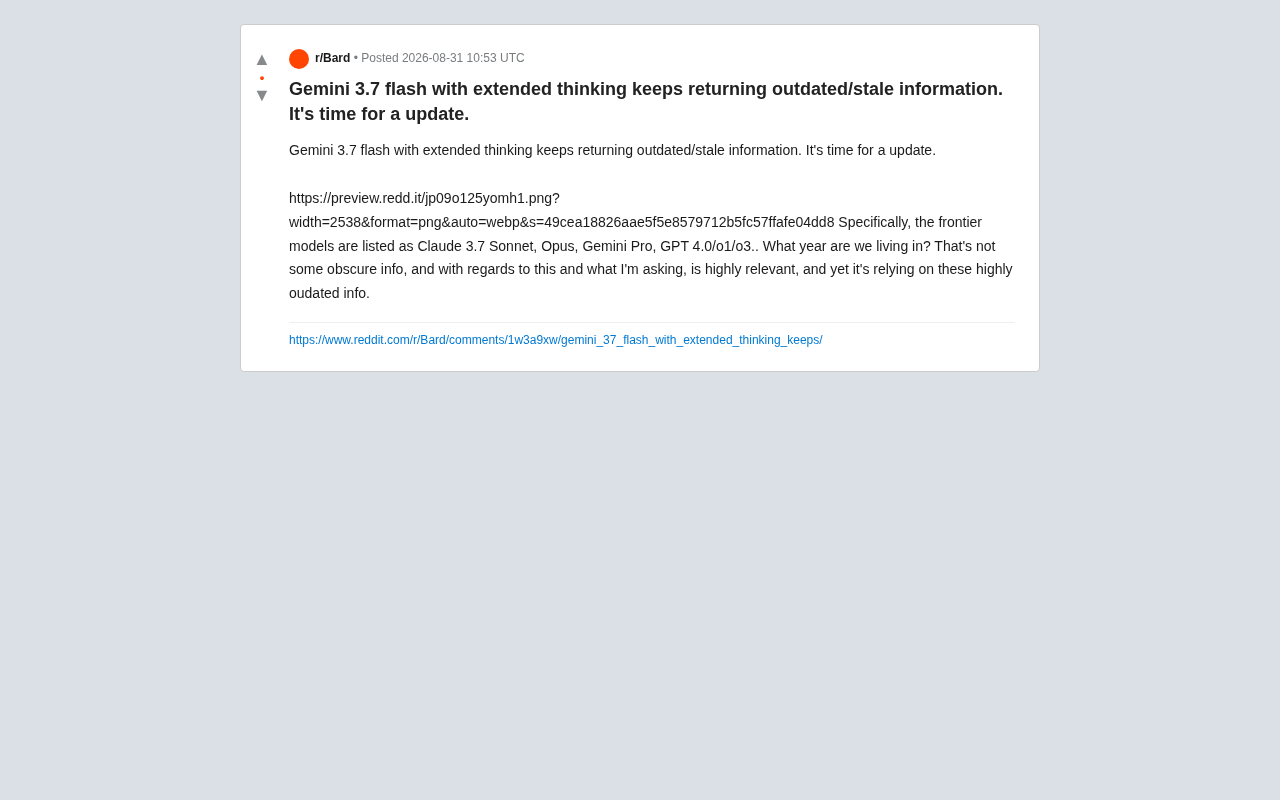
Recently, a Reddit user raised a question that resonated with many heavy AI users: even with "extended thinking" mode enabled, Gemini still frequently returns outdated, stale information.
The scenario described by this user is quite representative: when asked about current frontier models, Gemini's answer was stuck on Claude 3.7 Sonnet, Opus, Gemini Pro, and GPT-4.0/o1/o3. The user couldn't help but quip: "What year are we living in?"
The term "frontier models" mentioned here is a specialized term in the AI safety field, typically referring to general-purpose AI systems that are at the cutting edge of capability, surpassing the strongest existing models. This concept was jointly promoted in 2023 by multiple AI labs and policymakers, and is closely tied to AI governance and safety evaluation. Frontier models receive special attention because they may possess emergent capabilities that previous models lacked, introducing risks that are difficult to predict. Systems currently classified as frontier models include OpenAI's GPT series, Google's Gemini series, Anthropic's Claude series, and Meta's Llama series, among others. These models iterate so rapidly that any "latest list" from a fixed point in time can become outdated within weeks.
This issue may seem like a minor bug, but it actually touches on a deep-rooted structural limitation of current large language models (LLMs) — knowledge cutoff.
Why Models "Live in the Past"
Training Data Has a Time Boundary
The knowledge of large language models isn't updated in real time — it's determined by the training data fed into them. Every model has an explicit or implicit "knowledge cutoff date," beyond which events, product launches, and updated information are entirely unknown to the model.
Knowledge cutoff refers to the upper time limit of a large language model's training data. During the pre-training phase, a model digests massive text corpora — typically encompassing trillions of tokens from web pages, books, papers, code, and more — but the collection of this data has a definitive cutoff point. For example, GPT-4's training data cuts off around the end of 2023, meaning products released or events occurring after 2024 are completely imperceptible to the model without external retrieval assistance. This limitation stems from the fundamental paradigm of deep learning: a model's parameter weights are frozen once training is complete, and although hundreds of billions of parameters encode vast knowledge, that internal knowledge won't automatically update unless the model is retrained or fine-tuned.
This means that no matter how persistently you ask, the model has a complete "blind spot" for anything after its training cutoff. When users ask "what are the latest frontier models," the model can only answer based on its training-time memory, naturally listing the model names that appeared most frequently in its training data.
Extended Thinking Can't Compensate for Missing Knowledge
The user specifically mentioned having extended thinking mode enabled, yet still receiving outdated answers. This reveals a common misconception: reasoning ability ≠ knowledge updates.
Extended thinking (also called reasoning mode or chain-of-thought) enhances a model's logical inference and multi-step analysis capabilities, making it more rigorous when solving complex problems. But it cannot conjure new knowledge the model has never encountered. If the training data simply doesn't contain information about a new model, even the strongest reasoning ability only amounts to "deep thinking" based on old information — the result is still outdated.
To understand this, it helps to dive deeper into how extended thinking mode works technically. Extended thinking is a reasoning enhancement technique that major model providers have introduced in recent years. Its core principle originates from Chain-of-Thought (CoT) prompting, which has the model perform step-by-step intermediate reasoning before generating a final answer. Google's Gemini, Anthropic's Claude, and OpenAI's o-series models have all implemented various forms of extended thinking. This mode allocates more computational resources (i.e., more inference tokens), enabling the model to decompose complex problems, explore multiple solution paths, and self-verify, thereby significantly improving performance on tasks like math, coding, and logical reasoning. But it's crucial to understand that this capability enhancement is fundamentally a deeper-level combination and inference of existing knowledge — like a highly knowledgeable but isolated scholar who, no matter how much thinking time you give them, cannot deduce news events they've never been exposed to.
Lack of Real-Time Retrieval Is the Key Weakness
Behind the user's complaint lies another implicit issue: highly time-sensitive information (like "what are the most powerful AI models right now") should be obtained through web search in real time, rather than relying on the model's internal memory.
When the model fails to properly invoke retrieval tools (RAG or web search), or when it determines that a question "doesn't need searching," it falls back on training data for its answer, thereby exposing the knowledge cutoff problem.
RAG (Retrieval-Augmented Generation) is a technical architecture proposed by Meta AI in 2020. Its core idea is to retrieve relevant information from external knowledge bases or the internet before the model generates an answer, injecting the retrieved document fragments as additional context into the model's prompt, thereby allowing the model to respond based on the most current and accurate information. A RAG architecture typically includes two core components: the Retriever, responsible for finding the most relevant documents from the knowledge base, and the Generator, which produces the final answer based on those documents. This technology is considered one of the most viable solutions to the knowledge cutoff problem and is now widely used in enterprise AI products and search-based AI assistants (such as Perplexity, New Bing, etc.).
However, RAG's actual performance is highly dependent on the design of its retrieval trigger mechanism. Most current AI assistants use a model-driven approach to determine whether to invoke search — the model decides based on the nature of the question whether to answer directly or search first. The problem is that models sometimes become "overconfident," believing they possess sufficient knowledge to answer a question and thereby skipping the retrieval step. This is precisely the classic situation the Reddit user encountered: Gemini judged that "what are the frontier models" fell within its knowledge scope and directly extracted answers from training data, unaware that this information was already outdated. This also demonstrates that for time-sensitive queries, the integration and trigger mechanism of real-time retrieval is critically important.
Deeper Challenges Behind the Knowledge Cutoff Problem
A Gap Between User Expectations and Technical Reality
For average users, an AI that can "think" should logically know what's happening "right now." But the technical reality is that statically trained models are inherently behind the times. This gap is dramatically amplified in an era when the AI industry itself is iterating at breakneck speed — models iterate so fast that they don't even recognize their own "successors."
Ironically, when you ask an AI model "what is the most advanced AI model right now," it might not even be able to accurately describe itself, let alone newer competitors. This phenomenon is psychologically similar to the reverse of the "curse of knowledge" — it's not that it knows too much to explain simply, but that it fundamentally doesn't know it has fallen behind. Models lack a kind of "metacognitive" ability — they cannot accurately assess the timeliness boundaries of their own knowledge, nor can they proactively recognize that information in certain domains may have already expired.
The Governance Challenge of Time-Sensitive Information
For rapidly changing information in product and research domains, how to keep models "fresh" is a challenge that all major providers are working to solve. Currently, there are two mainstream solution paths:
-
Continual Pre-training and Incremental Updates: Periodically refreshing model knowledge with new corpora, but this is expensive and cannot achieve true real-time updates. Continual pre-training refers to conducting additional training on an existing pre-trained model using newly collected corpora to update its knowledge. However, this process faces severe technical challenges, the most prominent being catastrophic forgetting — the model may overwrite or corrupt previously learned knowledge while learning new information, leading to degraded performance on certain older tasks. Additionally, each large-scale pre-training run requires millions of dollars in compute costs and weeks or even months of training time, making frequent updates economically unsustainable. The industry is currently exploring lower-cost alternatives such as parameter-efficient fine-tuning (PEFT, including methods like LoRA and QLoRA) and knowledge distillation, but there remains a significant gap before truly real-time knowledge updates become feasible.
-
Retrieval-Augmented Generation (RAG) + Web Search: Having the model dynamically pull the latest information when answering — this is currently the more pragmatic approach, but it places high demands on retrieval trigger accuracy and information source quality. Specifically, a high-quality RAG system needs to address multiple sub-problems: how to determine which queries need real-time retrieval (intent recognition), how to filter reliable sources from massive search results (information filtering), how to integrate retrieved information with the model's own knowledge rather than simply concatenating them (knowledge integration), and how to handle cases where retrieval results contradict the model's internal knowledge (conflict resolution). Currently, Google's Gemini, OpenAI's ChatGPT, Perplexity, and other products have integrated web search capabilities to varying degrees, but there's still room for improvement in trigger timing and result quality.
Practical Methods for Users to Deal with Gemini's Outdated Information
Until providers fully solve the knowledge cutoff problem, users can proactively adopt the following strategies to mitigate risks:
- Explicitly request web search: When asking questions, directly instruct the model to "please search the web for the latest information" to force real-time retrieval. This leverages the model's instruction following capability, using explicit instructions to override the model's default "autonomous judgment of whether search is needed" logic.
- Stay vigilant about time-sensitive answers: For questions containing keywords like "latest," "current," or "this year," maintain a critical stance toward model answers and proactively cross-verify. Pay special attention to the model's tendency toward hallucination — when the model lacks up-to-date information, it may not honestly admit it doesn't know, but instead fabricate seemingly plausible yet actually incorrect answers.
- Provide contextual anchors: Include the current date or known latest information in your prompts to help the model calibrate its response direction. For example, you could say "It's now July 2025, Claude has updated to version 4.0, please answer based on this timeframe," which helps the model recognize that its own knowledge may be outdated.
- Leverage multi-source verification: For important time-sensitive information, don't rely entirely on a single model — cross-reference with search engines or multiple AI tools. Tools like Perplexity AI and Google Search often perform better for time-sensitive information retrieval because their product design centers on real-time search.
Conclusion
This Reddit user's complaint may appear to be frustration over a model bug, but it actually reflects a universal challenge across the entire LLM industry: how to make statically trained models keep pace with a dynamically changing world.
As AI product iteration cycles grow ever shorter, the sense of lag caused by "knowledge cutoff" will only become more pronounced. The real solution may not lie in how frequently training data is updated, but rather in teaching models to "know what they don't know" and proactively retrieve the latest information at the right moment. This capability is known in AI research as "calibrated uncertainty" — models should not only be able to provide answers but also accurately assess their confidence in those answers, and proactively seek external information when confidence is insufficient. This isn't just a technical problem — it's fundamentally about building user trust. When users discover that an AI can honestly say, "My knowledge on this topic might not be current enough — let me search for the latest information," that turns out to be far more trustworthy than an AI that answers confidently but incorrectly.
Related articles

Chain of Thought Isn't Just for AI: How Humans Can Use CoT to Improve Thinking Quality
Chain of Thought isn't just a prompt trick for large models. Starting from a Hacker News discussion, this article analyzes why CoT works for human thinking too, breaks down actionable ways to transfer it, and highlights the key differences between human CoT and machine CoT.
Cloudflare Teams Up with OpenAI: Closi…
Cloudflare Teams Up with OpenAI: Closing the Loop from Vulnerability Discovery to Defense with AI
Cloudflare uses OpenAI Daybreak to investigate security vulnerabilities and generate reviewable remediation plans, while developers use Codex to boost coding efficiency and quality.

Orca Multi-Agent Orchestration in Practice: A Guide to Parallel Collaboration with Claude and Codex
Orca is Stable AI's free open-source agent workbench supporting 34 agents like Claude Code and Codex in parallel. Learn its Git worktree isolation, multi-model orchestration, and mobile management.