Gemini's Neural Expressive Design Language Explained: Five Core Elements Redefining AI Interaction

Google unveils Neural Expressive design language for Gemini, opening a new era of AI experience competition.
Google has launched Neural Expressive, a new design language for its AI assistant Gemini, encompassing five core elements: fluid animation, vibrant colors, typography, haptic feedback, and visual response. This design language marks the extension of AI product competition from the capability layer to the experience layer. Google's choice to build an independent design system for Gemini rather than extending Material Design reflects its strategic intent to operate Gemini as a standalone AI brand.
What is Neural Expressive?
Google recently unveiled a brand-new design language for its AI assistant Gemini — Neural Expressive. This is a visual and interaction system built specifically for the AI era, marking a new phase in user experience for AI products.
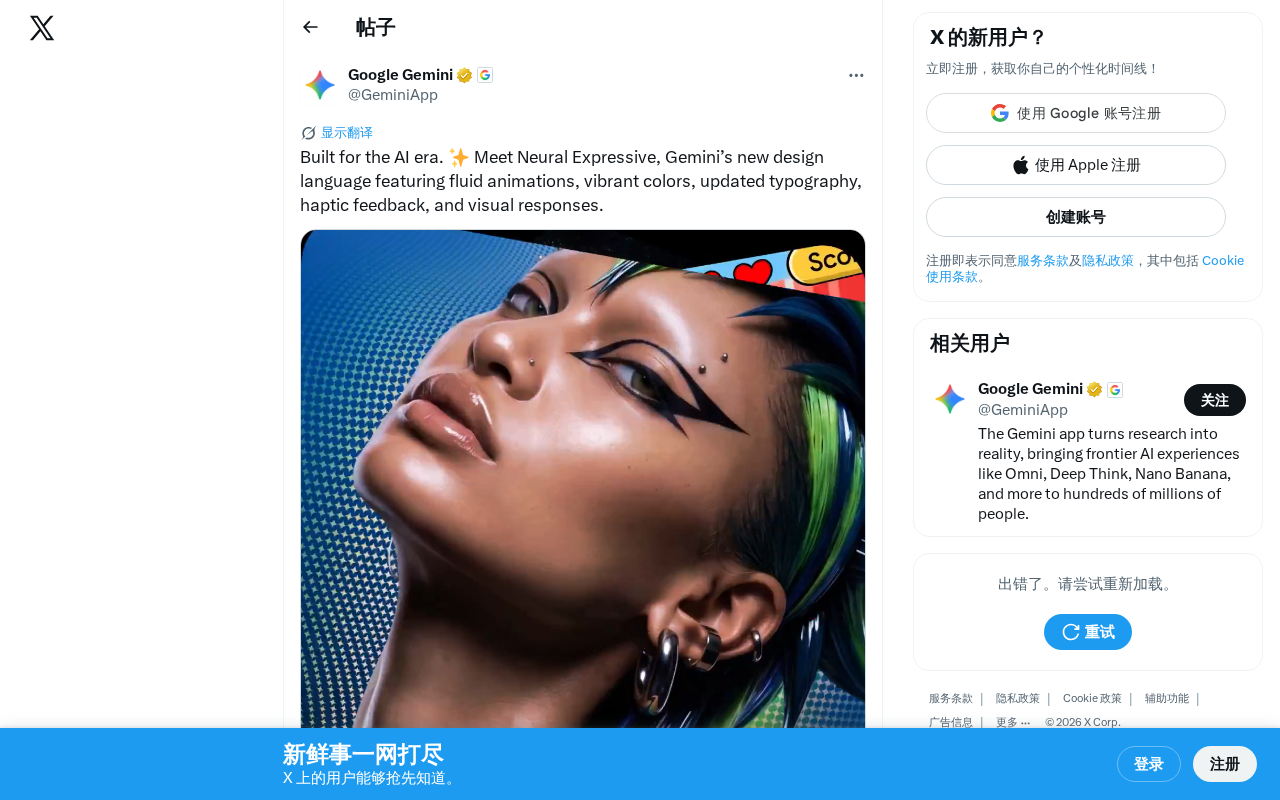
A design language is a systematic set of visual and interaction guidelines that ensures a product maintains a consistent look and feel across different platforms, devices, and contexts. Google's most iconic design language to date has been Material Design, launched in 2014, which used physical-world metaphors of paper and ink to define core principles around shadows, hierarchy, and motion — widely adopted across the Android ecosystem and Google's product suite. The emergence of Neural Expressive signals that Google believes Material Design's philosophy — rooted in physical-world metaphors — is no longer sufficient to support AI-era interaction needs, necessitating an entirely new language native to AI's characteristics.
Neural Expressive is not a simple UI refresh but a comprehensive overhaul starting from foundational design philosophy. It integrates fluid animations, vibrant colors, updated typography, haptic feedback, and visual responses across multiple dimensions, aiming to make AI interactions more natural, vivid, and expressive.
Deep Dive into the Five Core Design Elements
Fluid Animation: Making AI's Thinking Process Visible
Traditional AI chat interfaces often deliver static text output, but Neural Expressive introduces the concept of fluid animation. When Gemini is thinking, generating content, or switching states, smooth dynamic effects convey its "thought process."
This design is closely tied to the concept of "Perceived Affordance" in design theory — where the interface uses visual cues to communicate "what's happening right now" and "what actions are possible." Traditional software loading animations (like spinning circles) only signal "wait," whereas fluid animations can encode richer state information: thinking, generating, error, complete, and more. This design also has neuroscience backing: the human brain is highly sensitive to motion stimuli, and smooth dynamic transitions effectively reduce Wait Anxiety while enhancing users' sense of control and trust through "progress visibility."
This design allows users to intuitively perceive AI's working state, reduces anxiety during waiting, and gives AI a more lifelike presence. Compared to traditional loading indicators, fluid animations represent a qualitative leap in both information delivery efficiency and emotional connection.
Vibrant Colors: Improving Information Efficiency Through Visual Encoding
The upgraded color system is another major highlight of Neural Expressive. A more vivid, layered color palette not only enhances visual appeal but also uses color encoding to distinguish different types of information and interaction states.
In AI interfaces with increasingly high information density, this design strategy is particularly crucial — helping users quickly identify and understand content structure while reducing cognitive load.
Updated Typography: Adapting to Diverse AI Content
Typography updates may seem subtle but have far-reaching implications. AI-generated content comes in diverse forms — from brief answers to lengthy analyses, from code snippets to creative writing — all requiring clear, comfortable reading experiences. Neural Expressive's typographic system has been specifically optimized for these varied content scenarios, ensuring optimal presentation for different content types.
Haptic Feedback: From Visual to Multi-Sensory Experience
The addition of haptic feedback is a noteworthy signal. Google is expanding AI interaction from a purely visual layer to a multi-sensory experience. When users perform specific interactions with Gemini, device vibration feedback provides additional confirmation signals, making the entire interaction more dimensional and tangible.
Haptic Feedback technology has been developing on mobile devices for years, from early simple vibration motors to today's iPhone Taptic Engine and Android's Linear Resonant Actuators (LRA), with hardware precision now capable of simulating button clicks, texture perception, and other nuanced sensations. However, most AI applications have yet to fully utilize this channel. Introducing haptic feedback into AI interaction is essentially building a "multimodal feedback loop" — visual, auditory, and tactile channels working in concert can significantly enhance interaction realism and immersion. This also aligns closely with recent research directions in Human-Computer Interaction (HCI) on "Embodied Interaction."
This design choice also implies that mobile will be one of Gemini's core usage scenarios.
Visual Response: Information Presentation Beyond Text
The visual response mechanism enables Gemini's answers to go beyond text, presenting information through graphical means. This aligns with the current trend of AI products moving toward multimodality and lays the foundation for richer interaction forms in the future.
The Strategic Intent Behind Neural Expressive
From a broader perspective, the launch of Neural Expressive reflects the trend of AI product competition extending from the "capability layer" to the "experience layer."
Between 2023 and 2024, the gap between mainstream large language models on benchmark tests has continued to narrow — flagship models like GPT-4, Claude 3, and Gemini Ultra are now virtually indistinguishable on most general tasks. This "capability convergence" phenomenon is forcing companies to shift their competitive focus to the experience layer. Academia calls this the "Commoditization Trap": when core technology differences disappear, user retention and brand loyalty are primarily determined by usage experience. Research from Nielsen Norman Group also shows that users' long-term willingness to use AI tools is significantly positively correlated with the quality of emotional design in the interface.
In the tech industry, an independent design system is often a key marker of product brand independence. Apple's Human Interface Guidelines, Microsoft's Fluent Design, and Google's Material Design are not just design specifications — they are visual expressions of brand values. When Google chose to build Neural Expressive for Gemini rather than extending Material Design, there's a clear brand logic behind the decision: Gemini needs to establish a unique "AI-native" perception in users' minds, rather than being seen as just another one of Google's many applications. Together with OpenAI maintaining a minimalist black-and-white aesthetic for ChatGPT, and Anthropic shaping a "trustworthy" visual tone for Claude, these strategies collectively represent the current landscape of AI assistant brand differentiation.
The tagline "Built for the AI era" also indicates that Google believes AI products require entirely new design paradigms, rather than incremental patches on traditional interface design.
Implications for the AI Product Design Industry
The emergence of Neural Expressive may trigger a new round of competition in AI product design. Most AI assistants today still have relatively simple or even minimal interfaces. While conversational interfaces like ChatGPT are functionally powerful, they still have significant room for improvement in visual expressiveness and interaction richness.
As AI evolves from a tool-oriented to a companion-oriented role, user expectations for interaction quality continue to rise. The "expressive AI design" philosophy that Neural Expressive represents will likely become a key direction for the next phase of AI product design. For designers and product teams, finding the balance between functionality and expressiveness will be a critical challenge to address going forward.
Key Takeaways
- Google launched Neural Expressive, a new design language for Gemini, encompassing five elements: fluid animation, vibrant colors, typography, haptic feedback, and visual response
- Neural Expressive marks the extension of AI product competition from the capability layer to the experience layer, with design language becoming key to brand differentiation
- The introduction of haptic feedback expands AI interaction from purely visual to multi-sensory experience, reflecting the multimodal interaction trend
- Google's decision to build an independent design system for Gemini rather than using Material Design reveals its strategic intent to operate Gemini as a standalone brand
- This design philosophy may spark a new wave of competition in AI product design, pushing the industry toward more expressive directions
Related articles
 Product Reviews
The Programmer's Desk Setup Guide: Building a Workspace That Feels Like Home
Discover how programmers build productive, comfortable workspaces. From multi-monitor setups to ergonomic design, explore the desk philosophy that drives focus and flow.
 Product Reviews
Qoder vs Cursor Real-World Comparison: Which $20/Month AI IDE Is Better?
Hands-on comparison of Qoder vs Cursor AI IDEs: Agent autonomy, human interaction count, and architecture decisions. Qoder needed only 2 interactions vs Cursor's 8.
 Product Reviews
Cursor Cloud Agent Demo: Eliminating Bottlenecks Across the Entire Software Development Lifecycle
Deep analysis of Cursor's Cloud Agent demo showing how cloud VMs, automated test artifacts, and a full-chain control plane systematically eliminate human bottlenecks across the software development lifecycle.