Gemini's New Wave of Connected Apps: Expanded Integrations and Extensions

Google continues its gradual rollout of Gemini Connected Apps, expanding third-party service integrations.
Google is pushing a new wave of Connected Apps features to Gemini, enabling users to invoke Gmail, Calendar, Docs, and third-party services directly in conversation — breaking down information silos and creating a unified workflow hub. This isn't a first launch but part of Google's ongoing gray release cadence, with coverage expanding over time. For users, the improved convenience comes with a greater need to carefully manage OAuth authorization scopes and privacy settings. The overall direction reinforces Gemini's strategy toward becoming an all-in-one AI assistant, where deeper integrations drive higher user engagement and stronger competitive moats.
Gemini Rolls Out Another Wave of Connected Apps Updates
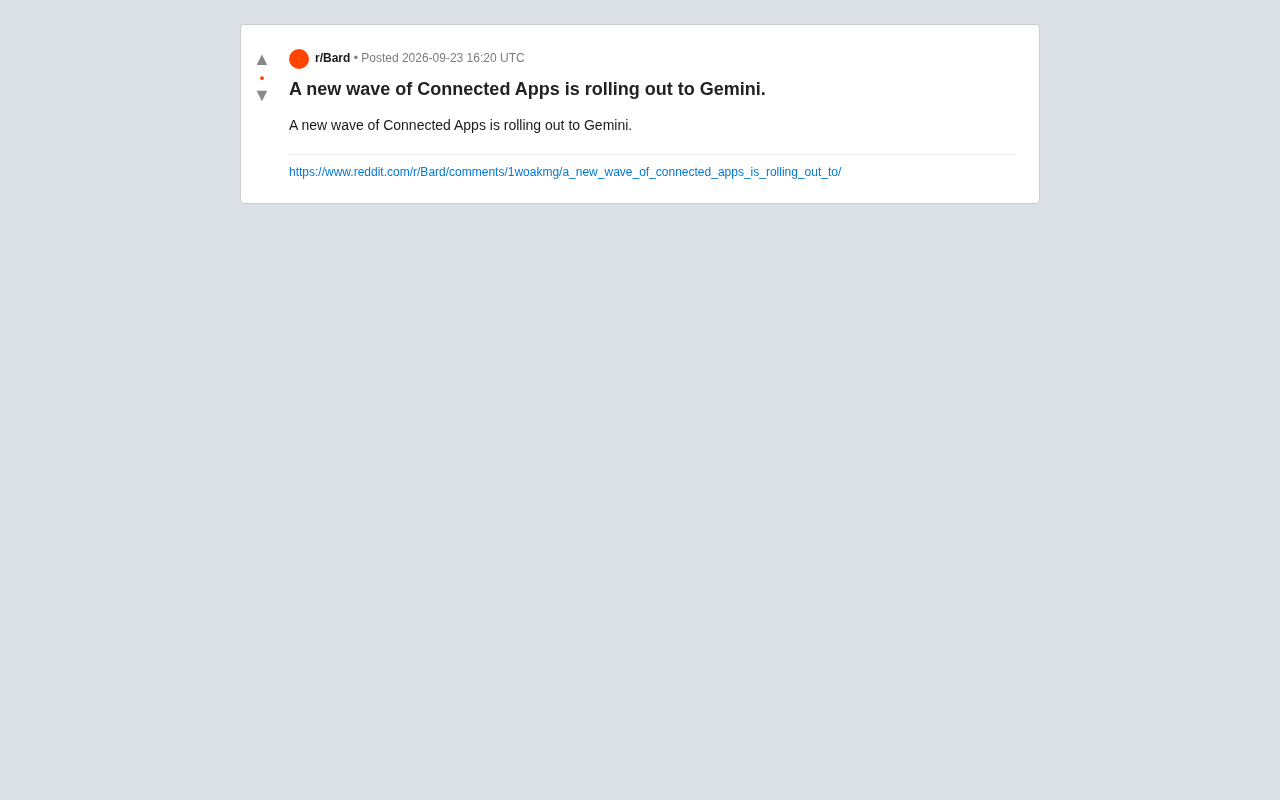
According to discussions in the Reddit community, Google is rolling out a new wave of Connected Apps features to Gemini. This update signals a continued expansion of Gemini's ability to integrate with third-party apps and services, giving users the potential to invoke external tools, access personal data, and retrieve content through natural conversation.
Connected Apps are a core part of the Gemini ecosystem. The underlying idea is to transform the AI assistant from an isolated chat interface into a hub that connects with the services users rely on every day — enabling genuinely useful assistance in real work and life scenarios.
What Connected Apps Actually Means
Connected Apps refers to a set of external application and service extensions that Gemini can interface with. Once authorized, users can ask Gemini directly within a conversation to search emails, organize schedules, look up documents, or retrieve information from other Google and third-party services.
The real value of this integration lies in breaking down information silos. Where users previously had to switch between multiple apps, an AI assistant with Connected Apps capability can serve as a unified entry point — weaving disparate services into a seamless workflow.
For Google, expanding the reach of Connected Apps is also a critical step in strengthening Gemini's position in the generative AI assistant market. The more deeply integrated the apps, the more users come to depend on the assistant.
From a technical architecture standpoint, AI assistant integrations with third-party apps typically rely on two approaches: one is through official plugins or extension protocols (similar to OpenAI's Plugin system or Google's own Extensions framework), where apps actively opt in; the other uses OAuth authorization to read user data from those services. The former gives the AI the ability to actively invoke tools, while the latter focuses on data access and information retrieval. Gemini's Connected Apps currently supports both forms. For example, connecting Gmail lets the AI search email content, while connecting Google Workspace tools can further trigger operational tasks like editing documents or creating calendar events — two approaches that differ significantly in permission scope and potential risk.
Why This Update Matters
Based on Reddit community discussions, this is described as a "new wave" of rollout, indicating that Connected Apps is not a brand-new feature but rather part of Google's ongoing iterative expansion. The gradual release strategy is consistent with Google's typical gray release cadence — usually covering a subset of users and regions first before broadening the rollout.
For everyday users, the key questions are whether your account is included in this wave and which new app connections have been added. Since the original source is fairly sparse on details, the definitive list of newly supported apps should be confirmed via official announcements or the actual in-app interface.
Gray Release is a common launch strategy for large-scale internet products, where new features are not pushed to all users at once but instead gradually made available to different user groups by proportion or condition. Google follows this approach across products like Gemini and Chrome: initially, access may be limited to a small number of accounts or specific regions, with broader rollout happening after feedback is collected and issues are resolved. As a result, different accounts may see different feature interfaces at the same point in time — this is not a bug, but an intentional testing mechanism by the product team. If you haven't seen the new Connected Apps options yet, simply wait for a subsequent rollout batch.
How Users Should Respond
If you're a Gemini user, keep an eye on the settings or extensions panel within the app to check whether any Connected Apps options have been updated. Before enabling a connection, it's worth paying attention to the authorization scope and privacy settings to understand exactly what data the AI assistant will be able to access.
As AI assistants become more deeply integrated with a wider range of services, the convenience gains come hand-in-hand with increasingly important data permission management. Configuring connection authorizations thoughtfully is key to enjoying the benefits of integration while keeping your personal information secure.
Overall, this Connected Apps update continues Gemini's product trajectory toward becoming an all-in-one assistant. The breadth of app coverage and the quality of the actual user experience going forward remain worth watching closely.
Related articles

Chain of Thought Isn't Just for AI: How Humans Can Use CoT to Improve Thinking Quality
Chain of Thought isn't just a prompt trick for large models. Starting from a Hacker News discussion, this article analyzes why CoT works for human thinking too, breaks down actionable ways to transfer it, and highlights the key differences between human CoT and machine CoT.
Cloudflare Teams Up with OpenAI: Closi…
Cloudflare Teams Up with OpenAI: Closing the Loop from Vulnerability Discovery to Defense with AI
Cloudflare uses OpenAI Daybreak to investigate security vulnerabilities and generate reviewable remediation plans, while developers use Codex to boost coding efficiency and quality.

Orca Multi-Agent Orchestration in Practice: A Guide to Parallel Collaboration with Claude and Codex
Orca is Stable AI's free open-source agent workbench supporting 34 agents like Claude Code and Codex in parallel. Learn its Git worktree isolation, multi-model orchestration, and mobile management.