Gemma 4 Deep Dive: Running Google's Top-Tier AI Free and Offline

Google releases free open-source Gemma 4 models, bringing top-tier AI offline to local devices.
Google released the Gemma 4 series, built on the same research as its top closed-source Gemini 3 model, under the permissive Apache 2.0 license. Available in four sizes from 2B to 311B parameters, it covers everything from phones to workstations. The 26B Mixture of Experts model achieves 26B-level intelligence with only 4B active parameters, deployable locally via LM Studio with zero coding. Testing shows near-ChatGPT performance in code generation and multimodal recognition — fully offline with no usage limits, marking a pivotal shift from cloud-monopolized AI to local democratization.
Google just released the Gemma 4 series — an AI model you can download completely free and run offline on your local device. No subscription, no internet connection, your data never leaves your device — something that was hard to imagine just a year ago. This article takes a deep dive into Gemma 4's technical architecture, real-world performance, and what it actually means for everyday users.
Why Gemma 4 Deserves Your Attention
There's no shortage of open-source AI models on the market, but what makes Gemma 4 stand out is that it stems from the same research behind Gemini 3. Gemini 3 is Google's most powerful closed-source model, and Google has essentially taken its best technology and released it under the Apache 2.0 license — one of the most permissive open-source licenses available — free for everyone, with no restrictions on personal or commercial use.
The Apache 2.0 license is a permissive open-source license created by the Apache Software Foundation that allows users to freely use, modify, and distribute software, even in commercial products. The only major requirement is preserving the original copyright notice. By contrast, many other open-source AI models use more restrictive licenses (such as Meta's Llama series, which previously used a community license with additional restrictions for companies with over 700 million monthly active users). Google's choice of Apache 2.0 means businesses of any size can embed Gemma 4 directly into commercial products without paying licensing fees or worrying about legal risks, dramatically lowering the barrier to AI commercialization.
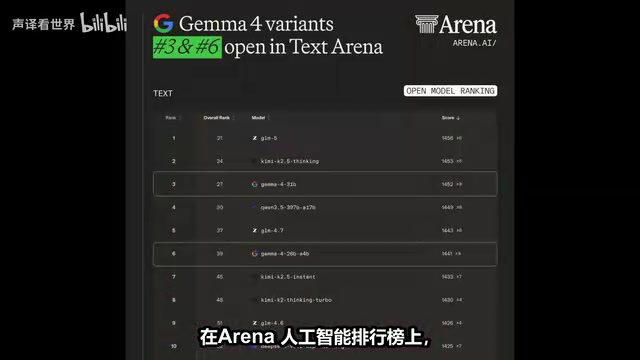
On the Arena AI leaderboard, Gemma 4's 31-billion-parameter model ranks third among all open-source models, with the 26-billion-parameter version in sixth place. What's even more interesting is that some versions can beat models 20 times their size.
This isn't just "another open-source model" — it's a genuine paradigm shift: top-tier AI capabilities are moving from the cloud to everyone's devices.
Four Model Sizes: From Phones to Workstations
Gemma 4 comes in four different sizes, designed to fit hardware ranging from smartphones to high-performance workstations:
E2B (2 Billion Effective Parameters)
The smallest version, designed specifically for phones and edge devices. Extremely fast with minimal memory footprint. Community benchmarks show it performing comparably to Gemma 3's 27-billion-parameter model on multiple tasks — a model 12 times its size.
Edge Computing refers to moving data processing from centralized cloud servers to local devices closer to the data source. In AI, on-device inference is becoming a major trend — Apple's Apple Intelligence, Qualcomm's AI Engine, and MediaTek's APU are all preparing for this at the hardware level. The core advantages of on-device AI include: zero latency (no network round-trips), complete privacy (data never leaves the device), offline availability, and reduced cloud costs. Gemma 4's E2B and E4B versions are designed precisely for this scenario — they're specially optimized to work within mobile devices' limited memory and compute power, representing a crucial milestone in AI's transition from "cloud-first" to "edge-cloud collaboration."
E4B (4 Billion Effective Parameters)
Still runs on phones but with stronger reasoning capabilities, natively supporting image and audio input.
26B MOE (Mixture of Experts)
Has 26 billion total parameters, but only about 4 billion are active at any given moment. This means it's as smart as a 26B model but runs like a 4B model. This is the sweet spot between performance and efficiency, and the recommended version for actually installing and using on a Mac.
Mixture of Experts (MOE) is a sparsely-activated neural network architecture whose core idea is dividing the model into multiple "expert" sub-networks, with only a small subset activated during each inference pass. The model has an internal "Router" mechanism that dynamically decides which experts should process the data based on input content. Taking Gemma 4's 26B MOE as an example, while total parameters reach 26 billion, each token only requires about 4 billion parameters for processing, dramatically reducing both memory usage and computation. This architecture was first systematically proposed by Google in a 2017 paper and has since been widely adopted in models like GPT-4 and Mixtral. MOE's advantage is achieving performance close to dense large models at much lower computational cost, though training stability and load balancing remain the primary technical challenges.
311B (Dense Full-Scale Flagship)
Every parameter is active at all times — maximum capability but requires powerful hardware.
All four models support text and image input, with Edge models also supporting audio. The larger models have a context window of up to 256,000 tokens — enough to feed it an entire book in one go.
A token is the basic unit that large language models use to process text — one token corresponds to roughly 3/4 of an English word, or 1-2 Chinese characters. The context window refers to the maximum number of tokens the model can "remember" and process in a single conversation. Gemma 4's support for a 256,000-token context window means it can process approximately 190,000 English words or about 500,000 Chinese characters at once — roughly equivalent to a 400-page book. By comparison, early GPT-3.5 only supported a 4,096-token context. Ultra-long context windows enable tasks that were previously difficult to achieve, such as long-document analysis, complete codebase comprehension, and multi-turn deep conversations.
Zero-Code Local AI Setup with LM Studio
The setup process is surprisingly simple. Using LM Studio, a free application, you can download and run Gemma 4 locally without writing a single line of code. The interface is very similar to the ChatGPT app. Here are the steps:
- Install LM Studio and open the app
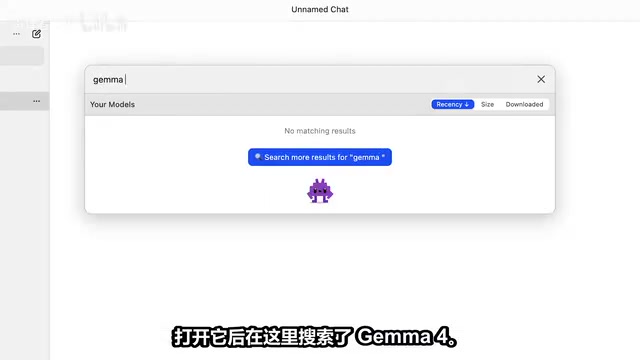
- Search for Gemma 4, select the 26B MOE version (~18GB)
- Once downloaded, open a new chat window and select the model
- Start chatting just like you would with ChatGPT
LM Studio is a desktop application designed specifically for running large language models locally, supporting Windows, macOS, and Linux. Under the hood, it relies on efficient inference engines like llama.cpp and can quantize models (e.g., from 16-bit floating point down to 4-bit integers) to run models on consumer hardware that would otherwise require datacenter-grade GPUs. Similar tools include Ollama (command-line tool) and Jan (open-source desktop app). These tools form a complete local AI ecosystem, allowing non-technical users to benefit from open-source models without needing to understand Python programming or model deployment details.
The most critical difference: there are absolutely no usage limits. No watching usage meters, no worrying about hitting caps and getting locked out for four hours — you can use it all day as much as you want. Once the model is downloaded locally, it's completely yours.
Gemma 4 vs. ChatGPT: Head-to-Head Comparison
To test real-world capabilities, we had both Gemma 4 and ChatGPT complete the same task: create an HTML file presenting Gemma 4 in an infographic style with smooth animations.
Gemma 4's performance: Generated a perfectly functional animated HTML page with clean layout, smooth animations, and thoughtful typography. Opens directly in a browser and works immediately. Notably, previously only Claude Opus could generate a comparably usable version.
Speed: Gemma 4 running locally via LM Studio generated the HTML slightly faster than ChatGPT.
Quality comparison: ChatGPT's version had superior visual effects but exhibited more "hallucinations" (generating inaccurate information). Gemma 4's version was cleaner and better aligned with the original requirements.
AI hallucination refers to large language models generating information that sounds plausible but is actually inaccurate or entirely fabricated. The root cause lies in how language models work — they're essentially predicting the next most likely token rather than retrieving facts from a reliable knowledge base. When the model has insufficient training data on a topic, it tends to "make up" reasonable-sounding answers rather than admitting it doesn't know. Current industry approaches to combating hallucination include: Retrieval-Augmented Generation (RAG), Reinforcement Learning from Human Feedback (RLHF), and incorporating fact-checking mechanisms during inference. Gemma 4's lower hallucination rate in testing may be related to the alignment techniques Google employed during training.

To be fair, Gemma 4 doesn't outperform ChatGPT in every aspect. ChatGPT still has significant advantages in certain complex reasoning tasks. But for everyday tasks, code generation, and creative work, this free local model absolutely holds its own.
Additionally, since there are no token limits, you can give Gemma 4 a very detailed system prompt to customize its behavior and style without degrading response quality. When the model is entirely yours, you can shape it into anything you want.
Multimodal Capabilities: Image Recognition and Offline OCR
Gemma 4's multimodal capabilities are equally impressive. In testing, we gave it a photo containing text and asked it to extract all the text while completely offline — and it did, quickly and accurately.
No need to install additional OCR apps, no dependence on cloud services — the model reads images and extracts text entirely locally. Traditional OCR (Optical Character Recognition) technology typically relies on rule matching or specialized character recognition models, while Gemma 4 uses a vision-language multimodal architecture where the model simultaneously learns image understanding and text generation during training. This enables text extraction based on semantic understanding of images, with accuracy and scene adaptability far exceeding traditional OCR solutions. Translating content in other languages, understanding text in images — everything works just like ChatGPT, but all locally.
This means you get full AI capabilities on flights, in remote areas, and in privacy-sensitive scenarios.
Completely Offline Phone Demo
The most exciting demonstration was running AI on a phone with no internet connection. Using Google's EdgeGallery app, after downloading the smaller E4B model:
- Enable airplane mode
- Turn off Wi-Fi and cellular data
- Completely disconnect from all networks
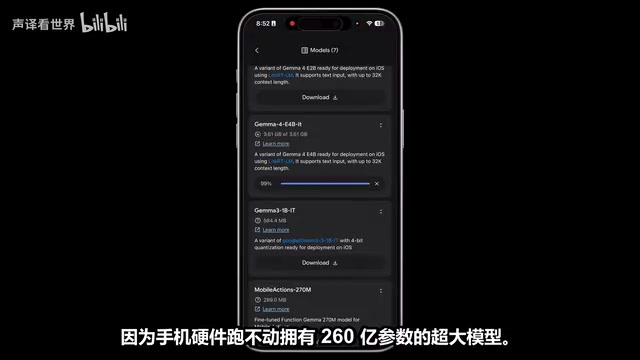
In this completely offline state, Gemma 4 successfully drafted a business email about a project delay. The entire process completed locally, no data was shared with any server, and generation speed was actually faster than ChatGPT on a slow network.
Who Is Gemma 4 For?
Let's be honest — Gemma 4 isn't a ChatGPT replacement you can just open in a browser. There's an initial setup step: downloading the app, choosing a model, possibly tweaking some configuration parameters.
Best suited for:
- Developers: Scenarios requiring local AI integration without depending on cloud APIs. Local deployment means zero API call costs, zero latency fluctuation, and the ability to fine-tune the model for specific business needs
- Content creators: Heavy AI-assisted creation users who are tired of subscription fees and usage limits
- Privacy-conscious users: Data stays on your device permanently, never passing through third-party servers. This is especially important for professionals handling sensitive information like medical records, legal documents, or trade secrets
- Subscription fatigue sufferers: Download once, free forever
- Tech enthusiasts: Those who want complete control over AI model configuration and behavior
Final Thoughts
With Gemma 4, Google has done something profoundly significant: released the research behind its most powerful model to everyone, with no strings attached. Truly capable AI can now run completely offline on your laptop or phone — fully private, completely free.
A year ago, this wasn't possible. Now, the democratization of AI is advancing faster than anyone expected. When top-tier AI capabilities are no longer monopolized by cloud services and subscription fees, everyone becomes a beneficiary of this technological revolution. From a broader perspective, Gemma 4 represents not just a model release, but a critical inflection point in the AI industry's transition from "centralized cloud services" to "decentralized local deployment." When models become small enough, powerful enough, and open enough, AI value creation will no longer be concentrated in the hands of a few tech giants — it will be distributed to every developer, every business, and every ordinary user.
Related articles
 Product Reviews
The Programmer's Desk Setup Guide: Building a Workspace That Feels Like Home
Discover how programmers build productive, comfortable workspaces. From multi-monitor setups to ergonomic design, explore the desk philosophy that drives focus and flow.
 Product Reviews
Qoder vs Cursor Real-World Comparison: Which $20/Month AI IDE Is Better?
Hands-on comparison of Qoder vs Cursor AI IDEs: Agent autonomy, human interaction count, and architecture decisions. Qoder needed only 2 interactions vs Cursor's 8.
 Product Reviews
Cursor Cloud Agent Demo: Eliminating Bottlenecks Across the Entire Software Development Lifecycle
Deep analysis of Cursor's Cloud Agent demo showing how cloud VMs, automated test artifacts, and a full-chain control plane systematically eliminate human bottlenecks across the software development lifecycle.