Gemma 4 Parallel Agents in Action: Local Multi-Agent Collaboration for SVG Generation

Gemma 4 26B runs an orchestrator with 10 parallel sub-agents locally, hitting 170+ tokens/s via model batching on a single GPU.
This article covers a local multi-agent demo using Gemma 4 26B: an orchestrator agent receives a "generate sci-fi SVG" prompt, decomposes it, and dispatches 10 sub-agents to work in parallel, then automatically aggregates their outputs into a complete gallery. The key enabler is model batching, which packs concurrent requests into a single GPU pass to achieve over 170 tokens/s aggregate throughput. The demo extends this to enterprise use cases — including large-scale parallel task solving and fully private on-premises chatbots for 50-person offices — while noting that the 170 tokens/s figure is aggregate, not per-agent, and real-world results depend on task decomposability, sub-task dependencies, and available VRAM.
Gemma 4 Parallel Agents Demo: Local Multi-Agent Collaboration
This demo focuses on Gemma 4's multi-agent capabilities, running entirely in a local environment using the Gemma 4 26B model. The workflow begins with a simple high-level instruction: "Generate a collection of unique SVG graphics based on space or sci-fi themes."
What makes this noteworthy is the system's orchestration approach: an orchestrator agent receives the prompt and, rather than generating images one by one, breaks the task down and distributes it. It spawns 10 independent sub-agents all at once, allowing them to handle their respective subtasks in parallel.
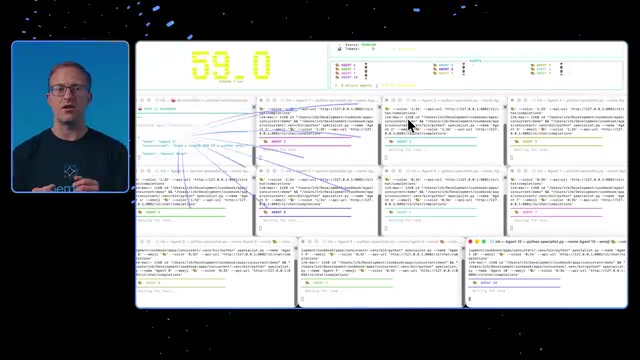
This "split-distribute-parallelize" architecture essentially decomposes a large task into multiple smaller, concurrent ones. For workloads that require batch output and are independent of each other, this pattern can significantly reduce overall completion time.
Local Inference Performance Through Batch Processing
The demo emphasizes that thanks to Gemma 4's batch processing capabilities, all 10 sub-agents can run in parallel on the same local machine — even on a single GPU.
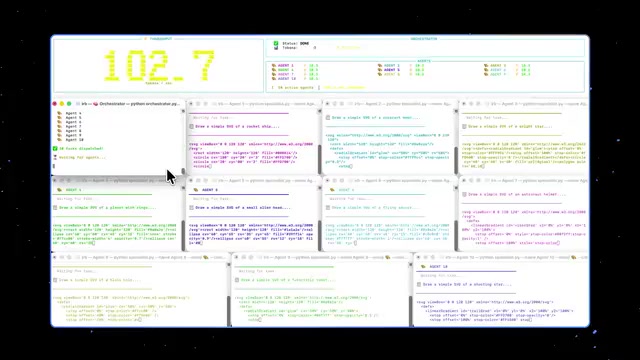
On the performance side, the demo reports reaching over 170 tokens per second across all concurrent tasks. Model batching is the key mechanism here — by packing multiple requests into a single batch and feeding them into the model together, hardware compute utilization improves significantly, boosting overall throughput without adding more GPUs.
It's worth noting that "170 tokens/s" is the aggregate speed across all concurrent tasks, not the speed of any individual agent. This is a reasonable way to express throughput in a batching scenario, but readers should keep this in mind when comparing against their own workloads.
The mechanics of model batching are worth explaining further. A GPU's parallel compute units (CUDA cores / tensor cores) tend to be underutilized when handling a single request, leaving significant compute idle. Batching addresses this by concatenating multiple independent inference requests into a single tensor matrix, performing one matrix multiplication pass for all of them at once — effectively merging what would have been sequential operations into a single step. For large language models, this is typically implemented via continuous batching: the inference engine dynamically replaces completed sequences with new requests rather than waiting for an entire batch to finish simultaneously, further minimizing GPU idle time. This is why aggregate token throughput in a multi-agent concurrent scenario can far exceed the speed of a single request monopolizing the GPU.
The SVG Gallery: Results of Autonomous Collaboration
Within seconds, the sub-agents finish writing their code. The orchestrator then seamlessly collects all outputs and assembles them into a complete SVG art gallery presented to the user.
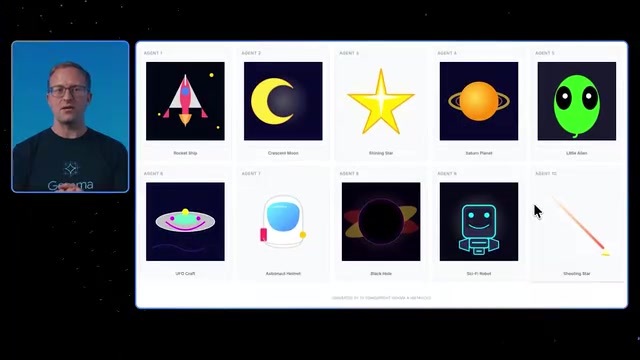
A point repeatedly emphasized in the demo: every icon in the gallery was written by Gemma 4 locally, simultaneously, and autonomously. This demonstrates that the value of multi-agent systems goes beyond just "parallel speedup" — it also lies in the end-to-end automation of task decomposition and result aggregation as a unified pipeline.
Implications for Real-World Workflows
The demo closes by extending these capabilities to enterprise scenarios. One idea: spin up 10 or more agent harnesses in parallel to instantly decompose and simultaneously solve a massive enterprise-scale task.
A more concrete use case is local private deployment — providing a fully on-premises, private chatbot capability for a 50-person office, running entirely on one or two GPUs.
The appeal here lies in data privacy and cost: data never leaves the premises, there are no per-call cloud API fees, and batch processing spreads limited GPU resources across multiple users or tasks. For teams sensitive to compliance and data sovereignty, local parallel AI offers a path that doesn't depend on external APIs.
In multi-agent frameworks, an "agent harness" refers to the execution container or wrapper layer that hosts and manages the runtime of an individual agent, providing each sub-agent with its own context, tool access, and lifecycle management. Unlike monolithic applications, harnessed agents can be instantiated, monitored, and recycled in bulk — forming the foundation for elastic scaling. In resource-constrained local GPU environments, the harness design directly determines the upper bound on concurrency: each agent instance consumes a portion of KV cache VRAM, and when concurrent demand exceeds available memory, the system must use queuing or paging mechanisms to schedule requests — otherwise it risks OOM (out-of-memory) errors.
Summary and Observations
This demo traces a clear trajectory: localized parallel multi-agent systems are becoming a viable deployment paradigm. The core technical foundation is an orchestrator architecture combined with model batching — transforming "one large task" into "many concurrent smaller tasks," then using batching to boost single-machine throughput.
As a product demo, it showcases capability ceilings rather than rigorous benchmarking. In real workflows, factors like how decomposable a task is, dependencies between subtasks, and VRAM constraints on concurrency will all affect real-world results. But the core insight holds: when a model is compact enough and batching efficient enough, running multiple agents in parallel on one or two GPUs is moving from concept to practical reality.
Related articles

Felix Rieseberg Personal Homepage
Felix Rieseberg's personal homepage sparks attention on Hacker News. This article covers the Slack engineer's technical background, the rise and fall of nativefier, and the value of a developer homepage as a tech calling card.

@ai-sdk/vue 3.0.306 Patch Release Syncs with [email protected] Update
@ai-sdk/vue 3.0.306 released, synced with [email protected]. A routine patch release for the Vercel AI SDK ecosystem with no public API changes; the Vue adapter layer stays version-aligned with the core package.

Gemini 4 Argon API Launches: The Era of Million-Token Output Begins
Google launches Gemini 4 Argon with sparse MoE architecture, up to 1M output tokens, and a 68.90% Vals Index score, available across API, AI Studio, and the Gemini app.