GEN-1.5 One-Shot Learning Explained: How Robots Learn by Watching Just Once

Exploring how GEN-1.5 enables robots to learn new tasks from just one demonstration.
This article examines GEN-1.5's one-shot learning capabilities, where robots learn new tasks from a single demonstration. It covers the technical foundations including few-shot learning, imitation learning, and foundation model pre-training, explains why robot improvisation matters for generalization, and offers a balanced perspective on limitations like cherry-picked demos and the distinction between one-shot and zero-shot learning.
Introduction: A Robot Video That Sparked Heated Discussion
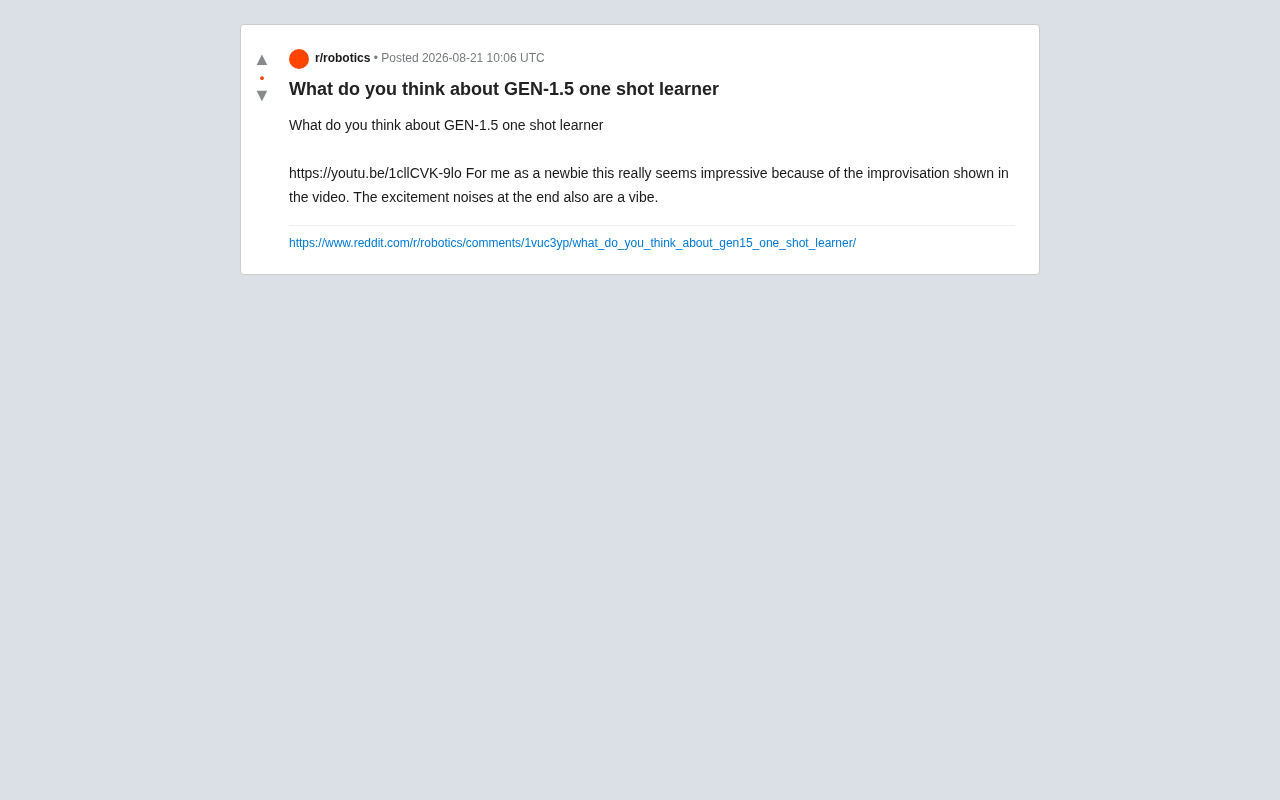
Recently, a video showcasing the capabilities of the GEN-1.5 one-shot learner sparked widespread discussion on Reddit. The original poster, a self-described newcomer to machine learning, candidly expressed their amazement: the robot's ability to "improvise" was deeply impressive, and even the researchers' excited cheers at the end of the video added a unique sense of atmosphere.
This intuitive reaction from an ordinary observer highlights one of the most noteworthy advances in the field of Embodied AI — the paradigm shift from relying on massive training datasets to learning from a single demonstration.
Embodied AI refers to deploying artificial intelligence algorithms in systems with physical bodies (such as robots and autonomous vehicles), enabling them to perceive, reason, and act through interaction with real physical environments. Unlike purely software-based AI (such as ChatGPT processing text), embodied AI must contend with the complexities of the real world — gravity, friction, object diversity, lighting changes, and more. This field has accelerated in recent years with the rise of large foundation models. Projects like Google's RT-2 and Stanford's Mobile ALOHA are exploring how to transfer the capabilities of large language and vision models to physical robots. Embodied AI is considered one of the key paths toward Artificial General Intelligence (AGI), because true intelligence requires not only understanding the world but also acting within it.
This article explores the significance and challenges of one-shot learning in robotics.
What Is One-Shot Learning?
From Big Data to Small Samples: A Fundamental Shift in Learning Paradigms
Traditional deep learning models typically require thousands of labeled samples to master a skill. In robotic manipulation, for example, teaching a robotic arm to grasp an object usually involves hundreds or thousands of repetitive training runs in simulated or real-world environments. While effective, this approach is costly and offers limited generalization.
One-shot learning aims to break through this limitation. As the name suggests, the goal is to enable a model to understand and reproduce a task from just one demonstration or example. This is much closer to how humans learn — we can usually tie our own shoelaces after watching someone do it once, without needing to see it thousands of times.
From a technical lineage perspective, one-shot learning falls under the broader research category of "few-shot learning." This field has accumulated several classical approaches: Siamese Networks perform classification by learning similarity metrics between samples; Prototypical Networks compute prototype representations for each class for matching; and meta-learning methods like MAML (Model-Agnostic Meta-Learning) enable models to quickly adapt to new tasks by "learning how to learn." In robotics, one-shot learning is typically combined with an imitation learning framework — learning policies by observing expert demonstrations rather than through trial-and-error reinforcement learning. These technical approaches are deeply intertwined and together form the technological foundation of current one-shot robot learning.
GEN-1.5's Position in One-Shot Learning
As an iterative version in the series, GEN-1.5's core selling point lies in its enhanced one-shot capabilities. Based on the version number, we can infer it builds upon the earlier GEN-1 with optimizations focused on improving the model's adaptability and improvisational ability when facing previously unseen scenarios. This is the technical essence of what the original poster called "improvisation."
The GEN series of models represents a cutting-edge exploration of applying large-scale vision-language foundation models to robotic manipulation. The core idea behind this approach is: first, pre-train a powerful foundation model on internet-scale image, video, and text data, equipping it with rich world knowledge and visual understanding capabilities; then fine-tune it with a small amount of robotic operation data to "ground" these general capabilities into specific physical operations. The "1.5" version number suggests an incremental improvement, potentially involving targeted optimizations to the visual encoder, policy network architecture, or training pipeline, thereby significantly improving one-shot adaptation efficiency while maintaining baseline capabilities.
Why Is Robot "Improvisation" So Exciting?
A Tangible Demonstration of Generalization
In robotics, "improvisation" typically means the model can make reasonable decisions even in situations outside its training distribution. For instance, when the position, shape, or ambient lighting of a grasping target changes, a model that relies on rote memorization will immediately fail, while a model with good generalization can "adapt on the fly."
From a technical perspective, this kind of "Out-of-Distribution Generalization" (OOD) is a core challenge in machine learning. Traditional robotic systems often encounter a severe "Reality Gap" in Sim-to-Real transfer — policies that perform well in simulation fail in the real world. To address this, researchers have developed techniques such as Domain Randomization and Domain Adaptation. The improvisational ability demonstrated by GEN-1.5 is essentially about handling OOD scenarios — it needs to complete tasks under conditions not present in the demonstration (such as different object placements or the introduction of distractors), which requires genuine semantic understanding rather than superficial pattern matching.
The improvisational ability shown in the video is a tangible externalization of this generalization. For observers, the robot is no longer a mechanical device executing preset scripts, but rather an intelligent agent that can understand intent and respond flexibly. This sense of the robot "coming alive" is the key reason viewers get excited.
A Complete Loop from Single Demonstration to Autonomous Execution
Another appeal of one-shot learning is that it dramatically lowers the barrier for "teaching" robots. In theory, future users won't need to write complex code — they'll simply demonstrate an action once, and the robot will learn and execute it. This interaction paradigm is crucial for deploying robots in practical scenarios like home services and industrial manufacturing.
This vision of "demonstration as programming" is actually a goal the robotics field has pursued for decades. Traditional robot programming requires specialized engineers using specific languages to step-by-step define motion trajectories and decision logic, with every new task demanding significant engineering effort. One-shot imitation learning promises to compress this process into a single natural human demonstration, truly achieving a "what you demonstrate is what you get" human-robot interaction paradigm, fundamentally breaking through the deployment bottleneck of robotic applications.
A Rational Look at GEN-1.5: Limitations to Keep in Mind
Demo Videos Don't Equal Real-World Performance
Here's an important detail: the discussion in the original post was primarily based on a video. As technology observers, we need to remind ourselves that carefully edited demonstration videos often showcase cherry-picked results. The impressive improvisational performance in the video may have been the one successful attempt out of many, or it may have been completed in a controlled environment.
What truly measures one-shot learning capability should be the model's success rate and stability across a large number of random tasks, not a single highlight reel. In the field of robotic manipulation, standardized benchmarks for evaluating one-shot learning are gradually being established. Common evaluation dimensions include: task success rate (the proportion of random initial conditions under which the task can be completed), generalization span (the range of object/scene variations the model can adapt to), robustness (the ability to recover from disturbances), and execution efficiency (speed and fluency in completing tasks). Benchmark platforms like Meta-World, RLBench, and CALVIN provide standardized multi-task evaluation environments. However, the industry currently lacks unified reporting standards for robot demonstration videos, making it difficult to directly compare results across different teams. This is an important reason why the community calls for more transparent evaluation and why experienced developers tend to remain cautious.
One-Shot Learning ≠ Zero-Shot Learning
Additionally, a common misconception needs to be clarified: one-shot learning still relies on a single high-quality demonstration, and behind that demonstration is typically a vast amount of "prior knowledge" the model has accumulated from massive pre-training data. In other words, GEN-1.5's ability to "learn from one example" doesn't arise from nothing — it's built on fine-tuning and adaptation on top of a massive foundation model.
This is underpinned by one of the most important technical paradigms in current AI: pre-training and fine-tuning. This paradigm was established in NLP by the BERT and GPT model series. The core logic is to learn general representational abilities and world knowledge through self-supervised pre-training on massive unlabeled data, then adapt to new tasks with only a small amount of task-specific data. In robotics, this idea has been further developed into the concept of "Robot Foundation Models" — Google's RT-2 demonstrated that vision-language models can directly output robot action commands, while the Open X-Embodiment project attempts to build more general foundation models by integrating robot data from multiple laboratories. GEN-1.5's one-shot capability is a product of this paradigm: massive pre-training provides prior knowledge, while a single demonstration provides a task-specific "anchor point." Understanding this helps us evaluate its technical merit more objectively — it's not a magical ability to "learn at a glance," but rather the efficient release of world understanding capabilities learned by a multi-billion parameter model from massive data.
Conclusion: One-Shot Learning Is a Key Direction for the Future of Robotics
Regardless of the specific implementation details, the one-shot learning direction represented by GEN-1.5 is indeed one of the most exciting trends at the intersection of AI and robotics. It liberates robots from the predicament of "requiring massive training" and moves them toward a learning approach that more closely resembles how humans learn.
For newcomers like the original poster, this intuitive sense of "amazement" is the best advertisement for technological progress. For practitioners, we should be energized by such advances while remaining rational, using rigorous evaluation standards to test their true capabilities. True breakthroughs are measured not by the cheers in a single video, but by robust performance that withstands large-scale validation.
In the future, as more technical details and independent reproductions emerge, we'll be able to more comprehensively judge whether GEN-1.5 truly represents a leap in the robot learning paradigm. In this era of accelerating convergence between foundation models and robotics technology, one-shot learning is not just a technical metric — it represents a vision of bringing intelligent robots into every household, learning and serving as naturally as a human assistant.
Related articles

Chain of Thought Isn't Just for AI: How Humans Can Use CoT to Improve Thinking Quality
Chain of Thought isn't just a prompt trick for large models. Starting from a Hacker News discussion, this article analyzes why CoT works for human thinking too, breaks down actionable ways to transfer it, and highlights the key differences between human CoT and machine CoT.
Cloudflare Teams Up with OpenAI: Closi…
Cloudflare Teams Up with OpenAI: Closing the Loop from Vulnerability Discovery to Defense with AI
Cloudflare uses OpenAI Daybreak to investigate security vulnerabilities and generate reviewable remediation plans, while developers use Codex to boost coding efficiency and quality.

Orca Multi-Agent Orchestration in Practice: A Guide to Parallel Collaboration with Claude and Codex
Orca is Stable AI's free open-source agent workbench supporting 34 agents like Claude Code and Codex in parallel. Learn its Git worktree isolation, multi-model orchestration, and mobile management.