GenAI_Agents: An Open-Source Treasure Trove of 50+ AI Agent Development Tutorials
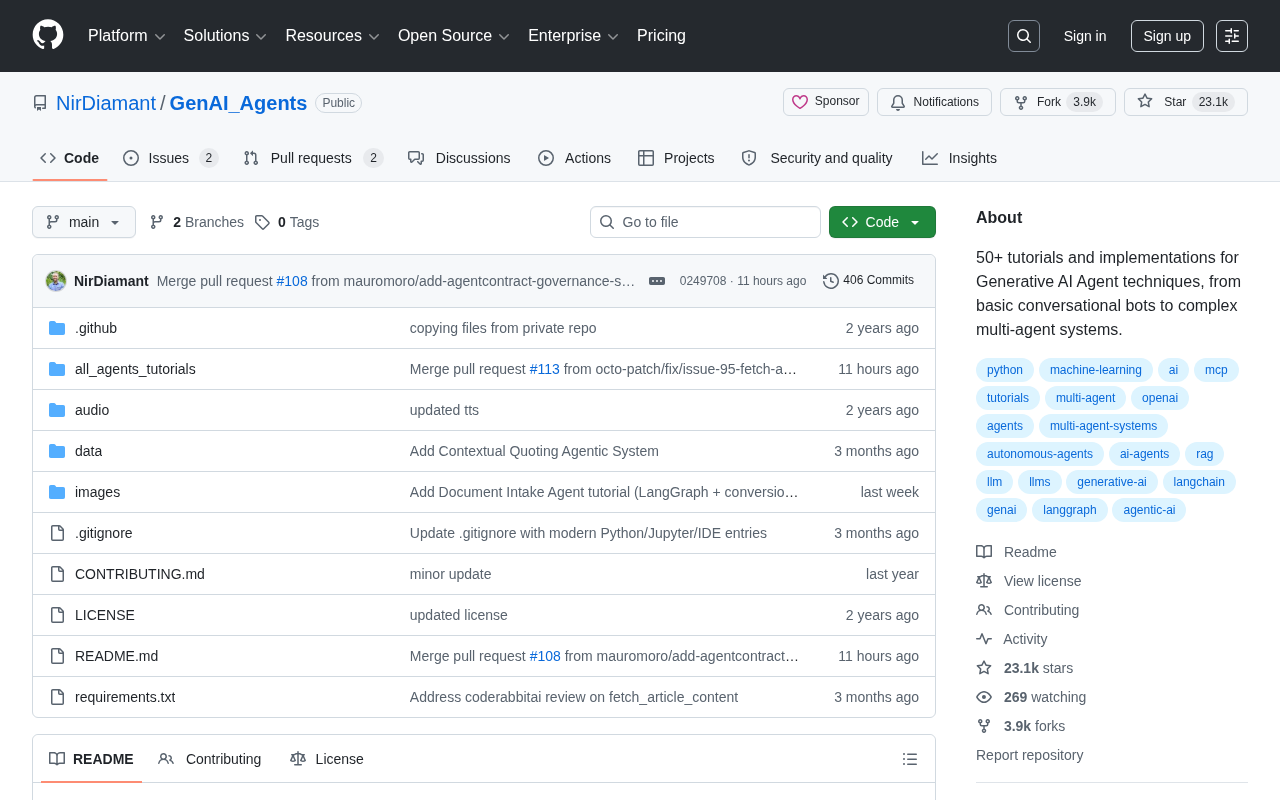
GenAI_Agents offers 50+ open-source tutorials for building AI agents, from basic bots to multi-agent systems.
GenAI_Agents is a highly starred GitHub repository maintained by NirDiamant, offering 50+ Generative AI agent tutorials as runnable Jupyter Notebooks. It covers the full spectrum from simple conversational bots to tool-calling, retrieval-augmented generation, state management, and multi-agent orchestration. The project's core value lies in systematizing fragmented agent knowledge into a coherent learning path, letting developers read, modify, and run code to observe Agent behavior in real time. Beginners should work through Notebooks sequentially, while advanced developers can use it as a pattern reference library.
An Open-Source Project Spanning the Full Spectrum of AI Agents
GenAI_Agents, maintained by NirDiamant, is a highly popular open-source repository on GitHub that has accumulated over 21,800 stars and 3,600+ forks. The project's mission is clear: provide 50+ tutorials and runnable code implementations covering Generative AI Agent technology, spanning everything from basic conversational bots to complex Multi-Agent systems.
For engineers and researchers looking to systematically learn AI Agent development, projects like this one — primarily delivered as Jupyter Notebooks — offer a natural advantage. Every concept comes paired with code you can run and debug step by step, rather than remaining stuck at the theoretical level. That hands-on quality is a key reason the project has attracted such a large following in a short time.
A Learning Path from Beginner to Advanced
The project's greatest strength lies in its completeness. Agent technology spans an enormous range: beginners may only need to understand how to enable multi-turn conversations with a large language model or how to invoke tools, while advanced developers face much more complex engineering challenges like task planning, memory management, and multi-agent collaboration and orchestration.
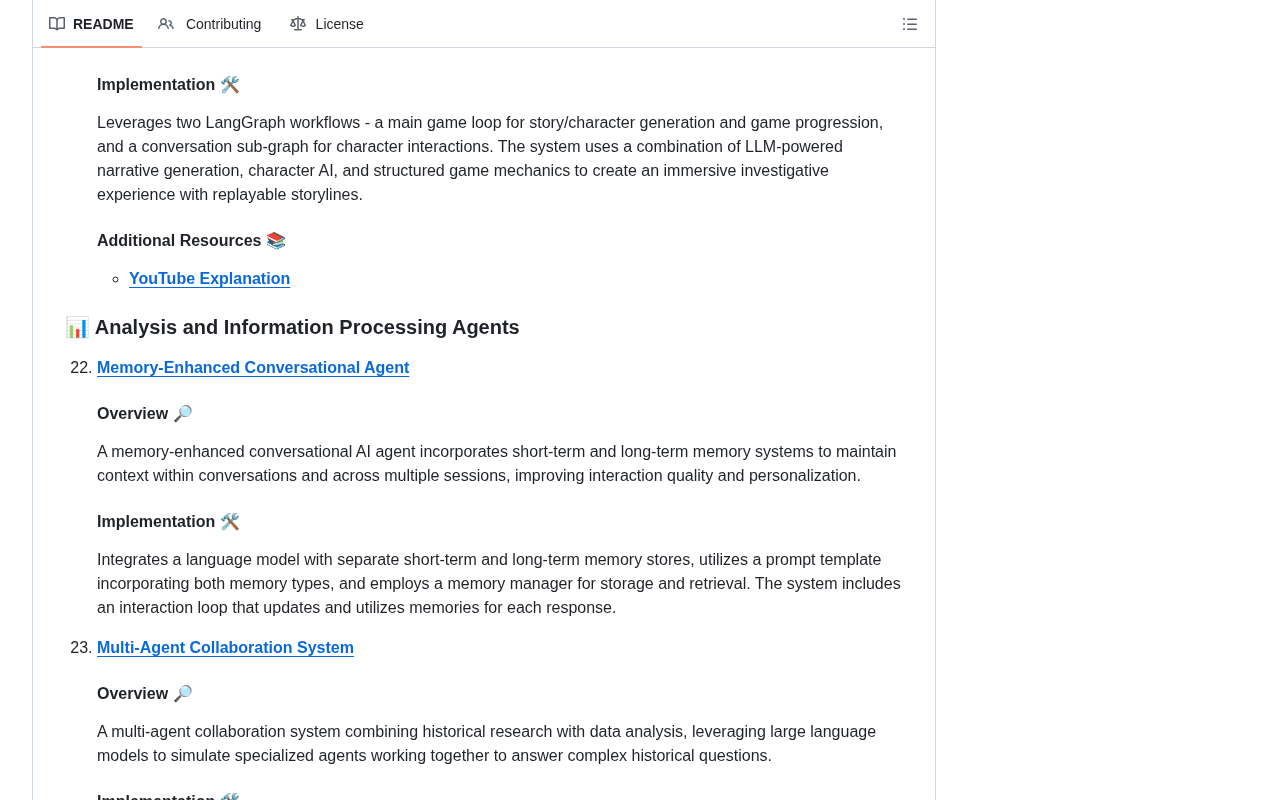
GenAI_Agents organizes these scattered knowledge points into a coherent, progressively structured learning path. It starts with simple conversational bots, gradually moves toward single agents with tool-calling, retrieval-augmented generation, and state management capabilities, and ultimately extends to complex systems requiring multiple agents working in coordinated roles. This depth-first structure lowers the cognitive barrier for learners and gives the project real value as a practical reference handbook.
Why the Notebook Format Makes Sense
Choosing Jupyter Notebook as the primary medium is no accident. It allows explanatory text, code, and execution results to coexist in a single file, so learners can read, modify, and run everything in place. For a technical domain like agent development that emphasizes hands-on practice, this format is far more effective than plain documentation — you can immediately observe how a prompt tweak or a new tool integration changes Agent behavior.
Why AI Agent Technology Is Worth Your Investment
AI Agents are among the most closely watched areas for deploying generative AI in production. Unlike pure conversational models, agents emphasize the ability to autonomously complete tasks: they can plan steps, call external tools and APIs, access data sources, and maintain context and state across multiple interactions. Multi-agent systems go even further, enabling multiple specialized agents to collaborate on complex tasks that a single model would struggle to handle alone.
These capabilities are being widely applied in automated workflows, intelligent customer service, code assistance, research assistants, and more. Understanding agent design patterns and implementation details has become a critical competitive skill for AI engineers. Open-source resources like GenAI_Agents — which consolidates 50+ technical approaches in one place — fill exactly the gap left by fragmented tutorials that rarely cohere into a system.
How to Get the Most Out of This Project
The right approach depends on where you are in your learning journey. If you're a beginner, work through the Notebooks sequentially — from basic conversation to tool-calling — and focus on understanding the core problem each pattern is designed to solve. If you already have a solid foundation, feel free to jump directly to advanced topics like multi-agent orchestration and complex task decomposition, using the project as a pattern reference library to consult on demand.
One caveat worth noting: open-source tutorial projects typically depend on specific model APIs and library versions, so pay attention to environment setup and dependency updates before running anything. The implementations in the tutorials are also oriented toward demonstrating core ideas; deploying to production requires additional consideration of error handling, cost control, and observability.
Conclusion
With its broad coverage and practice-oriented approach, GenAI_Agents stands out as a high-quality open-source resource for learning Generative AI Agent technology. Whether you're a newcomer looking for a fast on-ramp or an experienced developer seeking to systematically map out agent design patterns, you'll find relevant value across these 50+ tutorials. The 20,000+ star count is itself a telling signal of just how strong the community's appetite is for this kind of structured, comprehensive learning resource.
Related articles
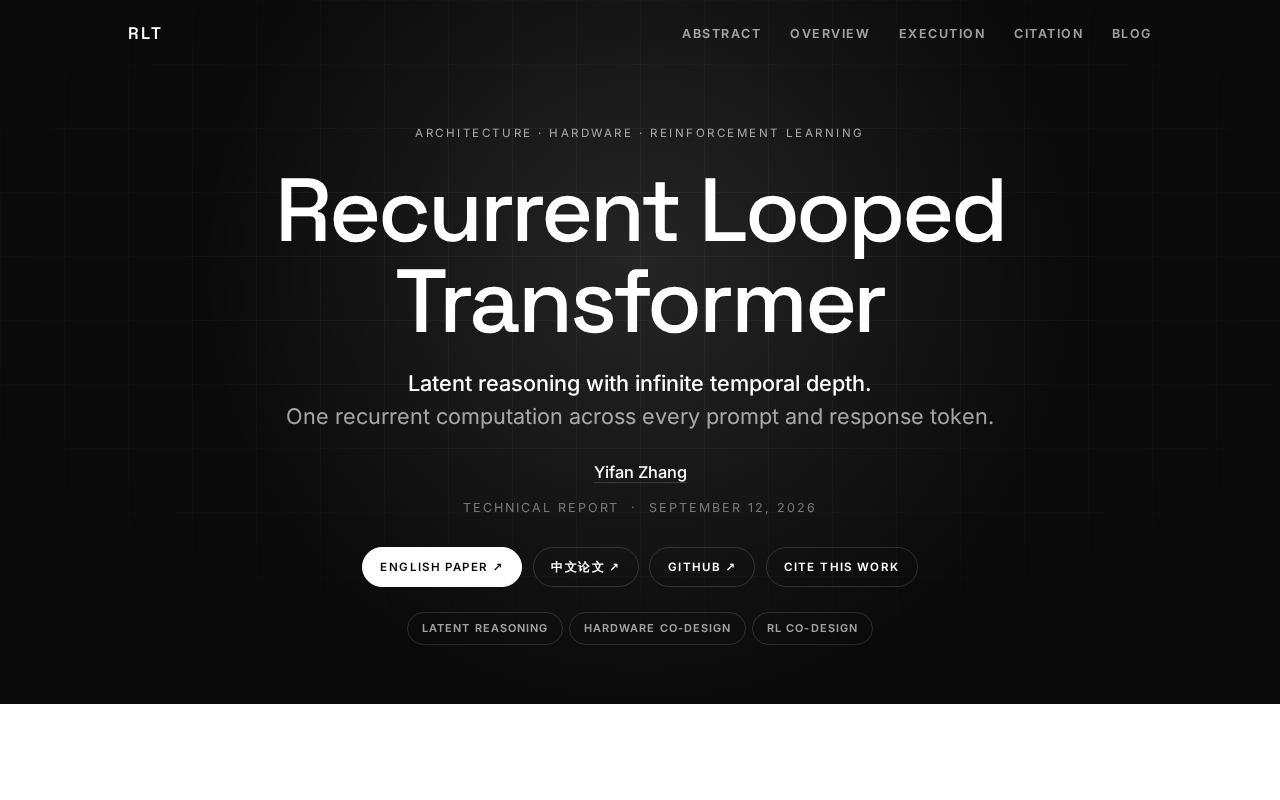
Recurrent Looped Transformers: A New Architecture That Teaches Models to "Think Again"
Recurrent Looped Transformers repeatedly apply the same Transformer block to decouple compute from parameters, enabling variable reasoning depth without scaling model size.
"Everyone Else Should Slow Down AI — Except Me": The Double Standard Trap in Big Tech
A viral Hacker News quip — "Everyone should slow down AI, except me" — exposes the double-standard at the heart of the AI race. We unpack why it's a Prisoner's Dilemma, not mere hypocrisy, and why institutions matter more than moral self-discipline.
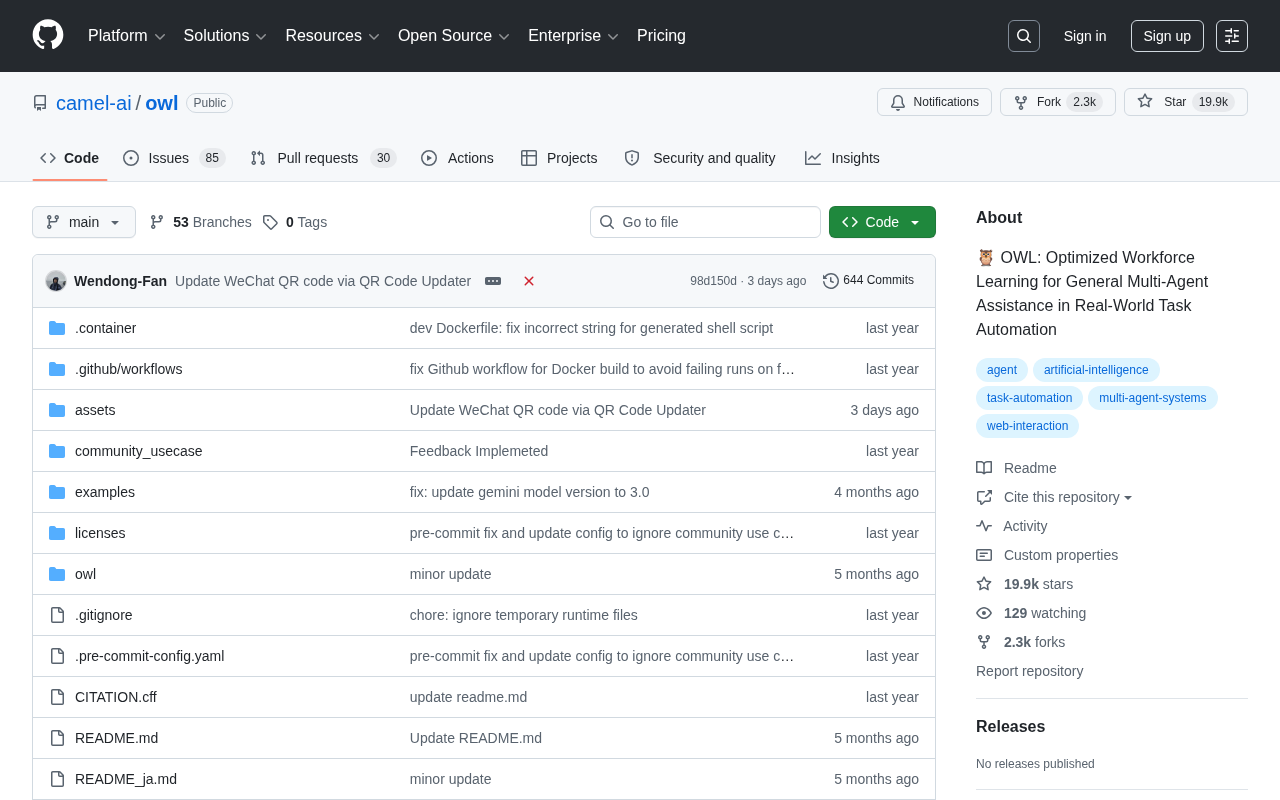
OWL: An Open-Source Multi-Agent Framework for Real-World Task Automation
OWL (Optimized Workforce Learning) is an open-source multi-agent framework by camel-ai for real-world task automation, with 19K+ GitHub Stars. Learn how it works.