Genchi: Let Frontline Engineers Predict Project Delivery Risk

Genchi lets frontline engineers vote anonymously in Slack to predict project delivery, helping managers spot delay risks early.
Genchi is a project prediction tool layered on top of Jira and Asana. Its core idea is to let frontline engineers who truly know the progress answer "will the project ship on time?" via anonymous Slack votes. Instead of forms or Gantt charts, it aggregates scattered votes into a portfolio score and trend chart per project, helping managers decide where to intervene. It integrates with Jira and Asana, and its live portfolio view can be viewed directly in Claude, ChatGPT, and Grok — aligning with AI assistants becoming the work entry point. Built by Rowland Savage and rewritten from the ground up, Genchi is free for teams up to 10 and suited to tech leads managing multiple engineering teams who don't want to drown in status meetings.
When Project Predictions No Longer Come from Management
Most project management tools rely on leads to manually update status, but the people who truly know whether a project will slip are often the frontline engineers. Genchi, ranked #11 on Product Hunt, hits this gap squarely: it lets team members cast a single anonymous vote in Slack to tell managers whether a project will ship on time.
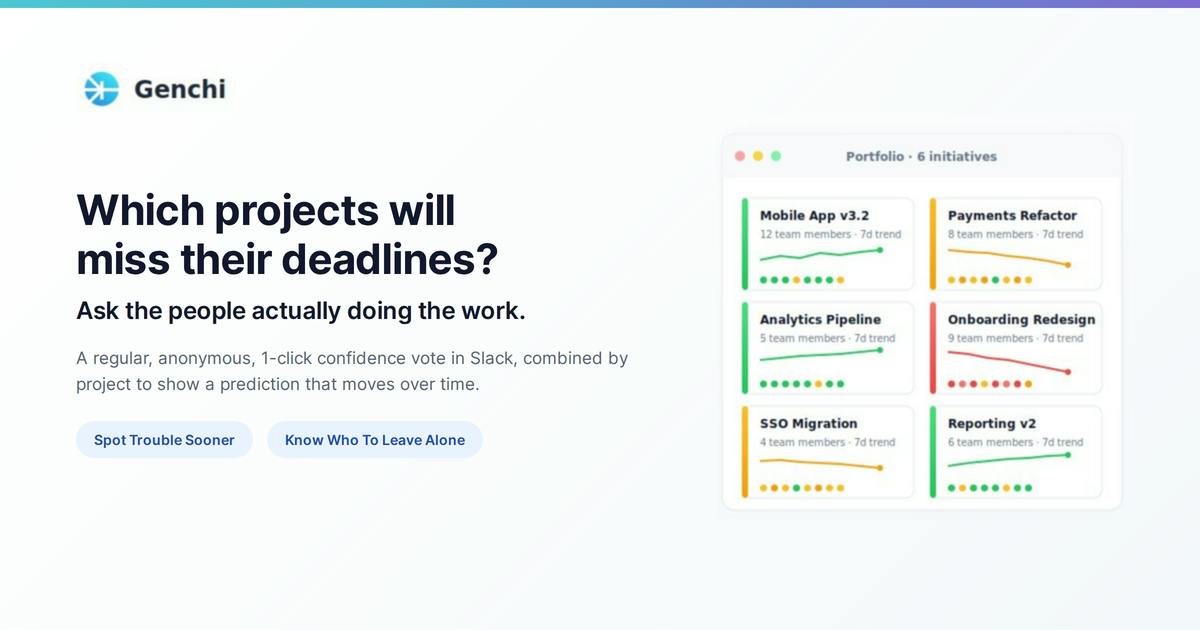
Genchi positions itself as "project delivery predictions from the people doing the work." It doesn't replace Jira or Asana — it layers on top of them, gathering signals from the execution layer and rolling them up into a portfolio view managers can scan at a glance.
How a Single Anonymous Button Becomes a Prediction Signal
Genchi's interaction design is extremely restrained. Team members don't fill out forms, pull meetings, or update Gantt charts — they simply cast one anonymous vote in Slack. This design lowers the cost of feedback while using anonymity to protect engineers who might otherwise hesitate to voice their true judgment publicly.
What managers see isn't scattered opinions — it's a portfolio score and trend changes. Genchi combines each project's vote results into a comparable score, letting leads decide which projects need intervention and which teams can be left alone.
This logic contrasts with the traditional "project manager reporting" model: the former tends toward good-news-only reporting, while the latter, thanks to anonymity and group aggregation, gets closer to the real risk distribution.
Portfolio Score is Genchi's core mechanism: the system aggregates each member's anonymous binary vote on a single project (will/won't ship on time) into a risk score for that project, then compares all projects under the same lead side by side to form a sortable, trackable portfolio view. Its statistical meaning resembles the "wisdom of crowds" — under anonymous and mutually independent judgment conditions, individual engineer biases cancel each other out, and the aggregate result is often more stable and closer to the true delivery probability than any single project report. Note that the portfolio score measures relative risk rather than precise delivery-date predictions; managers should use it as a prioritization basis for intervention, not as a direct replacement for milestone data in Jira.
Connects with Jira and Asana, and Viewable in AI Assistants
Genchi supports integration with Jira and Asana, meaning teams don't need to migrate their existing workflows. Project data flows in from existing tools, voting signals flow in from Slack, and everything is ultimately presented in Genchi's portfolio view.
Another detail worth noting: Genchi's live portfolio view can be viewed directly in Claude, ChatGPT, and Grok. This aligns with the trend of AI assistants becoming the entry point for work — managers don't need to switch tools, they can get project health information right within their everyday AI conversations.
According to the Product Hunt page, Genchi was built by Rowland Savage and is a version rewritten from the ground up. Teams of up to 10 people can use it for free.
MCP (Model Context Protocol) is an open protocol proposed by Anthropic in 2024 to let AI assistants (such as Claude, ChatGPT, and Grok) connect to external data sources and tools in a standardized way. Genchi's live portfolio view being directly readable in these AI assistants works precisely through a similar mechanism, exposing project management data as context callable through conversation. This means managers can ask questions in natural language (for example, "Which projects have the highest risk this week?"), and the AI assistant calls Genchi data on their behalf to generate an answer — no need to log into a standalone console. This "workflow embedded in AI conversations" model is replacing the traditional standalone dashboard and becoming a new distribution channel for project management tools.
Who Genchi Is For
Genchi is best suited for tech leads who manage multiple engineering teams at once but don't want to drown in status meetings. Its value isn't in replacing Jira's detailed tracking, but in providing a high-level, executant-driven risk radar.
For small teams, the free tier is already enough; for mid-size and large organizations, the combination of anonymous voting and portfolio view may surface delivery risks earlier than quarterly retrospectives.
If you're looking for a way to get genuine project predictions without adding burden on engineers, Genchi is worth adding to your toolkit and giving a try.
Portfolio View vs. single-project boards is a distinction worth clarifying: the latter faces execution details (tasks, owners, deadlines), while the former faces cross-project resource and risk distribution, emphasizing "which project to look at first given limited energy." For tech leads managing more than three engineering teams simultaneously, the portfolio view shifts attention from status meetings to outlier projects, reducing the cognitive burden of checking each item one by one. Its precondition is that data granularity is light enough — it only collects the boolean signal of "on time or not," rather than pursuing task-level real-time synchronization. This is exactly why Genchi complements rather than competes with Jira and Asana.
Related articles

RAG Getting Started in Practice: From Principles to Building an Enterprise Knowledge Base
Bilibili RAG course highlights: from retrieval-augmented generation principles, document chunking and vectorization, to five accuracy factors and enterprise knowledge base boundaries, with fine-tuning vs RAG selection advice.

AI Model Selection Guide: DeepSeek vs. Qwen3 in Practice
How should AI developers choose models? Based on a Bilibili tutorial, this article breaks down the Function Calling differences between DeepSeek V3 and R1, Qwen3's programmatic thinking mode switching and agent capabilities, and outlines a multi-model learning path and practical selection logic.

Anchoring, Loss Aversion, and Nudges: 5 Psychological Tactics Retailers Use to Make You Spend
Behavioral economics reveals how retailers use anchoring, framing, loss aversion, and nudge theory to manipulate your spending decisions. This article breaks down 5 common psychological tactics and offers counterstrategies like slowing down decisions and setting your own anchors to see through the pricing design behind discounts.