GeneFlow: A New Breakthrough in Thousand-Gene Spatial Transcriptomics Prediction

GeneFlow achieves efficient large-scale spatial gene expression prediction with a simplified flow-matching framework, improving performance by 56.8%.
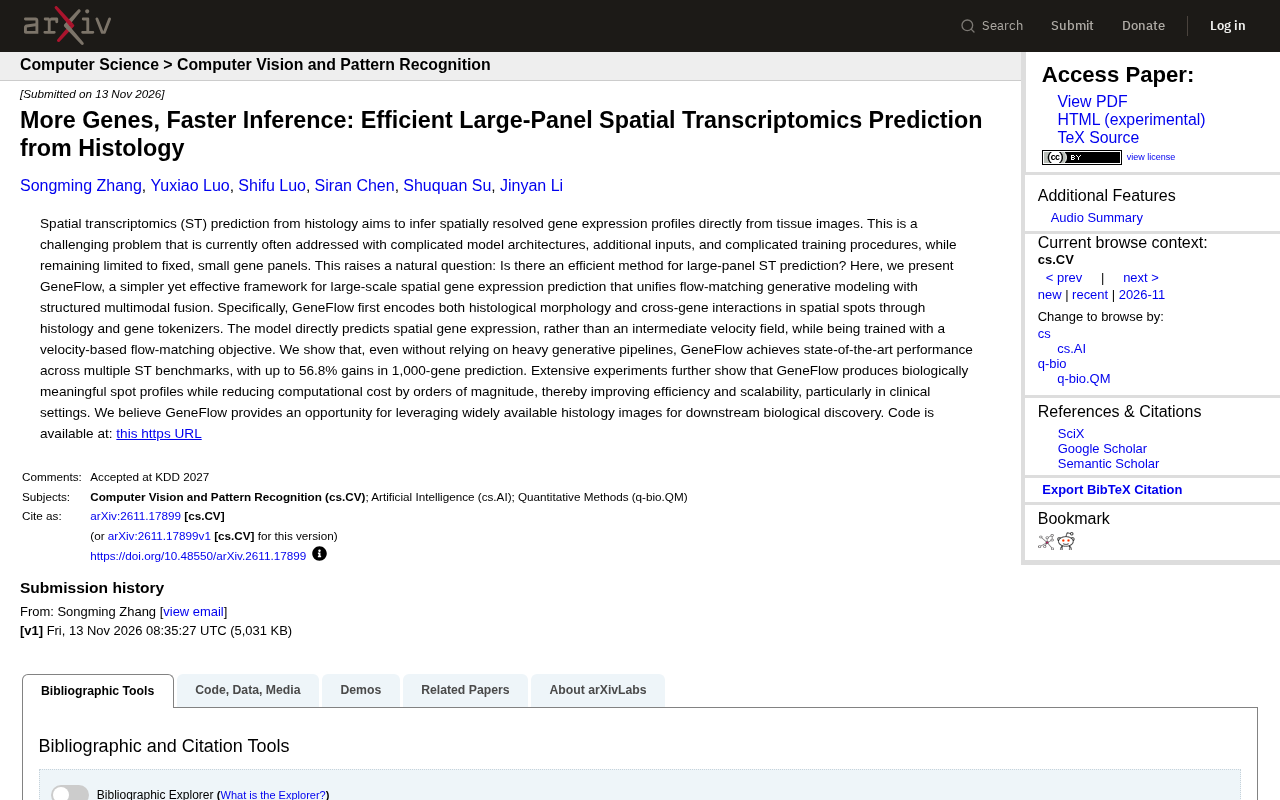
GeneFlow is a spatial transcriptomics prediction framework designed to address existing methods' reliance on complex architectures, additional inputs, and fixed small gene panels. It unifies flow-matching generative modeling with structured multimodal fusion, encoding tissue morphology and cross-gene interactions separately via a histology tokenizer and a gene tokenizer to directly predict spatial gene expression rather than an intermediate velocity field. Across multiple benchmarks, GeneFlow achieves state-of-the-art performance, with up to 56.8% improvement on a 1000-gene prediction task while reducing computational cost by orders of magnitude, enhancing clinical feasibility. Its generated spot expression profiles are biologically meaningful, and the code is open-sourced, promising to advance the broad application of ST in clinical and research settings.
Spatial transcriptomics (ST) can directly infer gene expression from tissue images, but existing methods often rely on complex architectures, additional inputs, and cumbersome training pipelines, and are limited to fixed, small gene panels. This raises a key question: can ST prediction be performed efficiently on large-scale gene panels? The recently proposed GeneFlow framework answers with a resounding yes.
Simpler Architecture, Stronger Performance
The core idea of GeneFlow is to unify flow-matching generative modeling with structured multimodal fusion. It first encodes tissue morphology information and cross-gene interactions within spatial spots separately through a histology tokenizer and a gene tokenizer, then directly predicts spatial gene expression rather than an intermediate velocity field. Although training uses a velocity-based flow-matching objective, the model does not depend on a heavy generative process.
Across multiple ST benchmarks, GeneFlow achieves state-of-the-art performance. According to the paper, it delivers improvements of up to 56.8% on a 1000-gene prediction task. This result shows that high-quality predictions can be achieved without stacking complex generative pipelines.
Flow Matching is a class of generative modeling methods whose core idea is to learn a time-dependent vector field that continuously transforms a simple prior distribution (such as Gaussian noise) into the target data distribution. Unlike diffusion models that denoise step by step, flow matching is trained by regressing a conditional velocity field and can in theory complete generation with fewer sampling steps, making both training and inference more efficient. GeneFlow leverages this framework but does not run a full generative trajectory at inference; instead, it directly outputs gene expression predictions, thereby avoiding the heavy iterative sampling process.
Multimodal fusion here refers to the joint modeling of histology images (morphological modality) and gene interaction information within spatial spots (molecular modality). GeneFlow extracts the two types of features separately through a histology tokenizer and a gene tokenizer, then fuses them in a structured way, enabling the model to simultaneously exploit tissue structure in images and expression associations among genes to improve prediction accuracy.
Balancing Efficiency and Scalability
Beyond accuracy gains, GeneFlow also significantly reduces computational cost—the paper reports a reduction of several orders of magnitude. This means the method is more feasible in clinical settings, where inference speed and resource consumption are typically subject to strict requirements.
More importantly, the spot profiles generated by GeneFlow are biologically meaningful, not merely numerically fitted. This opens new opportunities for downstream biological discovery using widely available histology images.
Spatial Transcriptomics (ST) is a class of technologies that measure gene expression while preserving spatial location information in tissue. Unlike traditional single-cell sequencing, which loses spatial coordinates, ST maps expression profiles back onto spots or cells on tissue sections, thereby revealing the spatial heterogeneity of gene expression. In clinical practice, acquiring ST data is costly and throughput is limited, so directly inferring spatial expression from routine histology images (such as H&E staining) has become an important direction. GeneFlow's efficient inference capability targets exactly this scenario, making large-scale gene panel prediction feasible in resource-constrained clinical environments.
Open Source and Future Directions
The GeneFlow code is publicly available on GitHub (https://github.com/ZZhangsm/GeneFlow), making it easy for researchers to reproduce and extend. This work demonstrates that, through a carefully designed simplified framework, large-scale spatial gene expression prediction can achieve both high accuracy and high efficiency, with the potential to promote the broad application of spatial transcriptomics in clinical and research settings.
As spatial transcriptomics data continue to accumulate, methods like GeneFlow that balance performance and efficiency may become an important bridge connecting tissue morphology and gene expression.
Related articles

Abnormal Error Rate Spike in Claude Mythos 5.2 and Fable 5.2
Claude Mythos 5.2 and Claude Fable 5.2 show an abnormal spike in request error rates, marked as investigating on the official status page. This article covers the incident overview, practical impact on developers, and recommended responses.

ReAct Runtime Context Trimming: Why Claude Code Acts at 70%
A deep dive into ReAct runtime context trimming: why Claude Code compresses at ~70% usage, why tool calls dominate, why messages must be dropped in pairs, and why codebases don't need RAG.

AI Agent vs LLM: How Cursor and Claude Code Actually Work
An in-depth analysis of the essential difference between AI Agents and LLMs: LLMs generate code suggestions, while Agents modify files and run tests via tool calls. Using a Spring Boot bug fix as an example, it breaks down the workflows, permission control, and verification mechanisms of Cursor and Claude Code.