Generating AI Sound Effects from Text + Reference Audio: Current State and Practical Approaches

Text + reference audio conditioning for AI sound generation remains a frontier gap — combined pipelines are the most practical solution today.
Inspired by a Hacker News discussion, this article examines whether AI can generate sound effects using both text descriptions and reference audio samples. It covers two main paradigms — text-to-audio (already commercially viable) and reference audio conditioning (still largely unsolved) — explains why audio generation lags behind image AI, and recommends a staged pipeline approach for creators who need results now.
An Underappreciated AI Generation Use Case
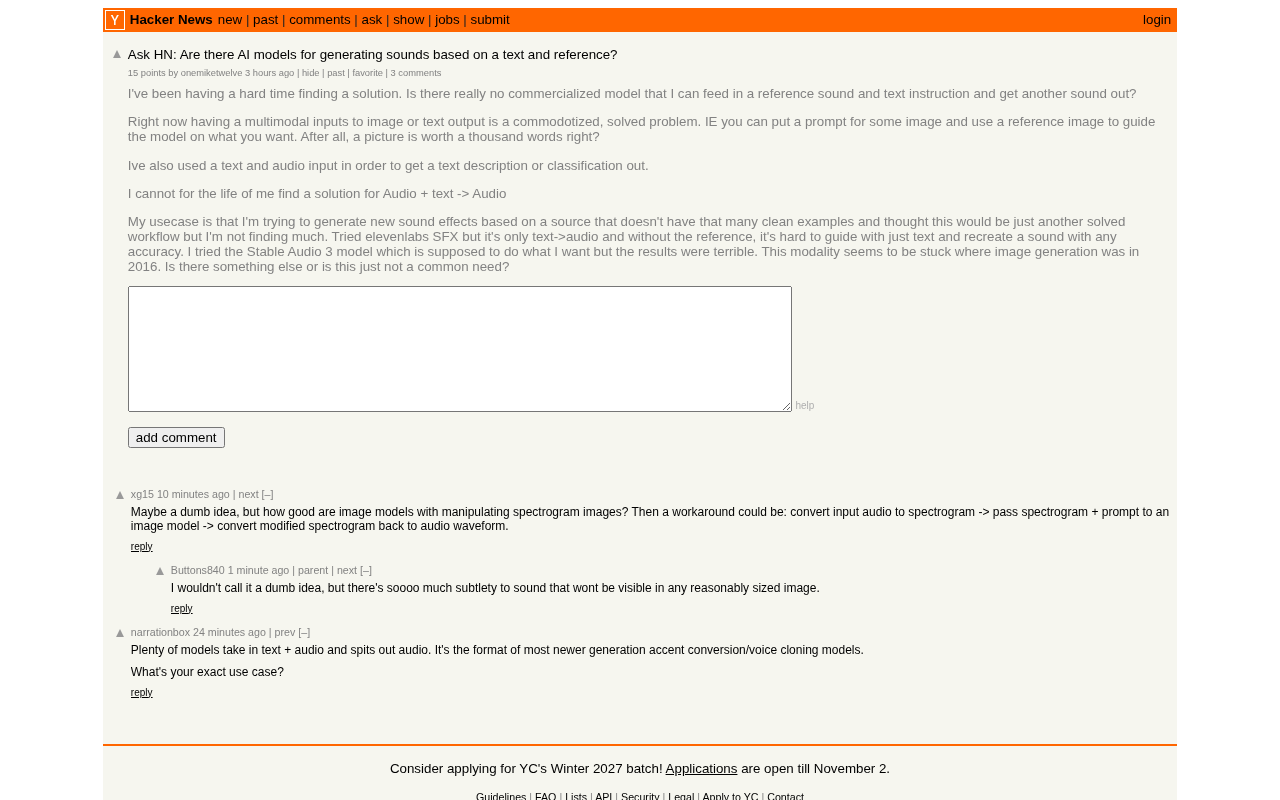
A question posted on Hacker News sparked a discussion that many developers and creators can relate to: does an AI model exist that can generate sounds based on both a text description and a reference audio sample? The question may seem niche, but it points to a critical gap in generative AI for audio.
Compared to the explosive growth in image and text generation, sound effects and audio generation have remained a relatively quiet space. Yet as game development, short-form video production, and independent creator communities continue to grow, demand for tools that let you "describe what you want and get the sound" is rising fast. The post received 15 upvotes, and while comments were sparse, they reflect a genuine pain point still being worked through.
Technical Approaches to Text-to-Audio Generation
Understanding this problem requires first mapping out the main paradigms in audio generation.
Text-to-Audio
This is the most mature direction today. A user inputs a text description — such as "rain hitting a metal roof" or "distant thunder" — and the model outputs a corresponding audio clip. These models are typically built on diffusion-based or autoregressive architectures, trained on large-scale audio-text paired datasets. The approach is intuitive to use, but controllability is often limited — it's hard to precisely match the specific sound a creator has in mind.
Leading models in this space include Meta's AudioGen, Google's AudioLM and AudioPaLM, and Stability AI's Stable Audio. Diffusion-based approaches (such as Latent Diffusion architectures) compress audio into a latent space before denoising, enabling high-quality output with faster inference. Autoregressive approaches (like AudioLM) discretize audio into token sequences and predict the next audio unit step by step, making them better suited for generating semantically coherent longer segments. On the data side, AudioSet — a collection of over 2 million labeled audio clips sourced from YouTube — is the most widely used benchmark dataset, but its coarse-grained labels leave current generative models with notable limitations in fine-grained semantic understanding.
Audio Reference Conditioning
What the original poster is really asking about goes a step further: adding a reference audio sample on top of text. This is analogous to ControlNet or img2img in image generation — using an existing sound as a "style or content anchor" so the model can produce variations or extensions based on the text while preserving certain characteristics. For example, providing a bird call recording and then specifying via text: "make it sound more open, with reverb."
This dual-condition setup — text plus reference audio — is precisely the capability that most open-source audio models have not yet fully covered. It requires the model to both parse semantic meaning from text and extract low-level features from the reference sample, such as timbre, rhythm, and spatial qualities.
In the image domain, ControlNet injects additional structured conditions (such as edge maps or pose skeletons) into the diffusion model to precisely control the spatial layout of generated outputs, without retraining the base model. The analogous approach in audio is called "audio conditioning." Technically, it typically involves using a pretrained audio encoder (such as CLAP or EnCodec) to compress the reference audio into an embedding vector, then injecting it into the generation network via cross-attention or AdaLN mechanisms. The core challenge is that audio "style" is difficult to cleanly disentangle — timbre, reverb, rhythm, and spectral envelope are deeply intertwined. A single embedding vector often fails to fully capture the specific dimensions a creator wants to transfer, which is one of the fundamental reasons current models lack fine-grained controllability.
Existing Tools Worth Exploring
While the "text + reference" combination isn't yet mature, there are directions in the community that can partially address the need:
- Text-to-sound-effect models: Several open-source and commercial models already support generating ambient sounds and sound effect clips from text descriptions, and are well-suited for rapid prototyping.
- Audio style transfer / variation generation: Some models support audio conversion conditioned on a reference, useful for timbre transfer or sound modification.
- Music generation models: Though oriented toward melody and composition, the conditioning mechanisms developed in this space offer useful insights for sound effect generation.
For developers who need to work with both text and reference audio today, a pragmatic approach is a combined pipeline: generate base material using a text-to-audio model, then apply audio processing or style transfer to align it with the reference sample in a second pass.
Why This Field Is Still Early
Audio generation lags behind the visual domain for several structural reasons.
High-quality annotated "audio-text" pairs are far scarcer than image data, and describing sound in language is inherently harder than describing a visual scene — human vocabulary for sound is surprisingly limited. Audio is also a time-series signal with strict requirements for long-range consistency and fine-grained fidelity; even small artifacts are perceptually amplified.
Reference audio conditioning adds another layer of difficulty: the model must strike a balance between "faithfulness to the reference" and "responsiveness to the text" — a multimodal alignment problem with no universally accepted optimal architecture.
From a data scale perspective, mainstream image-text paired datasets like LAION-5B have reached billions of examples, whereas no comparable dataset of "audio + natural language description" pairs exists at that scale. Human language is inherently impoverished when it comes to describing sound: we have rich vocabularies for colors and shapes, but sonic textures (like "a moist low-frequency rumble" or "a metallic scraping sensation") often require synesthesia and metaphor, which makes both automated labeling and model learning significantly harder. At the signal processing level, audio exists as waveforms or spectrograms, typically at sample rates between 16kHz and 44.1kHz — even a 5-second clip contains tens to hundreds of thousands of data points. Modeling long-range temporal dependencies is computationally far more demanding than processing equivalent-length video frame sequences.
Practical Advice for Creators
If you need a working solution right now, here are some actionable approaches:
- Clarify your priorities: If a rough match to a text description is sufficient, existing text-to-sound-effect tools will get the job done. If you need to closely match a specific reference audio, expect to invest more in manual post-processing.
- Work in stages: Separating "generation" and "style alignment" into two distinct steps using different tools is often far more realistic than expecting a single model to do everything in one shot.
- Track open-source community progress: This space is moving quickly. Keeping an eye on Hacker News and new GitHub projects may surface a model with native dual-condition support sooner than you'd expect.
Closing Thoughts
This brief Ask HN question highlights a gap that generative AI in audio has yet to fill. Text-to-audio generation has made meaningful early progress, but fine-grained control via "text + reference audio" remains a frontier challenge. For creators today, the most reliable strategy is to bridge the limitations of any single model with a combined pipeline workflow — while staying tuned to what the community ships next. A breakthrough in this space may not be far off.
Related articles

Felix Rieseberg Personal Homepage
Felix Rieseberg's personal homepage sparks attention on Hacker News. This article covers the Slack engineer's technical background, the rise and fall of nativefier, and the value of a developer homepage as a tech calling card.

@ai-sdk/vue 3.0.306 Patch Release Syncs with [email protected] Update
@ai-sdk/vue 3.0.306 released, synced with [email protected]. A routine patch release for the Vercel AI SDK ecosystem with no public API changes; the Vue adapter layer stays version-aligned with the core package.

Gemini 4 Argon API Launches: The Era of Million-Token Output Begins
Google launches Gemini 4 Argon with sparse MoE architecture, up to 1M output tokens, and a 68.90% Vals Index score, available across API, AI Studio, and the Gemini app.