Generative AI vs. AI Agents vs. Agentic AI: Same Prompt, Who Wins?

Four tiers of AI capability tested on the same coding prompt, and the open-source agent combo wins.
The article documents a YouTube creator's head-to-head test of generative AI, purpose-built AI agents, Agentic AI multi-agent systems, and an open-source combo on one complex crypto arbitrage tracker task. The task required real-time monitoring of the Binance–Coinbase spread, anomaly detection, and Telegram alerts on threshold breaches, involving network requests, async concurrency, and external webhooks. Results: generative AI produced only code with placeholders (4/10); Cursor and Devin ran it but at high cost with privacy concerns; multi-agent collaboration delivered high quality but consumed enormous tokens; the free open-source OpenHands + DeepSeek R1 combo added exponential backoff retries after a WebSocket timeout and delivered a runnable script with zero subscription fees. The author recommends choosing tools by scenario rather than hype and notes the conclusions come from a single sample requiring more validation.
A YouTube creator ran a head-to-head benchmark of three tiers of AI capability using the same complex, real-world coding prompt: generative AI, purpose-built AI agents, and Agentic AI multi-agent ecosystems—plus one open-source combo. The test task was a real-time multi-exchange cryptocurrency arbitrage tracker that monitors the price spread between Binance and Coinbase, detects anomalies, and automatically sends Telegram alerts when a profit threshold is breached. The task involves network requests, async concurrency, statistical logic, and external APIs and webhooks—a level of complexity developers widely consider a real engineering challenge.
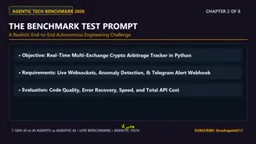
The Test Task: One Prompt, Four Tiers of Capability
The core question is straightforward: when every participant gets the exact same complex prompt, who actually delivers something runnable, and who breaks down along the way?
The task requires real-time monitoring of the price difference between two exchanges, anomaly detection, and automatic Telegram notifications when profit exceeds a threshold. A system like this must handle the timing of network requests, concurrent state management, and callbacks from external services—placing high demands on code completeness and runtime correctness.

Tier 1: Generative AI—Beautiful Text, Broken Code
Standard ChatGPT or Claude web versions operate in a one-shot Q&A mode. Given this complex prompt, they produced a nicely structured text response within seconds.
But inspecting the code reveals that a significant number of modules contain placeholder comments like "logic to be implemented here." Generative AI has no terminal access, cannot install dependencies, and cannot run tests. When syntax errors appear, the entire debugging burden falls on the user.
The source scored this tier 4 out of 10. This isn't a question of model capability but of interaction form: it excels at drafting and quick answers, not at delivering runnable systems.
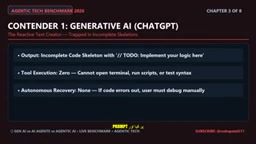
The core difference between generative AI and AI agents lies in whether there is a closed loop of environment interaction. A pure generative model's output is only a token sequence; it has no tool use, file system access, or code execution sandbox, and therefore cannot perceive the real state after code runs. An agent, by contrast, typically has a perceive–plan–act–observe loop, obtaining execution results through terminal commands and adjusting its behavior accordingly. This is why the same model can perform far better when wired into an agent framework than in a web chat—the difference often comes from the execution shell, not the underlying model.
Tier 2: Purpose-Built AI Agents—It Runs, but the Bill Isn't Light
Cursor Agent and Devin belong to the second tier. They don't just generate text; they carry an autonomous execution loop of plan–execute–observe–correct.
Given the same prompt, they open a terminal, install dependencies, generate a multi-file structure, and actually run tests. The resulting code works.
The cost is money and privacy. According to the source, Devin can run several hundred dollars per month, while Cursor uploads code to cloud servers. For budget-constrained students or independent developers, this ongoing SaaS subscription fee is a real barrier.

The ReAct (Reasoning + Acting) paradigm is key to understanding modern coding agents. It has the model alternate between "thought" and "action" at each step; actions can be running commands, reading files, or calling APIs, and execution results are fed back to the model as observations, forming an iteration. OpenHands, Cursor Agent, and Devin are all essentially engineered implementations of this paradigm. Loop round limits, error-handling strategies, and context compression methods directly determine whether an agent stays stable on long tasks—and explain why self-correction capability is more decisive than first-pass code quality.
Tier 3: Agentic AI—Stunning Quality, Fast-Burning Tokens
The third tier is not a single agent but multiple specialized agents collaborating like a team. In frameworks like Crew AI or LangGraph, one agent plays product manager and decomposes the prompt, another handles data scraping, and another acts as a QA engineer auditing the code.
The source described the output quality as "incredible": modular architecture with accompanying unit tests. The problem is communication cost—three or four agents passing context to each other consumes enormous tokens. If the orchestration loop isn't tightly controlled, the API bill can jump exponentially.
This architecture has a high capability ceiling, but its economics are not friendly to individual developers.
Exponential backoff is the standard strategy for handling transient failures in network programming: after a request fails, retry at intervals of 1s, 2s, 4s, 8s… usually with added random jitter to avoid a thundering herd when many clients retry simultaneously. For WebSocket or HTTP connections, pairing it with a maximum retry count and a circuit breaker can significantly improve robustness. In the test, the agent independently introduced this pattern, showing that it understood the mapping between error types and general fixes rather than merely matching code templates.
The Winning Solution: OpenHands + DeepSeek R1
The tester's best solution was a completely free and open-source combination: OpenHands paired with DeepSeekAd R1.
Given the same arbitrage tracker prompt, DeepSeek R1 first drafted the architecture inside visible think tags, planning an async WebSocket connection scheme; then the OpenHands agent executed the code in the VS Code terminal.
The most critical moment came at runtime: after a WebSocket timeout error was triggered, the agent didn't crash—it read the error log and added exponential backoff retry logic on its own. The final delivery was a runnable production script, with zero cloud subscription fees and fully offline privacy protection.
This case shows that an agent's self-correction capability determines practical usability more than one-shot output quality.
Conclusion: Choose Tools by Scenario, Not by Hype
The source's final judgment is scenario-based:
- Generative AI is suitable for drafting and quick Q&A, not for delivering complete systems;
- Enterprises with ample budget can choose multi-agent systems like Devin or Crew AI—the capability is genuinely powerful;
- For budget-sensitive independent developers, open-source agent combinations are the best overall in terms of cost, privacy, and practical usability.
It should be noted that these conclusions all come from a single YouTube channel's testing process, with a sample of only one prompt task; performance across tiers may differ under different task types. The open-source combo's self-correction ability stood out in this test, but whether it reproduces reliably still requires more independent verification.
Related articles

Pi Agent Tutorial: How Minimalist Design Reshapes AI Agent Development
An in-depth look at Pi Agent's minimalist design philosophy: why it still draws high attention alongside Codex and Claude Code, from GitHub Star trends to extension mechanisms, with a Bilibili practical tutorial covering installation, configuration, and Agent development for beginners and advanced developers.

Codex in Practice: A Complete Guide to Enterprise-Grade Agent Skills Development
An in-depth analysis of a Bilibili Codex practical course covering core capabilities, agents.md configuration, MCP protocol, multi-agent collaboration, and enterprise plugin development—building a complete framework for enterprise AI coding tool adoption.

A Beginner's Guide to LLM Fine-Tuning: From Principles to Industry Implementation
Starting from the layered structure of general LLMs, this guide systematically covers the motivations, cost comparisons, and applicable scenarios of LLM fine-tuning, with three open-source cases: Bencao, LawGPT, and FinGPT, illustrating implementation paths in healthcare, law, and finance.